Journal entries 71 – 80
Last modified: April 17, 2012Summer rains… four Almada women… Nuzum rooftop garden… Jacoby gardens & tequila… Plaza kiosk-bandstand… traveling hypnotist… anthropocene & human nature… ethnic accounting… Spanish Conquistadors… and Pueblo Magico.
80… Reflections on summer moments …

Time is another dimension that is seen through cracks in life's peripheral vision.
Where are we now and what are we doing? All the elements above seem to be blending into an Alice-in-Wonderland landscape as we stand outside Bishop Reyes Cathedral breathing fresh air after a afternoon summer shower. It is the hot and humid rainy season. June averages 6 rainy days and 30 mm – 1.18 inches of rain. July averages 15 rainy days and 125 mm – 4.92 inches. August averages 14 rainy days and 144 mm – 5.6 inches. September averages 11 rainy days and 63 mm – 2.4 inches. The tropical deciduous forest near Alamos averages 30 inches of rain during the three month rainy season.

And now this suddenly strange mirrored world becomes geometrically precise
There in the reflected watery sky is the proud Palacio Municipal. Here is man’s power to rule and govern. I remember another power, nature. I was west of the Alamos airport, XAL, listening to T.J. Cook’s record collection. We were talking about the forecast of a coming storm later that night. It was late in the afternnon, the air pressure suddenly dropped and the wind came up strong. I knew I had better head back to Alamos or spend the night, or longer, at the Cook’s.
Aided by a stiff tail wind I started to run back in a borrowed rain slicker towards town along an arroyo. In an instant the sky turned angry dark, the air became colder and a deafening wind shrieked through the trees and knocked me off my feet. I looked for shelter behind the widest tree trunk I could see. I took refuge out of the wind and hunkered low to the ground and covered up. I was unable to move for minutes or tens of minutes, it was so loud that there was no way for my mind to track time. I was in the wrong place at the wrong time. And then it stopped. The rain let up, the wind died and the air temperature warmed. I ran all the way until I reached the first paved street and then walked quickly in a falling mist during this lull in the storm. I returned to my lodging and changed into welcomed dry clothes. Distant lightening flashes lit up the sky. In a couple of hours, in a dark clouded night sky, the main body of the storm arrived. It rained and howled continuously until just before dawn.

A young father, like his father did, brings his child to the Plaza Kiosk.
The bandstand is a wonderful place to watch summer showers. Lluvia, lluvia, lluvia… in the coming jubilant glory of rain’s fulfilling prophesies healthy and happy faces embrace lush cornucopias of climbing jungle greens cloaked in vibrant wild flower rainbows. It is now in these brief moments, minutes at the least, hours at the most, that the many seeds of life spring forth leading a parade that will last into early June’s dog days until the arrival once again of summer rains.

A young girl stands in the doorway halfway between spiritual and secular worlds.
Carolina Bustamante Medina pauses for a photograph. Normally she was a blur running around town, selling wares, asking for money and delivering ice cream on roller skates to waiting cars on summer nights in the Plaza. Many of Alamos kids demonstrate at an early age entrepreneurial flair and work ethic, sometimes out of family financial necessity. Children working can be seen everywhere: shoeshine boys, ice cream cart pushers, vendors in the plaza, helpers at out door cafes, helping at family businesses, running errands, home chores and… A recent global study found that Mexican work the longest hours of any workers on this planet.

Other than modern street illumination and pavers this could be 1800.
The summer rains are here, the sweet night air cools warm bodies bringing relief and contemplation. The purity and hope of laughing young couples, alone with each other, drenched to the bone, wet clothes clinging to their forms, make their way home late at night splashing and dancing in cobblestone puddles. Above, the heavens explode, a cannonade of thunder rumbles across silhouetted mountain ridges backlit by fantastic lightening. It is time to go to asleep under one sheet in the cool of a warm night.
79… Almada women return to visit Alamos…
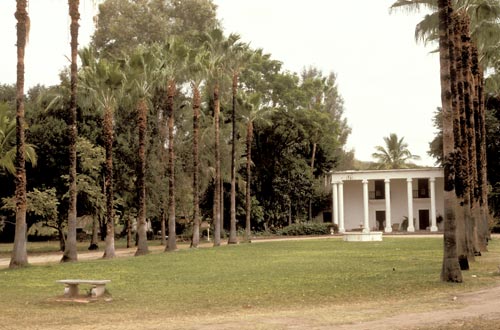
Formally an Amada house, during my visits it belonged to Ida Franklin.
Ida Louise Franklin’s formal driveway is directly across the street from the Panteon-Cemetery entrance. She arrived in Alamos during the 1950’s and began renovating this colonial ruin, Las Delicias. She was known for her dinners and entertaining as well as her writings: Alamos de Sonora – 1964, Bride for a Siver King – a novel set in Alamos, 1980, Ghosts of Alamos – folk tales of Alamos, 1973, Cadillacs and Cobblestones and Las Delicias; Restoration of a Colonial Ruin. Ida Louise Franklin lived to be 100 and is buried across the street along with her son Walter. It is a short walk for her spirit, if it ever left, to return to Las Delicias.
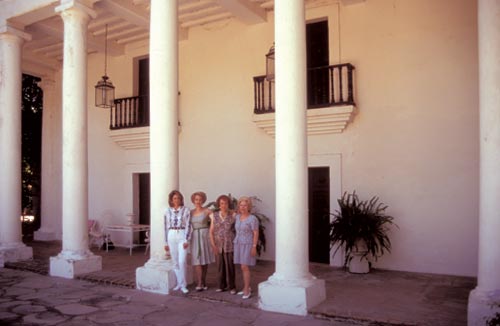
Almada woman revisits her former house on a Museo guided tour of Alamos
The woman, second from the right, remembers the night her father told her because rebels were approaching town they were going to leave Alamos and that they would never return to Las Delicias. The stately two story columns speak of great wealth from another era and also spoke in 1996 of expensive restoration and maintenance. I was struck by the effort, courage and determination that Ida Franklin demonstrated in bringing back the once Almada elegance to this large property outside of town. Museo director Tony Estrada asked me to give these Almada women a morning slide show in the Museo’s auditorium before they began their tour of all things Almada in Alamos. I learned their day’s schedule and met up with them again after lunch at Las Delicias for a photo session. A couple of Museo staff were always at the ladies sides swatting away any summer flies that rudely ventured close to an Almada. I was surprised the women didn’t travel by silver-trimmed horse drawn carriage across town.

Almada women attend an evening Estudiatina concert at La Posada hotel.
I remember little about these women other than: left to right, she lived in Los Angeles and had a flirtatious air, the redhead was part of the last Almada family to live in Las Delicias, the third women was an interior decorator from Connecticut and the youngest was married to a political big wig in Mexico City. All the women had friendly smiles, easy laughs, moments of bitter and sweet remembrance and multiple changes of clothes for an enjoyable day and evening in Alamos courtesy of a dedicated Museo staff. In Alamos, once an Almada always an Almada.

Almada family members staged an annual reunion in Alamos.
Almadas came from near and far to celebrate an annual family weekend reunion in Alamos. They wore matching t-shirts celebrating the event. On this day, an Almada squadron of red all-terrain four-runners continuously circled the Plaza and Alameda for hours. Much of the town watched with amusement and a touch of envy. There are many descendants of the Alamos silver kings around the world. As example here are two Almadas: Don Jose Maria Almada had 21 children with his first wife of 27 years and 5 more born out of wedlock with his mistress that became his second wife. These were children he acknowledged as his own, there could have been more, many more. Rafael Almada, born in 1861, married his cousin, Rafaela in 1897, and two years later moved south 90 kilometers to the El Fuerte in Sinaloa. He and Rafaela, she rode to church in an elegant carriage, spent five years and 100,000 gold pesos building their El Fuerte Almada mansion that is now the Posada Hildago Hotel. He died two years after completion of the mansion. He served as Mayor of El Fuerte and was instrumental in building the town’s grand Palacio Municipal from 1903 to 1907. Almadas left Alamos and went on to distinguish themselves in other places and other walks of life and their large families begat large families and their bloodlines flowed like water across continents.
78… A rooftop that lives and breath all things Alamos…
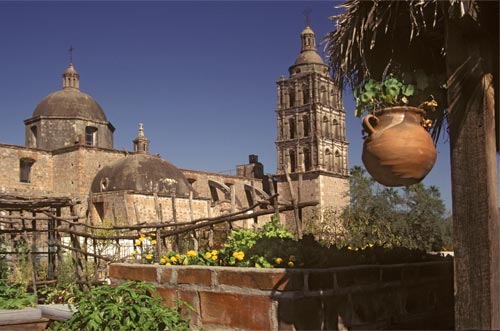
Elizabeth Nuzum's garden across the street from Bishop Reyes Cathedral.
Here, in the shadow of cathedral bells and angelic choirs was a multi-purpose rooftop garden. A narrow wrought iron caracol, snail, spiral staircase led one up from a back patio with a small pool to an expansive array of raised planter boxes. Elizabeth Nuzum enjoyed people, her home, her gardens and life in Alamos. For many, her husband Pember and Elizabeth were Alamos greeters, welcoming visitors inside the old wood doors on Calle Comercio. Elizabeth designed and managed her gardens while Pember kept an eye on the household finances.
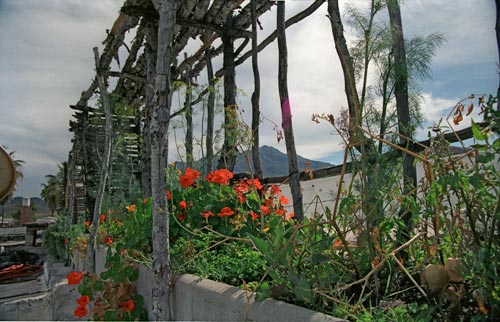
20 feet above the street one can hold a conversation with passing clouds.
The roof top garden and its 360 degree views was a special place. The sky at night, with stars there to be touched while one laid back on a substantial Sonoran cot, was a connection to all things in all places. Rooftop eavesdropping on the comings and goings along Calle Comercio and Calle Guadaloupe Victoria tuned one in with the heartbeats of Alamos: Bishop Reyes Cathedral, Palacio, Plaza de Las Armas, Mercado, all points of the compass and all events past and present.
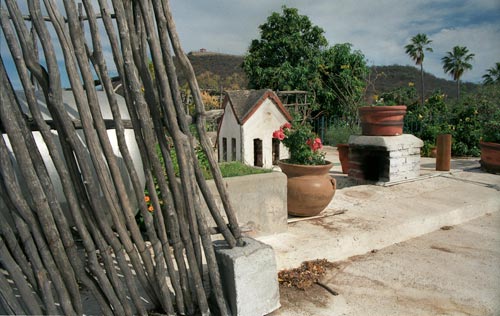
Mirador voices, at times, arrived here with a favorable wind.
Let me count the sounds I heard up on the roof: uniformed school kids walking in groups, talking, laughing, singing, stepping off rhythms, kicking balls, kids being all things kids. Occasional horse hoofs echoing on cobblestone streets. Music from rattling car and truck radios ricocheting off narrow streets. Surround sound bird songs and calls punctuated by barking dogs, working hammer and saws and distant braying burros. All combinations of people passing by: one, two, or three generations together talking, workers, errand runners, neighbors en-route to visit neighbors or hang out in the Plaza, shop at the Alameda and Mercado or attend to business at the Palacio or… This garden overlooked the center of Centro Alamos’ rainbow of expression: joy, surprise, acceptance, expectations, anger, yearning, anticipation. greetings, farewells…
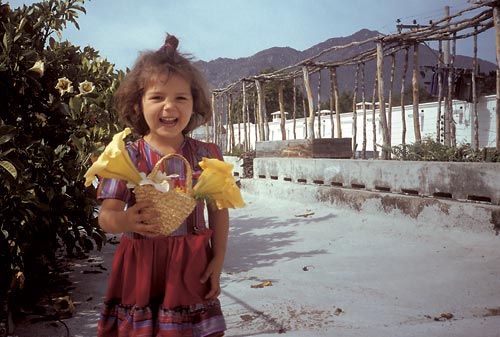
A young girl picks flowers on the roof, a simple moment, a simple smile.
Christina Vega, daughter of Chacho and Cammie, sister of Gaspar, walked in all worlds Alamos. Her Mexican blood was Chaco’s large family and her American blood was Cammie’s parents Elizabeth and Pember and brother Kit who came to visit from his world travels. Cammie and Chacho lived modestly on Calle Ninos Heroes, a short walk from the grand roof top garden on the the other side of Guadaloupe Hill.
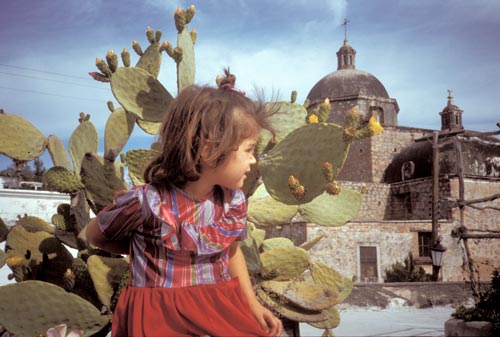
What does Christina see, and hear, on this spring day in 1984?
The roof’s northwest corner, with a view into the Plaza and Gazebo, was across the street from the bank. At opening time a line of people would be waiting sharing conversation. Daily masses brought people to the church’s eastern door. Funerals processions would leave the church and passed by as they headed east to the Panteon – Cemetery. Police headquarters, at times busy, were three houses to the east on Calle Comercio. Tourists speaking English, French, German and other languages would stop and chat as they headed to and from surrounding lodging. At night, one could listen to quitar playing coming from Polos restaurant’s kitchen as well as the Estudiantina practicing at the Museum. At this moment Christina is listening to the public serenade that is Alamos.
77… A garden that fills the land with grace and majesty…

A tale of two sides of a fence, one managed by Judith Jacoby and the other?
I remember Judith Jacoby as a charming graceful petite woman. On each side of her house were gardens taking advantage of what was there before, or left behind, and drawing inspiration from the landscape backdrops; Sierra de Alamos to the south, Cerro Cacharamba to the west, the northern mountain ridges and a long formal drive way in from the town to the east. I am sure she knew every inch of this land.

Jacoby gardens' design, detail and power to transport one to another place.
When I visited Mrs. Jacoby she was there by herself, a captain maintaining a property that was her ship on the vast Sonoran way of life. She would ask me what I knew, knowing that all I did was walk. look and listen with cameras in hand. She would intently attend my interpretation of events, rarely commenting other than a nod of her head or small smile. At the time, she must have had the largest Alamos garden in acreage. Laid out on what was once a tequila factory warehouse, the gardens, with wild lands on the other side of tall walls, were always ready for presentation as if today there was to be a party.

Here is variety, scale, year-round color, pride, love and stewardship.
Knowing the human condition there is a good chance the original tequila factory was successful. Men have long sought distilled drink for company. And in the mining days of Alamos there was a large population of hard working men, certainly there was a need for tequila. Questions rise: how many gallons were produced yearly and when was the height of production?… how far was it exported – did bottles make their way to San Francisco, Mexico City or Europe?… what did the bottles look like?… was all the agave grown locally?… how many workers were involved?… was this a profitable enterprise for the Urrea family?… were these the tequila makers that had a ranch near the top of Sierra de Alamos?.. and?
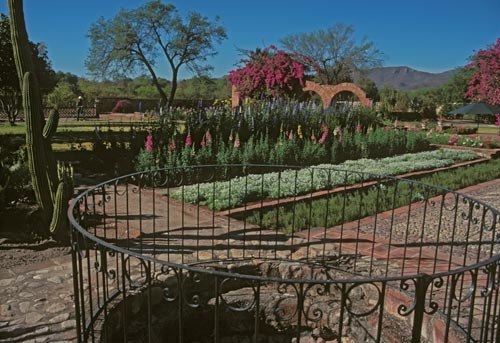
Was tequila stored underground in these large brick clad chambers?
The Aztecs made a fermented drink from agave. After their arrival in the 1500’s Spanish Conquistadors created, when their brandy ran out, the first North American distilled drink from the agave and tequila was born. Alamos is at the northern edge of Mexican agave production. In 1944, Mexico declared that tequila could only be produced in the state of Jalisco and certain areas in Guanajuato, Michoacan, Nayarit and Tamaulipas. The agave plant is related to the lilly and amarylilis and is considered a succulent. A healthy drink, pulque, rich in nutrients and vitamins, is made from the plant. Stringy fibers from the long leaves were woven into clothing, mats, rope and paper. The tequila ruins-history of Jacoby gardens became elements anchoring views, drawing the visitor into an enchanted landscape. Were there gardens here when the Urrea family lived on, and or, worked this land? The answers to all our questions are blowing in the wind.
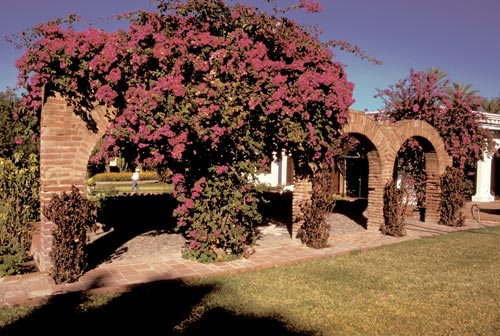
Ruins covered with climbing bougainvillea brilliant with cascading flowers.
Are these gardens in the same magnificent state as they were when I visited? Judith Jacoby has passed on. What I saw was the product of her imagination and discipline. It takes a leader to oversee and maintain gardens at this level of grandeur. That visionary was Judith Jacoby. She touched the land and the land responded.
76… Quiet days in Plaza de Las Armas as stewardship continues on…

1984, It is a quiet day in the well-maintained Plaza de Las Armas.
All sight lines lead one to the Kiosk, the visual centerpiece of the Plaza de Las Armas. In days of old, traveling dance bands would donate an hour public performance in the Kiosk to avoid paying a municipal tax and also help promote their evening concert. The elevated bandstand Kiosk offers a wonderful vantage point of Plaza activities and surroundings. Bishop Reyes Cathedral and Sierra de Alamos as a backdrop,especially with magic sunrise-sunset light, is a stunning vista from the Kiosk. Here, curious imaginations can sense the past.
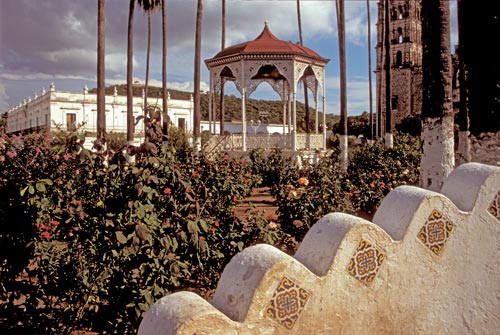
1996, large rose bushes filled up the park surrounding the Kiosk.
Twelve years have passed from the first photo to the second. Much is the same and some has changed. The landscaping is different: roses cover much of the bare ground have replace small trees and scattered bushes. A decorative backdrop for a drinking fountain has been added to the northwest corner of the park. And the kiosk’s canopy is now painted red. Many of my North American friends in Alamos were displeased with the change, they felt it was a cheap move to make the plaza more touristy. Ah, the hands of change move in synchronized concert with the hands of time as man restores, rebuilds and remodels.

Restorers begin work on the inside panels of the Kiosk canopy.
The cloth painted mural panels in the Kiosk were badly deteriorated and pigeons nests were inside the torn fabric and the canopy ceiling. Museo Costumbrista de Sonora’s director Antonio Estrada was in charge of the restoration project. Antonio, a fine-art sculptor in his own right, has strived to maintain the colonial integrity of Centro Alamos. As I write this post I realize I have images in one of my Alamos books of un-scanned slides of the panels just before these men started to remove them. Later today I will find and scan the slides and add them to my digital Alamos image database. I saw on the beautiful tourism site Alamos, Pueblo Magico that the panels were restored, and maintained, to their original magnificence. Stewardship in the face of advancing time and the hands of unrelenting gravity is never done until there is no more to steward.

A bird-eyes view of Plaza de Las Armas as seen from Mirador.
Even from a great distance the Kiosk draws the eye as one takes in the Plaza from up high on Mirador to the east. The colonial charm of Alamos, and the interaction of its citizens, is evident in this photo. On November 23, 2000, President Zedillo declared 188 Alamos, Sonora, Mexico structures as National Historic Monuments. The buildings seen here were built in the last half of the 18th century on older existing sites. I am certain that a photo taken today from the same place with the same lens will be much the same. Plants and paint may be different but the historic structures will be the structures that have been here for over 200 years.
75… the day Profesor came to town with his blue tent…
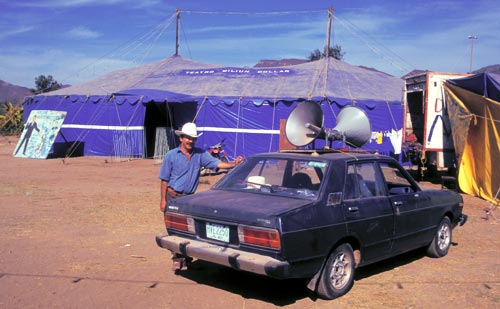
A traveling hypnotist sets up his blue tent in Alamos.
There, on a Wednesday afternoon, a traveling hypnotist arrived in town and began to setup camp in a bare field across the street from the hospital for a weekend series of shows. The small circus tent was going up on the edge of the Navajoa road, at that time Alamos’ only paved entrance and exit, and word quickly spread that something new was in town. New in Alamos was a big deal: a circus came once a year, occasional touring dance bands played at the Ganadera, a couple of rodeos setup at the municipal baseball park and independent productions would ride in on a Sonoroan breeze or a Sinaloan tail wind.
Not long ago, low budget movies, with missing edits, were shown at the Dominquez’ cine on Calle Rosales.
The Costumbrista de Sonora Museum had a small theater. Sporadic concerts, plays and events were presented on the Palacio stage. Today, 2011, there is the annual multi-day Ortiz Festival celebrating music and the arts along with the first annual Alamos Film Festival that was held in April. A couple of private theaters have been built in hotels and resorts.
Back then, Spring of 1995, the blue tent was the big show in town, there was new entertainment passing through in Alamos.
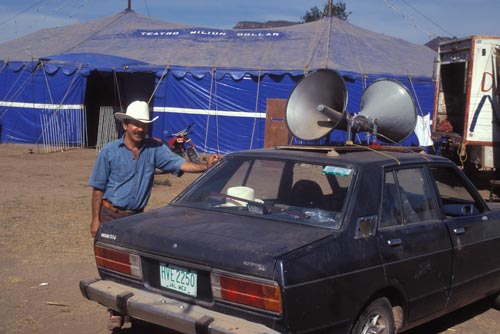
The fine art of road promotions as practiced by a professional.
For the next couple of days this car repeatedly circled throughout the barrios, all day long from 8 am into the early evening, blaring promotions for the upcoming shows. This was common practice to announced activities such as the man who buys your silver, road show events, concerts and Profesor Marcovich.
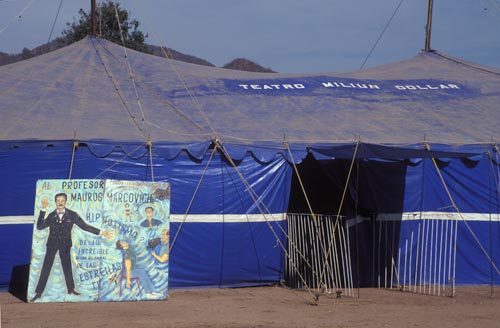
The entire show fits in one truck and a loudspeaker car.
Welcome to the Teatro Milion Dollar, notice how someone took the time and energy to brush the dirt off these alluring words. Excitement was building on the day of the first show. A couple of North Americans were going and promised me an opening night review. For some reason I was not interested in walking through the magnificent entrance that was the Teatro Milion Dollar, notice that’s dollar not dollars.

This is Profesor Marcovich's fold-out promotional billboard.
Hollywood, Bollywood, Broadway, Las Vegas this isn”t. Entertainment that makes it to Mexico’s back country towns, it is. Reviews from Americans that visited the Friday night opening show were the the topic of many Saturday morning coffee get-togethers. “Obscene”, “Child pornography”, “Disgusting” and on and on. Apparently Profesor Marcovich’s liked to chose and hypnotize young boys from the audience and have them perform acts with sexual overtones. A couple of Mexicans I knew in attendance shrugged their shoulders, no big deal and not worth the money. The next night’s audience was much smaller. Alamos had given Profesor Marcovich Teatro Million Dollar a thumbs down.
Today I googled Profesor Mauros Marcovich to see if he was still in the “entertainment” business and nothing showed up. Mexican media is a land of sexual conquest fueled by sexy macho males and conniving big busted females in revealing garb. Bawdy comics deliver body functions gags for big laughs, especially fart jokes. Sultry latin dance adds hot sauce to the stereotypical image of Mexico – a land of sensual delights and romance. Ribald plays big in Mexico but Profesor Marcovich presented a show that few in Alamos found entertaining. Each show had a smaller audience until there was no audience, no money, just a blue tent attracting highway grime and desert dust.
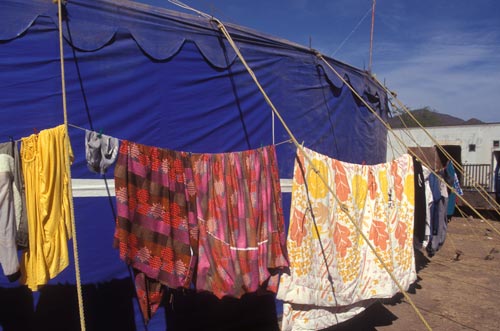
Laundry for a stranded traveling show hangs out to dry in the dust.
The gypsy camp in plain view was becoming an eyesore. Laundry was strung up along side the tent Profesor was seen around town running errands on his motor scooter. Day after day passed by. Rumor on the street was that Profesor had run out of money. He couldn’t afford gas to get to the next town. He was becoming a problem. Alamos doesn’t allow strangers to come into town with a large tent-camp and squat on public property for all to see. I was told the City gave Profesor money to leave and he was gone.
74… on modern times, anthropocene and human nature…
Part Three of Three on an Eternal Debate.

Old and new as a family walks past the airport towards the campo.
The recently revised U.N. population estimate for 2050 is 9.3 billion people A projection for the USA in 2100 is 478 million. Challenging times are ahead but this is nothing new, survival is challenging for individuals and societies of all species.
Driving across the Mexican Sonoran desert on a star-filled 1984 spring night listening to a Hermosillo rock station’s uninterrupted presentation of Jethro Tull’s Aqualung was the best of two worlds. Music is universal. Friends are universal. Traveling is universal. Being is universal.
In the USA there are 78 million baby boomers aged 45 to 64. This is a force of change. They will go where they can get maximize their resources for survival and comfort. How many will leave the USA for retirement is dependent on the USA’s ability to cope with growing pressures and increasing challenges.

1984, directions and graffiti painted on a school wall along Calle Rosales.
September 1775, De Anza is leaving with a Spanish expedition to create a fort in San Francisco to head off the Russians coming down the west coast. George Washington and his Continental Army have besieged the British in Boston as Colonel Ethan Allen is captured at the Battle of Montreal by the British. Much has happened in the following 236 years leading up to 2011. Some say this is part of a new epoch, the Anthropocene, as human events, consequences of collective actions, alter-change the planet.
Human impact is equal to the population times affluence times technology. Global affluence in 1900 was 2 trillion dollars, 5.3 trillion in 1950 and 55 trillion in 2011. These are all in 1990 dollars. The population in 1900 was 1 billion, 2.4 billion in 1950 and will reach 7 billion in 2011. As for technology, there were 141,000 patents in 1900, 412,000 patents in 1950 and 1.9 million patents in 2011. The growing human biomass is 100x greater than any large animal species that has walked and faced extinction on planet earth. Currently, 65,000 text messages are sent every second. This is the Age of Great Acceleration.
This three part series was prompted by an internet group created in late 2002 for North Americans interested in Alamos. This group, 613 members as of 5-7-11, communicates needs, haves, events, thoughts, desires, alerts, recognitions, questions and answers. Here, at the end of April, 2011 a discussion started about influences that are changing Alamos. It began with a post by a recently arrived American who had started a dance studio in Alamos. She was coordinating a community participation dance, as part of an international event, to Michael Jackson’s Thriller. Another group member responded that this was inappropriate and bad for Alamos. A digital conversation with several North American members began: who is doing what to whom? Why, what, when, where? How?

T-shirts, wearable bumper stickers, make contemporary statements.
A tale of two T-shirts, one celebrates Selena, the Queen of Tejano, born and raised in Texas and a superstar in Spanish speaking countries. Shortly before the release of her first album featuring songs sung in her native language, English, she was murdered by her former manager. The other shirt promotes the American dream, everyone own their own home. Unrelated but related, today, the world’s largest military, and consumer of oil, is the United States. It spends nearly as much on its armies, navies and air power as the entire world collectively. Meanwhile, the Mexican army is engaged in a war with ruthless drug gangs fighting, with weaponry smuggled from the United States, over distribution routes to meet growing heroin, cocaine, meth and pot market demands in places like Fairfield, USA.
5% of the world population speaks English and 5% speaks Spanish. There are 50.5 million Hispanics in the United States, 14 million in California and 4.7 million in Los Angeles County. On Cinco de Mayo, 2011, a presidential commission declared a need for a museum devoted to Latino and American history. A Smithsonian study in 1994 stated that Hispanics were the only major contributor to American civilization not recognized in the museum.

Here is Alamos, east to west, on a spring morning from the north.
At one time, the 1770’s, there were two to three times the population as seen here in 1996 which is half the population of 2011. When I first visited Alamos there was talk of building a freeway from Navajoa through Alamos to El Fuerte and Sinaloan farm land. The United States was interested and engaged because food would arrive in Southern California hours faster. Since I last visited, roads from the west, Navajoa, and southwest, Masiaca, are new or rebuilt. Now it is easier and faster to drive to Alamos if one is headed north or south on the Navajoa-Las Mochis section of Highway 15. Roads are a major stimulus for change – expansion both at the destinations and en-route. Once there was Indian foot paths and then El Camino Real and now improved auto routes to, and through, Alamos. Pave it and they will come.
One can only wonder what the population of Alamos, Sonora, Mexico will be in 2050.
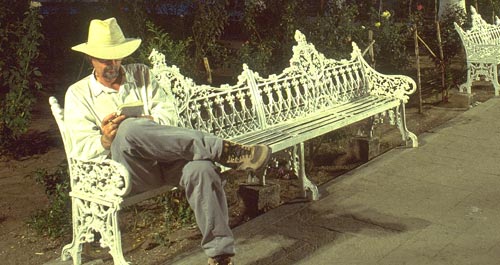
Anders reflects on the day's work notes, photo by Antonio Figueroa.
Human impact on planet earth is equal to population times affluence times technology.
A climate change report commissioned by the Vatican, issued 5-5-11, indicates there are three things we need to do: “reduce worldwide carbon emissions by stopping deforestation and other initiatives: reducing the amount of warming air pollutants such as methane and soot by as much as 50 percent, and preparing for chronic and abrupt changes that cannot be avoided.” No mention of population. It is human nature to promote growing populations, this is a “healthy” economic condition. Cities that grow are doing well, cities that are lose people are doing poorly. New homes being built is good, ghosts towns are sad. This human nature was present yesterday when we lived in caves and present today in urban super-sprawl. And tomorrow?
In my mind, the big issues in the future are women’s role in society, abortion and sex-education. I know these are long standing ideological battles. It is human nature to reproduce to save-replace oneself and the species. We will be dealing with Anthropocene consequences because stopping population growth is the same as trying to stop a super volcano from erupting, or is it?
Human impact, and change, is equal to population times affluence times technology.
73… An ethnic accounting, human nature and life in the Southwest…
Part Two of Three on an Eternal Debate.

Roofs collapsed into debris filled patios once filled with laughter and song.
Why did Alamos continue on after the mining bust(s)? There is no simple answer because there are always multiple causations. Here are a couple of my theories. First of all, Alamos was once a huge city that served as a regional center that thousands of people people passed through on their way to settle the southwest. The natural beauty of Alamos was unforgettable, it spoke to many in a clear and convincing voice, “here is a wonderful place, priceless”. Immense silver riches remained in the hands of a few families as they moved away to discover new opportunities. They stayed connected by keeping Alamos property and coming back to visit relatives and, or, sending support. When the mining industry closed down there was still workable land, and water, to raise cattle and crops. Four or five thousand people could get by with what was available. Alamos sustained itself by marshaling its resources, energy and lowering its expectations. Beautiful, historic Alamos was, and is, a survivor.

Life can be reduced to bare essentials and survive with grace and dignity.
400 years earlier there were as many as 115,000 indigenous people in Sonora and Sinaloa. And then a monumental migration began. and continues, as traditions and cultures came and left with each passing day. Spanish colonization had extended to north beyond San Franciso, California. What had been Mexico would become the United States and what was the United States’ would become Mexico’s in more ways than one. This is the essence of human nature: discover resources, adapt, reproduce, accumulate and, sadly, hold grudges. If there is a possibility of making a profit by importing-exporting customs and traditions, here, anywhere, will influence there and there will influence here. And…
Now, we are going to look back at 1920: that year’s census found 275,127 people living in the state of Sonora. 13.8% were of pure indigenous backgrounds, 37,914, of these 6,765 spoke an indigenous language. 40.4% were of mixed backgrounds, 111,089. 41.9% were of white backgrounds, 115,151. The 2000 census indicated that 2,183,108 people were living in 72 municipios, like Alamos, that make up the great state of Sonora. The 2010 census population was 2,662,440, and increase of 480,000 in ten years. Also, 3.9% of Alamos’ population, and 5.9% of Navajoa, are of indigenous backgrounds and across the state 55,609 speak indigenous languages. What will be Sonora’s 2020’s population and where will they be coming from and going to? And what will be the impacts on Alamos?
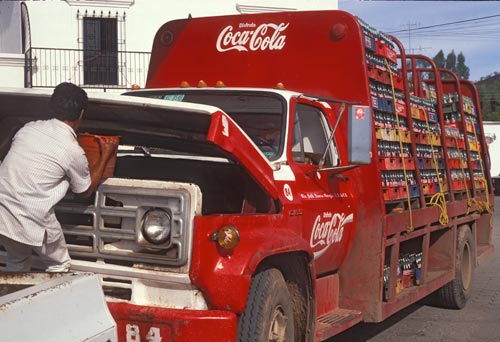
Even Coca-cola trucks get thirsty, and when they do, they drink water.
I have spent various degrees of time in San Diego, Ensenada, Tijuana, El Cajon, Encinitas, Escondido, Los Angeles, Santa Barbara, Monterey, Alamos, Santa Cruz, San Jose and San Francisco. Since the 1950’s, I have lived in neighborhoods along side Mexican-American families, many who did not speak English inside their own homes. I never really knew where the border between USA and Mexico began or stopped, it didn’t seem to matter. Currently, this mixed nation has migrated as far north as Alaska and as far south as Chile. The ever increasing human population is pressured to go somewhere, to do something, to survive.
People, throughout time, have entertained the pros and cons of change. Today, is no different. But there is a difference, the last 200 years has seen a global human population explosion that is expanding change at a exponential rate. The planet reached one billion humans around 1800, six billion in 1999, seven billion in 2011 and… This is change driven by a constant: human nature wants more humans. More humans means more opportunities, more consumers, more taxpayers, more soldiers, more followers and more believers. More and more and more and then…
The planet could care less if humans ultimately over-produce, over-extend, over-consume and experience a population crash by their own hands or natural events with global impact wipe out major population centers. More is less predictable, less has better odds of more sustainability. In summation, change is a product of human nature and population growth.
72… Forces of change challenge human nature at every turn…
Part One of Three on an Eternal Debate.

In days of old, man moved by foot paths through sparsely populated lands.
There was a time and a day that Indigenous people, speaking one of 18 Cahita dialects, were those who knew this land as their own. They numbered 115,000, the largest Indian group in Northern Mexico, and lived along the lower reaches of the Sinaloa, Fuerte, Mayo and Yaqui rivers. The Spanish called these agriculturalist Indians, spread out across the region in small groups, “rancheria people”. They had come from Asia, and possibly Europe, thousands of years ago. We know that those that came from these distant places were in turn descendants of those who started the great human migrations out of Africa and the Middle-east. There is truth in the belief that we are all, under the sun, brothers and sisters. Various cultures and traditions, if they helped people survive, will be adopted by others. This is a hallmark of human nature – adaptability.
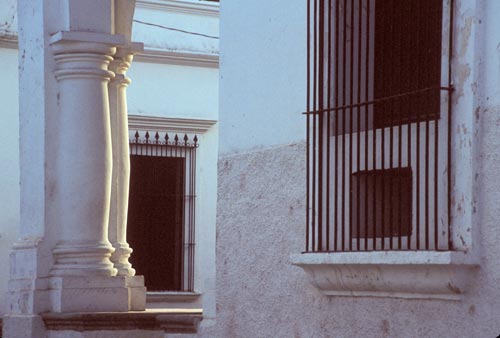
End of day's sun illuminates a classical column of another time and land.
One day the sun came up and menacing rattles of Spanish Conquistador swords, moving fast on old Indian trails, grew louder. December of 1529, Nuno Beltran de Guzman, once a lawyer, led an army of 500 Spanish and 10,000 Tlaxcalans, Aztecs and Tarascans into Sinaloa. March of 1531, Guzman defeated 30,000 Indians in present day Culiacan. Many that survived were captured and enslaved. Later, Guzman’s Amerindian army was wiped out by epidemics and hunger. His was a reign of terror. Spanish colonialization was approaching Alamos.
And then Silver was discovered near Alamos. And the world was attracted by the riches:
miners from Europe, merchants from India, silk makers from Japan, coin makers from China, Philippine sailors and to work the mines: African slaves, local Indigenous people, free mulatos and Indians from other parts of Mexico. Globalization arrived in Alamos.
And the riches brought in the finest goods from around the world. An international settlement was growing along the arroyos. Cultures and traditions blended together as did the people. Apexes of personal consumption were reached by those who could pay the price. The poor observed the rich and knew they were the human engines that made the rich richer. Lessons on modern times were there to be learned and mastered, the art of supply and demand was at hand. Consumerism flourished in Alamos.
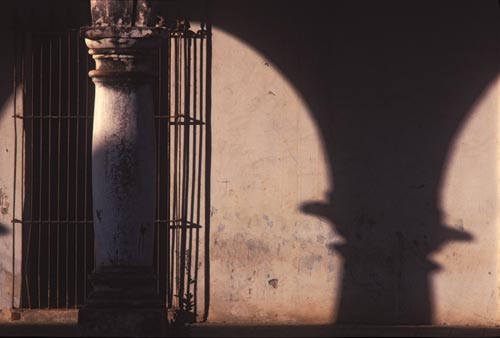
The shadow of Southern Spain spread across Alamos and the Southwest.
Alamos became a valuable resource to fund California coastal settlements along with emerging political movements – militias throughout Sonora and Sinaloa. Alamos was now helping export traditions and customs that not long ago had arrived here.
And then, things change like things do. Much of the International mining community left Alamos for gold and silver discovered in Central California’s Sierra Nevada foothills. Miners come and go to where there is buried treasure and international prices high enough to make mining profitable. Alamos experienced economic fluctuations that is the nature of mining boom towns. Many of these become ghosts towns and others continue on. Some Alamos families faithfully remained and made their livings amongst the aging architecture in a village that was a reduced footprint of its former self. The world had touched them. It could be seen in the art, furniture, books, and music left here and there, and so it was and so it is. Alamos was one of the mining towns that accepted, adapted and continued on. Over the next hundred years Alamos had a couple of small economic upturns and several longer downturns that turned into dust covering ruins of once grand mansions. The silver boom and busts had come and gone.
71… On the nature of Alamos the Pueblo Magico…

Looking east from Guadaloupe Hill and back through time to a beginning.
In 2005, Alamos became the 17th town to be honored as a Mexican Pueblo Magico, “a magical village”. As of 2011, there are 40 such towns and villages in 28 states across Mexico. Nearby, El Fuerte, just south of the border in Sinaloa, is also recognized as a Pueblo Magico.

Calle Rosales is a wonderful stroll as one approaches the Plaza and Alameda.
Pueblo Magico is “a place with symbolism, legends, history, important events, day-to-day-life. In other words, “magic” in its social and cultural manifestations, with great opportunities for tourism.” Ring the bells,that sure sounds like Alamos, Sonora, Mexico.

A spring day walk home as a family returns from shopping.
Alamos is a pedestrian friendly town. People walk and ride bicycles from here to there. One can drive across Alamos in minutes or walk across Alamos in less than a hour. The experiences are entirely different. Driving gets you somewhere at a time you feel, or need, to be there. Walking open up possibilities and discoveries as Alamos comes to you at its pace. The experience is in the detail, preservation and sustainability. This is a historic Mexican town in the foothills of the Sierra Madre near the Sea of Cortez. This is home to families that cherish the next generation and honor the past. This is a Pueblo Magico.
This photo is from the Spring of 1984. There is a good chance the door, wall, wood shutters, ironwork and trees are the same today as then. The cobblestone may be different but the shadows move as they always have.

Sun and shadows play on a wall facing the Plaza, another day has begun.
Behind any door is another a world that combines past, present and future. As you walk by their voices speak to you. In a car, there is the sound of traveling, your conversations and inward thoughts. So much of the Alamos experience is what you hear, smell, sense and see. Little things take on great import with observation and reflection. And there are the people who have decided this is where they should be, each with a story, each with a connection, each with an opportunity. Sagas unfold with body posture, gesture and inflection. It is all there to be a part of if one goes with the Alamos flow, or not.
Return to Journal entries 61-70 or forward to Daily Journal
©2011 Anders Tomlinson, all rights reserved.


