Journal entries 91 – 100
Last modified: August 23, 2012Alamos horses… Elizabeth Nuzum’s special place-garden… Cobblestone crew… kids playing in streets… the red brick building… View from Tecolote Hill, mining, Mirador, gangs, dump… sweeping streets… restoration and repair… and Easter Sunday in the country.
100… An Alamos moment with some horses…

A solitary horse stands in the middle of Calle Comercio.
A man in the background is working on repairing a drain spout Calle Comercio. Behind the horse is the former Governor’s mansion. Why is this horse here? Because it is here. In the bigger picture the answer could be that Christopher Columbus brought the first domesticated horses on his second voyage to the new world. His expedition selected 25 horses from Andalusia including the Spanish Jennet, know for their athleticism, medium size and comfortable gait. The Spanish royal architects who laid out Centro Alamos as it is found today were also from Andalusia.
Hernandez de Cordoba in 1517 brought horses to Yucatan. Conquistador Cortez set sail with 16 horses, 500 men and 11 ships in February 1519. He landed on Mayan territory in the Yucatan peninsula and marched inland to what is now Mexico City. Today, Andalusians are bred with quarter-horses and Mexican Criolla to produce the Mexican Azteca, beautiful and durable. The horse above, living in the moment, is unaware of all of this.

The lone horse knows there is food in the trash buckets waiting for pickup.
The horse has found food scraps to rummage through. Food is food. While taking this photo I wondered if someone realized this horse was possibly not where this horse should be? And, would they go looking for the horse or is this a regular occurrence and the horse returns unassisted? A horse on its own in Centro Alamos is not a common sight but it should not be a surprise given Alamos, Sonora, Mexico’s old west nature.

Looking through the Museos' window at the old Alamos fort's front door.
All of Centro Alamos is a museum as illustrated by looking out Museo de Costumbrista de Sonora’s northern windows and seeing La Ciudadella, one of the oldest and best kept buildings on the Plaza. This was the town’s original Spanish fort. It is said that a Spanish soldier’s ghost is here protecting hidden treasure. This ghost is not alone. There are reports of ghost throughout Centro Alamos, purchase a home and a ghost, or ghosts, come along in the deal.

Small details tell stories and events that transcend time and space.
Mystery and magic are in the details seen from the street. Events are recorded in the weave and pattern of old sidewalks. Pride can be found in the well-intended performances of skilled workmen and artisans. Days of old remain with the care and respect of today’s owners and helpers. It is community mindset and municipal dictate that perpetuates past legacies.
The streets of Alamos are living history.

Maria Louisa, the first owner of La Ciudadella, died from a loose ceiling brick.
La Ciudadella went from a government fort to a private residence to two residences and then restored back to one 22 room mansion. In the early days this was a fortified mansion to securely store silver bars from the Aduana mines. Behind these doors Important business was conducted that had implications as far north as San Francisico. Inside the compound there were ramps to move the treasure along with a dungeon, deep well and secret emergency escape tunnels.
When I visited La Ciudadella in 1995, David and Jennifer McKay were living there. I sat down with David at a big old table from the soldier’s mess hall and had a glass of water and a brief conversation. Today La Ciudadella, 15 Cardenas, is owned and watched over by Margo and Richard Howell. During the winter and spring seasons La Ciudadella is often included on the Saturday house tour that gathers at 10 or 11 a.m. in the Plaza. The modest house tour fee benefits local charitable organizations, this is a long-standing tradition.

Horses can be seen on the streets and arroyos of Alamos, Sonora, Mexico.
Counter clockwise from upper left: Independence Day celebrations feature horses, music, food and beer in the arroyos. A grandfather and grandson ride together on a quiet weekday in downtown Aduana. A summer rodeo and music concert is staged in the baseball park, nothing started on time. A young man walks his horse in front of the church.

A private entrepreneur started a tourist horse drawn carriage ride around town.
And now for a little horse history in Mexico. In 200,000 B.C. Equus Mexicanus were common in North America. Starting around 136,000 B.C. they began to leave for Asia. Some 76,000 years ago Toba, one of the world’s four super volcanos, errupted in Sumatra and wiped out many species on earth. The human population, reduced to a thousand breeding pairs, barely survived. In recent times the onager, a wild ass, was common throughout North America. And then the Spaniards arrived. In the background are the steps leading up to the Monastery, formerly the Boor’s mansion. The pink building on the corner is now the Alamos hostel.

Be it for transportation or recreational activity the horse is part of Alamos.
Counter clockwise from upper left: A couple of charros, horsemen. pass Calle 5 de Febrero as they ride eastward in Arroyo La Aduana. Horses and riders gather and celebrate Independence Day in Arroyo La Aduana. A woman and child on horseback near the cemetery along Calle de Las Delicias. Man and horse rest as the Plaza fills with summer tourists.

A magnificent Arabian purebred stands in the high noon warmth of spring
Dr. Martin Dale Edwards and Zora Tyler owned Rancho Las Crucecitas, a 15 minute walk from the Plaza, when these photos were taken in 1995. They had two large houses, with two caretaker families living in one, two barns and 23 corrals. Water was provided by an abundant well and a dam behind the main house which caught and stored runoff from Mt. Alamos. They had an Arabian breeding program that used the son of Fadjur as their primary stallion. We are not sure where Arabian horses came from: northern Syria, southern Turkey, northern edge of the Fertile Crescent, Iraq, across the Sinai, Egypt, southwestern Arabia… We do know that around 1500 B.C. records begin to appear talking of the impacts these powerful “hot blooded” Arabian horses were making.

Soon the mountain behind the main ranch house will be vibrant green
These horses lived a different life than the horse on Calle Comercio that began this scene-segment-post. Life in the undisturbed country is much different than the narrow streets and homes wall to wall in downtown. These city homes do have their walled-in courts – patios where outdoor living, and privacy, is a given. But in the countryside, wide open spaces present an all encompassing freedom. Here, the sounds are of surrounding wildlife and of your own making. I believe Rancho Las Crucecitas was named for a murder that took place on the property where an old woman is buried. The herd of Arabian horses would die years later at Las Crucecitas from bad food or disease or? Something had gone terribly wrong.
Las Crucecitas’ 175 acres was purchased from Zora by Sharon Bernard and renamed Estancia Crysalis. Frank Bernard, her father, had owned a 1200 acre ranch that was three miles northwest of Alamos and might have been named Estancia Crysalis. He was a hotelman and a former Spanish Consul to Vancouver. After he sold the ranch its name was changed to Rancho El Palomar. Frank, and his second wife, Atie, then purchased Calle Comercio 8, the Bishop’s mansion in Alamos Centro. I met briefly with Frank in 1993 and he told me that I had brought a talented crew to film Alamos over the Christmas holidays. Horse spirits and ghosts are everywhere.
99… Elizabeth’s experimental place – garden, El Pedregal… first of two parts…
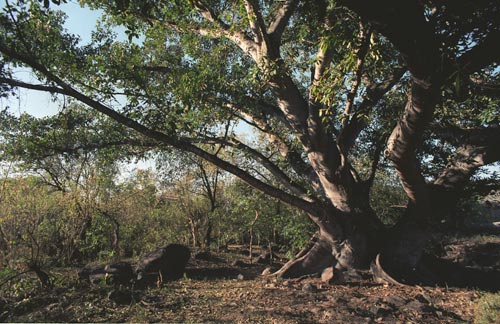
In a magnificent setting there is this fig tree to admire and celebrate.
Pember and Elizabeth Nuzum owned a lot off a dirt road in the Chaleton area, place of the fig trees, west of Alamos. They planned to built a tennis court on it. One day Elizabeth traveled further west on the road and came across this fig tree. It was love at first site. She coaxed Pember into selling their lot, and it sold unexpectedly quickly. Elizabeth, on her own, purchased the undeveloped three acres with the fig tree from Martha and Al Haywood. Elizabeth christen the property El Pedregal, the stoney place. This was her project, her experimental place to build and plant what she wanted. It was her dream to bring art, community and nature together under the out-stretched limbs of a magnificent fig tree.

Elizabeth loved her big green door that was El Pedregal's entrance.
The first thing Elizabeth did at El Pedregal was build a meandering road leading through and around the property to the fig tree. The heavy green gates at Pedregal’s entrance, where the public dirt road comes to its end, were made from old doors Elizabeth collected in town. She had put them together by Nemecio Figueroa in his family’s carpenter shop on the way to the Panteon, cemetery, at the eastern edge of town. Behind these green gates there were, and are, worlds of natural wonder. The seasons pass as birds, insects and mammals come and go.
A straw-bale studio…
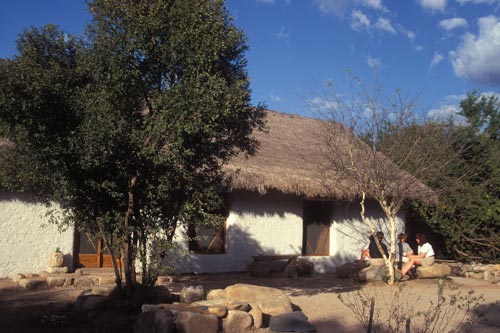
Elizabeth Nuzum wanted to build a straw bale house in Alamos. She did.
Elizabeth had read the book Out on a Limb by Peter and Victoria Nelson. It was about tree houses and other construction such as straw-bale houses. Elizabeth decided she wanted to build a straw-bale in her garden of experiments. She contacted the Nelsons as they were preparing to visit Russia and demonstrate straw-bale technology. They recommended that she talk to the authors of The Straw-Bale House, Bill and Athena Steen. Elizabeth felt it was important to build a straw-bale structure as an example of what could be a relatively inexpensive home concept for Mexico. Unable to have an expert come down to build the straw-bale studio she relied on the Steen’s book and hired her son-in-law Chacho Valdez and his brothers to start the project. Chacho would build the basic structure: roof, walls and an unfinished floor.
A palapa for all seasons and reasons…
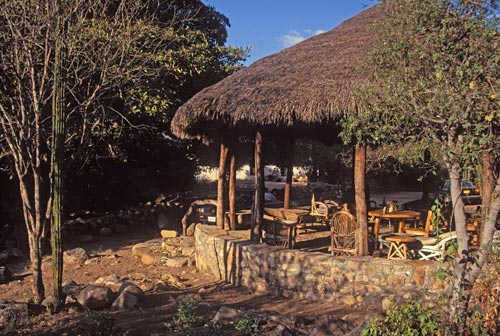
The Palapa was the first structure built at El Pedregal. It was a work office.
Before the Straw-bale studio was started Elizabeth and Chacho took a stick and scribed out a large circle as the palapa’s floor-plan. Her intent was to have a place where people could socialize and admire the fig tree. She wanted it to have two entrances and no center pole. Chacho said it could be done and he went about construction.
The amazing hand-woven palapa roof took a crew five months to put together as they had to wait for after full moons to collect the palapa leaves. As work continued on the property the fig tree was host to shamanic dances, earth renewal ceremonies, sweat lodges, barbecues, coffee parties, art classes and…
Chacho Valdez, man of mystery…

Chaco Valdez, renaissance man, making a spiritual point and jump starting a car.

I always thought of Chacho as a rock n’ roll medicine man. He looked like a pirate with long flowing hair and beard, bandanas and hats. One day Chaco looked at me with one eye somewhere else and stated, ”if you stare at a cloud long enough it will disappear…” This is an anthem-theme that I use whenever I speak of Alamos.
Chacho and Cammie, his former wife, were instrumental in creating the Children’s Kite Festival held in the spring. Chacho, a bit of a mischievous child himself, loved children. He also loved to sing in his big booming voice. The last time I saw Chacho he was building a circular two-story house on the well-traveled entrance road up to the top of El Mirador. The site doesn’t seem like it would be conducive for privacy during park visiting hours but, my oh my, what a magnificent awe-inspiring view! …
98… Returning to El Pedregal’s ever-present spirit… second of two parts…
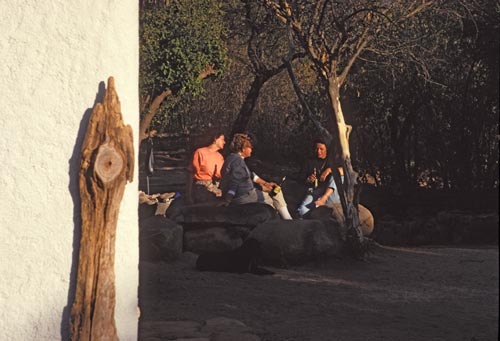
Here is a place to come together and be a warm late afternoon dream.
Liliana Carosso, on the right, and Ginny Brown, along with an unidentified woman in the middle, enjoy a natural moment. Lilliana is a prominent Alamos real estate agent. Here, one is in another world. Time loses importance and nature, and a couple of beers, encourages relaxed deep breathing.
Kit Nuzum returns to Alamos…
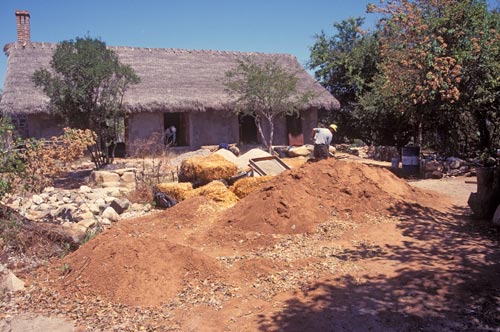
From dirt and straw and other natural elements a large studio is born
Elizabeth’s son, Kit, returned from one of his many global travels and took over the task of finishing the straw-bale studio. He also managed the digging of a well at the spot chosen by a water dowser. A solar pump was installed and irrigation began with water from beneath El Pedregal”s surface. Elizabeth purchased indigenous and rare trees and plants. And as the nature is for these parts some took, and some didn’t as any Alamos gardner has experienced.

Most of construction team and advisors gather around Elizabeth Nuzum.
Kit had no prior working knowledge of straw-bale construction and “just went for it” with the help of Chone, a cousin of Chacho. They poured an earthen adobe floor with the help of Steve Frielobs. The windows were made by Angel Rosas. The adobe interior walls that made the kitchen and bathroom was there but unfinished. Kit and Chone, along with several others, finished the walls and the loft decking as well as the grand stair case, designed by Alamos resident Irmine Stelzner, with wood from the old Boors monastery on the southwest corner of the Plaza. The original douglas fir came by train from Oregon in 1910. Irmine’s husband Allen Stelzner designed and made the iron latch on the front door.
Creating color pigment from nearby hills…

The finished exterior blended in with the surroundings.
Elizabeth’s straw-bale studio was originally painted with a palette of colors made from dirt in the surrounding hills. The soil that would be used to make the paint came from a spot that was along a long walk that Chacho took me on the last day of my first visit to Alamos. Chacho said it was a local custom. As we were returning to Alamos I asked Chacho if the earth was purple and he nodded yes. In this one area there was literally a rainbow of dirt. Fifteen years later, Kit and I, along with a couple of assistants and a wheel barrow, set off to find this magical place. We found it not far from El Pedregal along with shards of am old pottery. The work crew spent the morning gathering earthen colors from the area as I filmed. Later, Kit mixed the earth-toned dirts – pale green, red, blue, green, ivory, white and lavender with prickly pear and agave goo called baba. The solution sat for a week before glue was added and wiped onto the interior walls: home made paint.
Later, author Paul Molyneaux, seeking a quiet harbor from his noisy young children, finished his book The Doryman’s Reflection, a Fisherman’s Life in the serene straw-bale studio. Tony Estrada, director of the Museo de Costumbrista and artist, sculpted a centaur for Elizabeth that was placed beneath the fig tree.

The morning begins with seeing where we will be in a couple of hours.
On this summer day in 1996 I would go on a hike with Chacho, his young son Sereno, his girlfriend and Chone to the top of Tecolete Hill, seen here sun-capped. Sierra de Alamos rises up in the background. We would leave from El Pedregal at sunrise and be atop Tecolote Hill in a couple of hours. This turn out to be a day of exercise and aroma therapy in Alamos, Sonora, Mexico.
El Pedregal today…
Elizabeth sold El Pedregal to Jennifer and David MacKay in 2005. They added another 17 acres to what is now El Pedregal Nature Lodge and Retreat Center. They have also upgraded the infrastructure and added a couple of casitas. Today, they offer lodging, nature tours, sunday brunches and yoga lessons amongst many other activities that they are involved with.
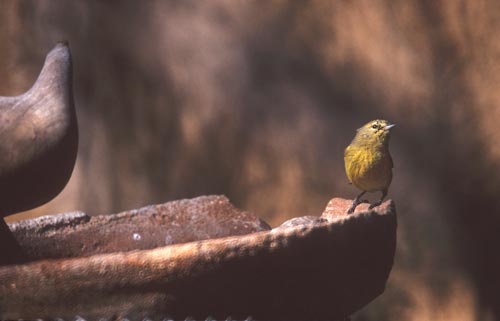
Elizabeth's intent was to have both a nature preserve and artist studio
I recently enjoyed watching David Wilson’s Big Birding Day on PBS’ POV, point-of- view, series. The 2011 12-minute film features David Mckay as a birding guide for several birders intent on a big birding day. The film documents the world of competitive bird watching where one tries to see, or hear, as many bird species as one can in 24 hours. The opening scene takes place under the Pedregal’s palapa as they prepared for a day of ambitious adventure. I was struck by David’s curiosity and connection to his environment.
I had spent nine years filming wildlife on the Tulelake, Lower Klamath, Clear Lake, Upper Klamath Lake and Klamath Marsh National Wildlife Refuges along the California-Oregon border. If David had come and spent a couple of days in the field with me he would have had a wonderful time. And I am equally sure I would enjoy spending a couple of days with David Mckay in Alamos and surrounding habitats. Both of these regions are known for diversity of flora and fauna, especially numbers of bird species. There are birds that visit both Alamos and Tulelake on their yearly migrations.
Elizabeth Nuzum placed this bird bath on Pedregal’s giving ground for her small friends to use, just as she built the straw-bale studio and palapa for friends to visit with friends, even if it is only communing with one’s self, alone.
This entry was aided by notes from Elizabeth Nuzum, Kit Nuzum and Joan Winderman.
97… The cobblestone crew in action…
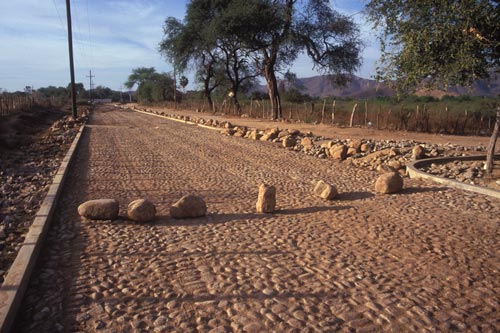
A rock blockade warns, do not continue on, there is road work ahead.
This is a cobblestone section of the old El Camino Real headed west out of Centro Alamos and then turning northwards. The airport runway is to the left and an open field is on the right. It would be interesting to learn when this important Spanish highway to the Californias went from dirt to cobble. Another time, another way exemplifies a grand human tradition of using materials at hand, and experienced intuitiveness, to create function and design.
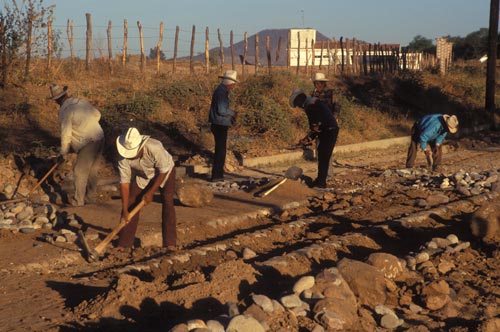
They are out early on the road to San Bernardo near the airport terminal.
This is a special crew, a few men selected to continue road building and repair customs that go back centuries. These men spend days, weeks, months and years digging rocks up and placing rocks down. My friend Chacho’s father can be seen with a hat, or wrap, under a hat.
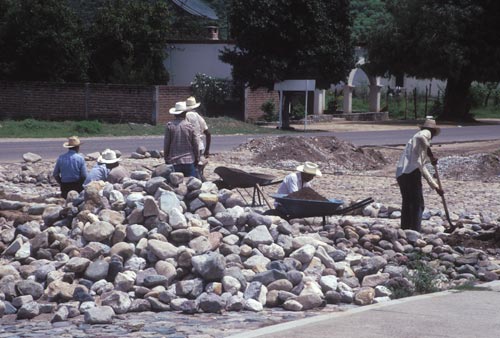
Rock, dirt, hand-tools, hard labor and minds that enjoys solving puzzles.
This is an ultimate jig saw puzzle that when finished reveals no image or icon. Pieces, rocks, go where they fit, or are compatible, for a variety of reasons known only to those who position the rocks. I didn’t see any overweight men on this work detail, nor back-braces. It is hand labor: pick axes, shovels, wheel barrels, dirt, boulders and heavy lifting. There are percussive rhythms that come with their tools in repetitive action and layered human harmonies from their melodic conversation, singing and laughter.
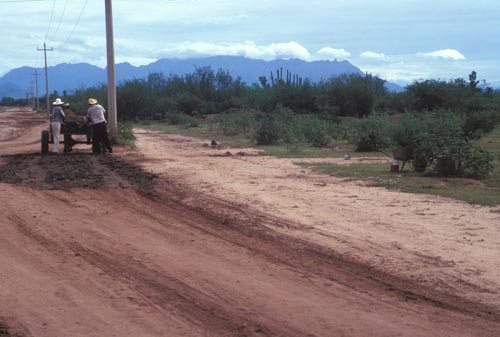
Two men with hats and a wagon load of dirt at work in the campo.
It is summer and dirt roads are quickly damaged by monsoon flash floods.. The hot sun and humidity is unavoidable but rural road repair goes – on fill the hole with dirt. Is it a special dirt or blend of dirts or…? The road looks like it is a good distance to the southeast of Alamos. I was probably returning from the Cuchujaqui River and asked the driver to stop so I could get out and take this photo.
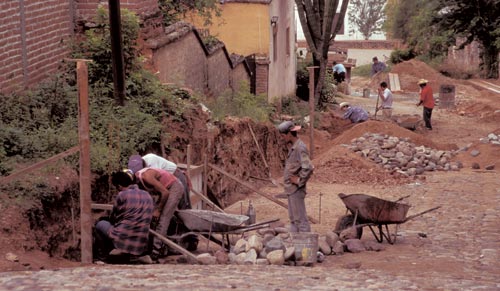
A large crew is busy digging a trench on a road going up Guadalupe Hill.
Municipal projects employ workers. Digging a trench by hand employs more workers than bringing on-site a fossil-fueled mechanical trencher. Employment grows with inefficiency and decreases with labor-saving-payroll-cutting devices. Alamos, like the all the world, needs job. Work crews are digging on Calle Maria Felix, a street that climbs a short distance up Guadalupe hill before coming to a stop at the front door of a cliff-backed house. This is as close to being a cul-de-sac as any road in Alamos. Calle Galeana, to the west, is in the background.
96… Kids playing in the streets add to the many charms of Alamos…

Kids playing on Calle Alberto Gutierrez, In the distance is the Bishop's mansion
If you are a kid, and live in town, the streets are yours. Friends and neighbors come together, spending their time playing games and enjoying-developing their social skills-relationships. And as they play friends and family, young and old, pass by and everyone acknowledges each other…
it does take a pueblo to raise a child.
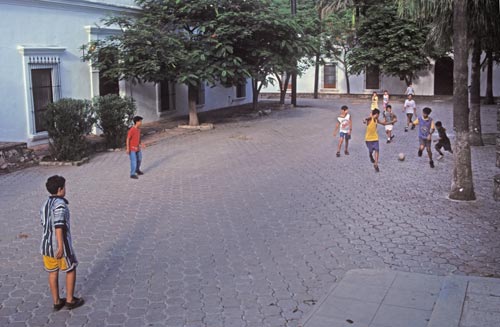
Across town small groups of kids, boys and girls, play games kicking a ball.
Soccer, futbol, is a national pastime. It is played on dirt fields, grass patches, paved and unpaved roads. Here, the playing field is Calle Molina Galeana in front of an entrance to Hacienda de los Santos SA de CV. All players, on both teams, no matter the score, will win.

Young kids laugh and talk and play ball and on Calle Aquiles Serdan
The sound of a bouncing ball and joyful enthusiasm of children making up rules as they go, priceless. This is what life is all about, this moment, moments that are both serious fun stuff. Here, conspirators whisper confidential information and in the next instance gleefully whoop and cheer for this or that. These are kids doing what kids do in an environment that is safe and nurturing. The house on the left was the home of Noli Ernaldo Garcia. On the right was Antonio Figuerro’s studio and rented house. At least once a day I walked on this one block street, it was a short cut connecting Calle Galeana and points southwest and the Alameda, Plaza and points east.

There are places where one can sit in the shade and peek at the world.
If one sits still in one place, for five minutes, part of the world will pass by, even if it is only this girl on a bicycle. Sound travels through these narrow streets, and around corners, bouncing off walls and pavers like whimsical free sonic spirits with a directional broadcast all their own. Here, Anders’ first law of safety applies, “one cannot see everything they hear.”

Street soccer playing kid signs for his three friends in Anders' photo workbook
Boys playing soccer take a break to write their names in one of Anders’ photo work books. Jose Guillermo Calderon Q,, Jose Maria Palomeras V., Erwin Marques Valenzula and Rafael Valenzula Vega are four more faces and names linked together for the future to look back and recognize. Their playing field is the alley between Calle Guadalipe Victoria linking Calle Alberto Guiterrez and between the Museo La Construmbrista de Sonora and the old two story Alamos Hotel.

Preparing for the Independence Day Parade that will end in the Plaza.
During the week leading up to Independence Day school kids practice marching through the streets. Red, white and green will be seen everywhere: symbolically red represents union, white represents religion and green represents independence. On September 16th, these kids will be marching sharply in their school uniforms through parts of central Alamos along with government officials, municipal workers and band. Admiring spectators line the parade route’s streets, many will follow the procession to the Plaza.
In the hearts of many, Alamos is the center of the universe.
Independence day starts early in the morning with a municipal parade through the town’s colonial center. Alamos school kids, the first high school in the Californias started here, and the entire city government take part. Video…
In 2010 the students added their own uniformed marching band to the parade.
From children to government, Alamos continues.

All of the schools, all of the classes and all of the students come together.
School kids, municipal employee, government officials and admiring bystanders gather in Plaza de las Armas for ceremonies to begin at 11 am. Across Mexico’s outdoor meeting places and plazas there is a moment of silence that begins as the church bells strikes eleven o’clock and ends with the last strike of eleven. And then the speeches begin. Father Miguel Hildago on September 15, 1810 called out to his congregation to fight the ruling Spanish. His words, “Viva Mexico” and “Viva la Independencia” are repeated and celebrated each year. September 15 is the eve of Independence day, followed by the 16th, Independence Day, “grito de Independencia”.

Banners have been hung in preparation for Independence Day celebrations.
In the evening there are speeches from the Municipal Palacio’s balcony as people celebrate in the streets and a surreal mist of firework smoke, illuminated by the town’s lights, lingers overhead. Folks have come from near and far to be part of this moment. It is a magical time in a magical town. “Viva Mexico!” “Viva la Independencia!” “Viva Musica!”
95… A mysterious building on Calle Gral Antonio Rosales and Mariano Matamoros…

Looking down from Red Cross hill at a two-story red brick building.
There, north of the Plaza, or below in this photo, is an interesting L-shaped building. The red- brick building in the bottom right corner is this entries’ subject, Each of its many doors opening to the street must have had stories, history, take place within. The rock outcropping in the photo’s foreground can be clearly seen from town.

Walking from a barrio to central Alamos for any of a variety of reasons.
Here, a Calle Antonio Rosales runs into a building. These two women are only a block away from the Mercado and the Alameda. They most likely are out walking about doing their daily food shopping. On the other foot, they could be going to the bus station, or visiting a doctor or dentist, doing errands, visiting friends, picking up repairs, or shopping in various stores, stalls and carts comprising the business, retail and service center of Alamos. The woman on the right is carrying a large bag, a good clue shopping will be included on this walk.
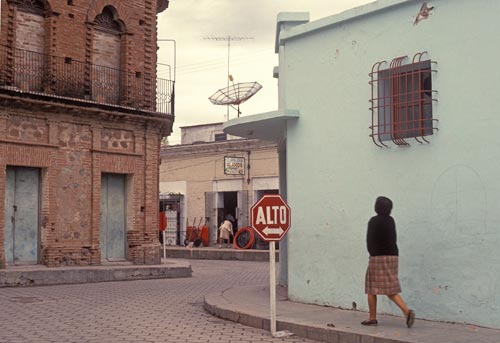
Calle Gral Antonio Rosales jogs across Calle Mariano Matamoros.
A woman walks west on Calle Gral Antonio Rosales which runs east-west through the northern part of central Alamos, one street south and parallel with Arroyo de La Aduana. Calle Mariano Matamoros, left to right, is three blocks long with the northern end beginning at Arroyo de La Aduana and the southern end running into the Museo Costumbrista de Sonora’s north facing wall. In the background a hardware store displays its wares on the street. Marketing, marketing, marketing… location, location, location…

It is a wonderful day to be out walking and visiting on Calle Rosales.
An old woman with walking stick, dressed in grey, baby blue and pink, stands at the red brick building’s entrance as another woman walks by in the street headed east. One would think all the shuttered doors, so near the Alameda, once had vendors inside. This does not look like a typical residence, it being without a single window treatment at street level and also one of the few two story structure in Alamos, Sonora, Mexico.
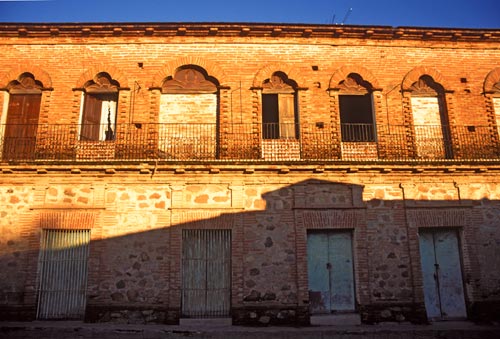
The architectural shadow of one building cast upon a sun blazoned building.
Early morning sunlight music plays on the moorish details of this building which are similar in spirt to the municipal government building, the Palacio, also made of red brick. History is here to be comprehended as one looks at textures and patterns of the old buildings. Think back to the day when the stones and bricks were being laid in place. Pause, look and listen.
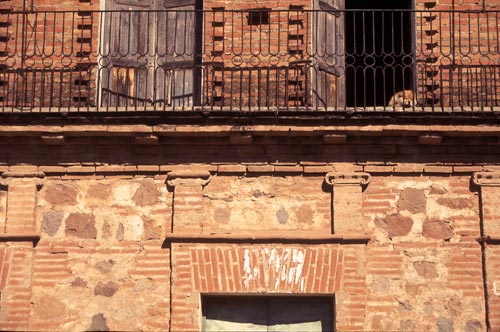
What a wonderful vantage point for a dog to take a morning siesta.
A resident of the red-brick building rests in the warm sun. At this time, 1996, the owners of the town’s printing shop, which had a sign I remember as ” Impresta F. Hernandez, Sucn,” managed by Elena del Carmen, lived here. The printing shop was working with letter presses that could have been over a hundred years old. The shop was planing to purchase a computer and move into the digital era. History is forever changing for history is the record of change.
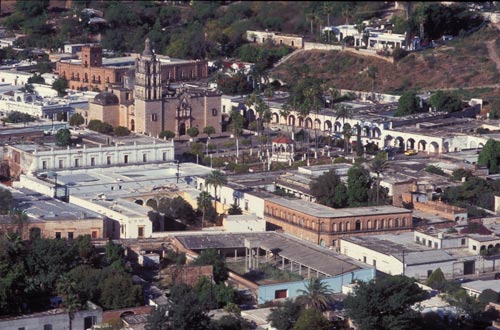
The Municipal Palacio and the brick building look as if they are related.
We return to the northeastern hill overlooking Centro Alamos. From here the Palacio, in the upper left-hand corner, and this two story brick building, which resembles a mercado from another day, in the bottom right-hand corner, bookend the plaza and church.
94… The day starts off and continues into tomorrow…

Burning wood for cooking and warmth provides comfort on a chillyl morning.
Alamos, at sunrise, seen from Tecolote Hill high up the Sierra de Alamos foothills. Off to the east the Sierra Madre foothills climb into rising mountains and plunging canyons. The gauss like smoke blanket over town will linger through the early morning stillness and move off with the first breezes. One can hear the church bells ringing from this vantage point and an occasional loud vehicle. other than that it is the sounds of insects and cold air turning warm. I wonder how many people have shared this view over the centuries and eons. This up close and personal view of Alamos was made possible with a 800mm lens.

A proud sign marks an intersection-entrance into Alamos from the southeast
The sign says it all: Sonora is Mexico’s premier copper producer and second in gold. Mexico, overall, is rich in natural resources. It is the world’s second largest silver producer and eleventh in copper production. Alamos is seven kilometers east of the historic Aduana and Minas Nuevas mines which produced some 40 million ounces of silver. Alamos is what it is today because of the silver from nearby mining camps that began over 400 years ago.
Today Alamos is surrounded by mining interests. 21 kilometers to the north-northwest is Frontera Copper Corporation’s Piedras Verdes open-pit, heap leaching copper mine.
40 kilometers to the south-east Pan American Sliver began construction in
April 2005 of its open pit Alamo Dorado silver mine. In 2010, according to their website this mine produced 16,749 ounces of gold and 6,721,358 silver ounces.
7 kilometers to the west Silver Pursuit Resources is exploring silver mining options at the historic La Quintera Project.
When I was last in Alamos, 1997, there was no actual mining in the region. There was talk that someday mines might reopen if the global prices were right. If one stood by this sign long enough it is possible one would see a municipal garbage truck coming from town and headed south to the dump, following the direction of the truck in the photo along the El Camino Real.

It is a fine day in the Plaza. The town is alive with the sounds of summer.
Plaza de las Armas on a brillant summer day in the Cuidad de los Portales. The Plaza is bewteen Juarez and Victoria streets, on the corner of Cardenas street. The Moorish style bandstand came in 1904 from Mazatlan. Bishop Reyes Cathedral, or Cathedral of Our Lady of Conception, was built between 1786 and 1804. Alamos is considered by many, thanks to the skills of.early architects from Andulusia, Spain, as being the most colonial city in Mexico.
The Plaza, with the church, Museo Costumbrista de Sonora, hotels, tourist office, convent, Alamos Hotel Ruin, bank, juke box, art gallery and private homes was the center of social activities. surrounded by buildings of culural and historic importance.

If you can clearly see the Mirador the Mirador can clearly see you.
The old days are always with Alamos, Sonora, Mexico, they are in the details, textures and patinas. They can be seen in the work that has been done over and over throughout the years. East of the Plaza, rises Cerro del Perico, hill of the parrots, and the inspiring 360 degree panorama from El Mirador, the Viewpoint. The Mirador provides an understanding of where one is when they visit, or live, in Alamos, Sonora, Mexico.

The trash container near the top of Mirador's wonderful 360 degree view
It would be hard to miss this trash enclosure as you go up the road to the top. One fine 1993 winter evening Anders conducted an informal poll with a small group of young school girls taking in El Mirador vistas. The question was what did they want to do in the future? They giggled and answered mafia wifes. A fringe benefit of being a mafia wife, they thought, was that their husbands most likely would die young and the gangs was obligated to take care of the widows for life. These were the days that the drug gangs did not show up the government. They had a place, their place. They were there, certainly not invisible, but ignored if they stayed out of the headlines. As contextual background for this story, in 1996 the Alamos police chief, a retired Sonora State highway patrolman, proudly told me Alamos had the lowest crime rate in Sonora.
Ramon Salazar, raised in Alamos, was a big gangster in the region at this time. I was told he was involved with marijuana and his soon to be wife, Poppy, was involved with opium. Their large wedding reception was held at the old Alamos Hotel, on the Plaza, during the 1993 Christmas holidays. A large big band was hired and arrived from Mazatlan in their painted bus with sparkling sequin-studded band uniforms and bright shiny instruments. A couple of our film crew dropped in, and filmed a couple of songs, at the reception. Later, I heard Ramon skipped payment on the band, hotel and beer. And that was that. What are you going to do?
Ramon Salazar died a couple of years later traveling with his mother and brother on a back country road near the Sonora capital of Hermosillo. After being shot, Salazar got out of his car and walked towards the police with one of his arms blown away. The police asked if he was spending lots of money. Salazar asked them to ” end me now”. They did. He died, of seven gunshot wounds, in his mother’s arms. He is buried in the Alamos cemetery. There was probably a song written about the life and times of Ramon Salazar. What is, and what was, depends on circumstances, times, places, relationships and everything moves and changes with the winds of history.

The Municipal dump is a short distance to the southeast of Alamos.
One can tell much about a civilization by examining its dump. During the summer, Antonio Figuerroa and I walked to the Asoc. Ganadera local de Alamos building next to Pemex gas station off the Alameda.. Here Ernesto Alcorn, a veterinarian and ranching association officer, had his office. We hopped in his small pickup and headed for the dump. Soon we were headed south of town driving on the dirt old El Camino Real. Antonio and Ernesto wanted to make a video about the dump and its black water that reaches the Cuchujaqui River. Their goal was to send the video to a Mexican TV channel contest. The winner would receive a video camera, VCR and TV set. Both young men were concerned about the dump’s environmental impacts and wanted to bring attention to its condition.
I wonder about the dump today. I went on the internet to find any current information. There wasn’t any. But in the search I came across a book by David Yetman, Sonora, an Intimate Georaphy, which begins with a 24 page chapter, Alamos. The opening sentence is “Go see see Alamos, David, there’s no goddamn place like it.” The 264 page book was published November 1, 1999 by University of New Mexico Press. I enjoyed visiting Alamos through David Yetman’s experiences.

Down in the valley Alamos begins another day in the circle of life.
The smoldering dump, directly above El Mirador, can be seen tucked up against a distant foothill. Its smoke plume, for the moment, is headed in a south-easterly direction. On the hike to this vantage point we followed two men and a supply loaded burro. They were headed to their mining interest. At a fork in the trail we went left where they had went right. The quiet became louder.
93… Sweeping Alamos streets and cleaning Church candlesticks…
Alamos prides itself on clean streets. For some, it is a lifetime occupation. For others, it is a family chore. For all, it is a signaling that they care and they respect all of those who have, are and will travel these streets. These are serene moments.

Keeping the streets clean by hand is an unending ptrocess.
Clean is as clean does. There is a sense of order to freshly swept streets and side walks along with a charisma of community caring and municipal pride. The post man delivers and the street sweeper taketh away. The eastward-slow-rising-tilt of oneway Calle Aurora shows off any street debris from a distance. There is no place for litter to hide. If it is there, it’s sheer presence, no matter how large or small, casts stained shadows upon aging walls – all is influenced by its reflection. Order is disturbed. The street’s two century old character is challenged by an errant plastic cup. The illusion is gone. In this way, the street cleaners are magicians: they take us back in time with each sweep of their brooms. Order, and respect, is restored.

Another sunrise, another opportunity to tidy up the streets by hand.
It is morning in the Plaza. Women open their shops and offices for business and sweep their entrances. This woman is sweeping the street in front of the former Boors mansion, now a convent. It is a humble but gracious act. She can sweep away the trash and reveal the patina, if not spirit, of human travelers who have passed this way by foot, horse, carriage or car.
There was a 16mm film made by a North American couple living in Alamos, The Brooms of Alamos, about a girl, her true love and her eternal sweeping. It was suggested by an Alamos contact that the filmmaker’s name was Al Gordon. Anders had access to a film print, via Kit Nuzum, in the late 1980s or early 1990s.

Sweeping the front yard and your half of the street is the Alamos way.
Young or old clean the streets in front of their homes. Contrast the style of clothes, and brooms, between this young girl in pink sweater and red pants and the woman above in her paisley summer dress. No matter their differences, culturally or spiritually, as they sweep they share a common timeless experience. For as long as one is in Alamos there is sweeping, and as long as there is sweeping there are these Alamos streets, loved and passed on to the children.

How many people have cleaned these candlesticks over the years?
The gentlemen smiling as he works could be a cousin of Noli Ernaldo Garcia. Noli was a long time Pember and Elizabeth Nuzum employee. He was their driver and took care of household maintenance and repairs. At the time of this photo Noli had retired because of illness. The doctors’ prognosis didn’t look look good. The woman helping clean candlesticks looks like she is the same person seen in a preceding photo sweeping the street in front of the Convent on the Plaza: similar dress, shoes, and hairstyle. Working together these two are closer to God, each in their own way and each on the universal path of cleaning that is life unto death.
92… Restoration and repair keep buildings breathing…
Old buildings carry on with the hands and minds of people dedicated to maintaining and restoring that which has lasted centuries. For many it is their way of life. We salute the workers and the owners. For the owners it is pride, responsibility and investment. For the workers it is a livelihood that supports their families, and hopefully, moments of pride for work well done.

Restoring and repairing old structures is an unending process
This is the busy corner of Calle Allende and Calle Cardenas. The Primary school is to the left. The two story structure is the north side of what was the Governor’s Mansion in 1828. Behind the stop sign to the right is the rear, east side, of the Museo de Costumbrista de Sonora which opens on the Plaza. There is much work to do to keep these three buildings alive.

There is no end to doing what could, or should, be done.
Two buildings down from the Cathedral and Plaza, on the north side of Calle Commercio, a workman surveys a rain gutter. The flat roofs of Alamos have a hard time shedding water during a heavy downpour. Blocked or damaged downspouts need to be cleared and repaired before the next rain, especially in the summer when coastal hurricane remnants may pass through Alamos.
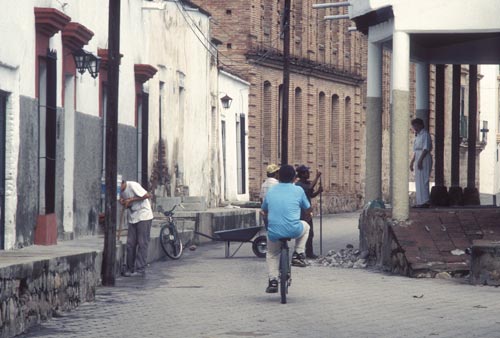
It is a busy morning on Calle Rosales. Places to be, things to be done.
Work and play on the architecturally diverse Calle Rosales. This is one of my favorite streets in Alamos Homes line both sides of the streetand the two story primary school’s northern side seen in the background. A home owner discusses her plans and needs for the day with attentive workers. This is one day at a time, day after day, month after month, year after year and…
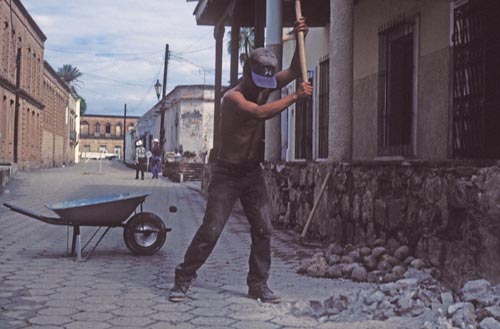
One man, one pick-axe, one street, one task. Life goes on.
All great plans and achievements are created by muscles with minds. There are rhythms to hard labor starting with the cycles of breath and heart beats. There are the exertion groans and, in this case, the pick-axe moving through the air, crashing into the street and sizzle of sparks from hard metal striking rock, over and over. All of the elements in this photograph, minus modern clothing and fancy wheel-barrow, could have been here 200 years ago. This is one of many Alamos charms.
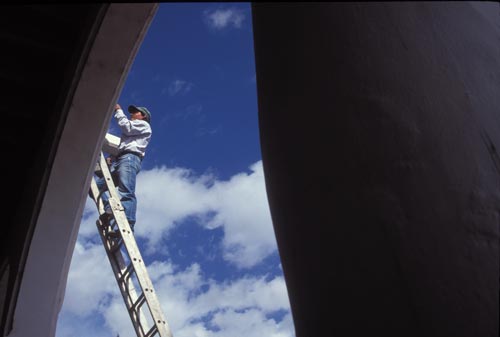
Framed by a classic arch man and sky do their thing.
The Bishop’s mansion, kitty corner from the Governor’s mansion on the south side of Calle Comercio, is having roof and rain spout inspection. King Carlos III established a new Bishopric in 1781. It would cover the territories of Sinola, Sonora and the Californias. Franciscan Antonio de Reyes was appointed Bishop and moved into this Alamos residence in 1783. The building’s two story majesty illustrates the grandeur that was Alamos in the mid 18th century. This period was the height of Colonial New Spain, an era of pomp and circumstance. Just think of the moments and secrets this perfect portales could share.

The construction crew working on the Primary school meet with the boss.
What is the kid on a bike in a red shirt listening to? Are the men discussing what needs to be done next? Is it a safety meeting? Are figuring out ways to restart the truck? Are picking straws to see who goes get tortillas? Was there a problem with suppllies arriving? Are they gossiping? Are they striking? Has the city run out of money? The correct answer is it is Friday and they are gathered to collect their paychecks. All is good. The primary school’s western entrance is to the right and the south side of the Museo de Combrista de Sonora is in the background.
91… Part Two: On Easter Sunday in the Country…
There are some days one never forgets. Easter Sunday 1995, on the Figueroa family ranch was one of those days for me. Unfortunately, my workbook’s location, for this period of time, is unknown, so the names of Antonio’s parents, wife, daughter, brothers, sisters, nieces and nephews are not at hand. It is hard to tell a story about a large family without names but I will do the best I can. This story is told in two parts.

Step outside from under the supported roof and one is in thick outback
The morning began with a tour of the brothers’ bedroom. While going to school the brothers had lived on the ranch and the sisters lived in town. It was a long country walk to and from town for the boys. There had been seventeen sisters and brothers. Now it was the father, mother and Moro. Over the years, mother, who could not read, had acquired a large library of books and drafting tables for the boys. As I walked into their room, isolated from Alamos by distance and geography, the world was in their hands by picking a volume off the book shelfs. Antonio and his brothers were proud of their childhood bedroom. They knew this was a special place. I remember the moment as a hopeful dream with knowledge being the coin of the realm and all that is good in command.
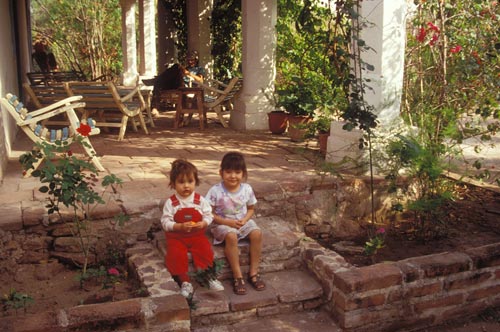
Two girls and their uncle, in the back rest reading, after breakfast.
We all went into the kitchen to join mother cooking breakfast. There was no TV, radio or computers but there was paper and pen. And so the Figueroas entertained themselves by drawing caricatures of each other. There was an innocence in the room as they showed their cartoons and the others laughed. Joyous home entertainment without electricity.
Outside, the only sounds were time passing by as these humans reenacted a common thread throughout all of mankind from the creation of paper to the power grid. So much had changed so quickly. The world Antonio knew is not the world his father knew. Many call this progress. Few ask of unintended consequences. I felt at home in a world I understood.
You can see Anders art at artfeats.com.
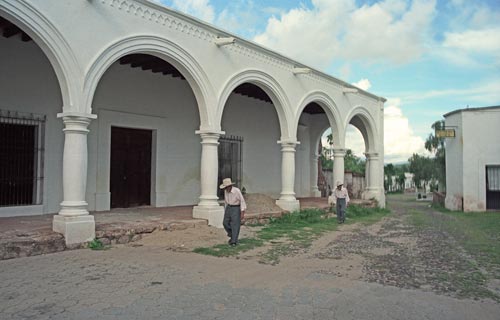
Every day he walks the long walk from the family ranch and returns.
Antonio’s father, as a young man, held a infant girl in his arms. This baby grew up into a young woman and the now aging man married her. Together, they would have seventeen children. Antonio was the last born born to an elderly man who now hardly, if at all, recognized his youngest child.
I had seen the father in the late afternoon walking into town. I asked Antonio where he was going and he answered ” to church and then he turns around and walks back to the ranch.” Walking is the form of transportation that most people use in Alamos. Elderly people on their daily walks are a common site. In many cases one could tell time by their passing by. The father’s walk from the ranch is another leap, as far as walking goes, in magnitude order. I am sure there are well-worn foot paths through arroyos and over hills, as old as man, that cut the actual distance compared to the many miles our taxi negotiated in reaching the ranch from town.
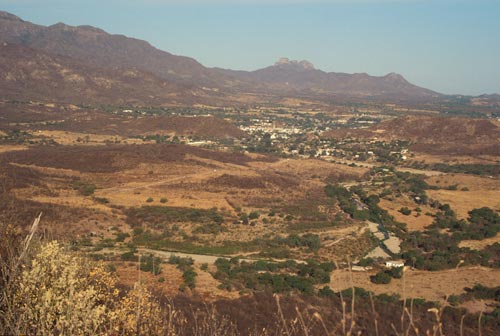
It is late Spring looking west at Alamos from the ranch's high ground.
Antonio and I hiked after breakfast to the top of the hill the ranch sat on. The hills and valley were dry. The sky was dirty with dust and smoke from burning farm fields surrounding Navajoa to the west. This is the way it is in late spring. Alamos is two hills to the west and Cacharamba crowns the western horizon. Beyond that the Sierra Madre foothills descend to the great agricultural flood plains and the Sea of Cortez. In the distance a young boy was playing stick with his dog. It could have been Antonio’s ghost from 15 years past. From here, a place to take in what living really means, the struggles and rewards travel on the wind. We, as one, are the past, present and future.
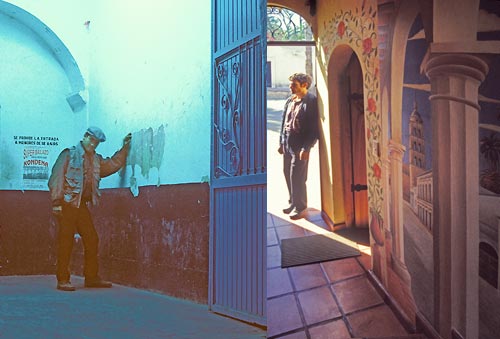
Two brothers raised on the ranch, a photographer and an architect-artist.
The seventeen Figueroa children went their own ways. A brother became a priest, a sister worked in the Vatican. Some became teachers. Some did not marry and those that did planned to have two children, no more. It is an amazing step forward in one generation, 17 children to two. Much of this deals with economies. Modern children are an expensive investment and for some marriage is an economic challenge. Above, Antonio poses as a drunk outside an Alamos bar and his brother, an artist-architect working in Guadalajara, stands next to one of his murals he painted while in Alamos. Both of these brothers are skilled and accomplished. I think back to their bedroom on the ranch. This is where they came from, a room of books and drafting tables.
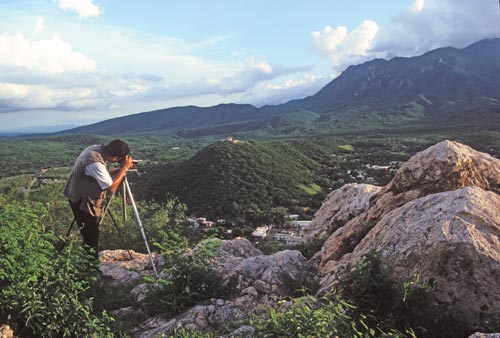
Antonio Figueroa doing what he loves, taking pictures with nature's warm light.
A photographer and his town. A man in the moment. A father seeing the future. A husband embracing the present. A son understanding the past. This photo of Antonio, at work, is a portrait of all these moments and much more. Summer comes once a year, ten times a decade and a hundred times in a century. Each summer washes away the previous seasons and starts many growing cycles anew. Nature’s cycles are meaningful, as is Antonio taking sunset pictures of summer Alamos from high ground.

In the upper left corner one can follow the blue water pipe coming to Alamos..
The ranch is somewhere out there along the water pipe from the east. This photo was taken in the summer. The hills and valleys are green, the air is clean, and the morning sun heats up the day. Thunderheads will begin to build. Most people will stay in the cooler shade. Siesta becomes a day-long affair. I wonder what summer it is like on the ranch. Here, another season is another world.
Return to Journal entries 81- 90 or forward to Journal entries 1-10
©2010-2011 Anders Tomlinson, all rights reserved.


