Journal entries 61-70
Last modified: April 17, 2012Beisbol, rodeo and dancing horses… Estancia Crysalis… Pemex… kids in the summer… painting the Mercado… kids at night… two churches, two men, two bells… Uvalama pottery family… woodworkers… and Dr. Joaquin Navarro.
70… I say baseball, you say beisbol and it’s three strikes and you are out…

Arroyos-roads will do for makeshift baseball fields.
Baseball is not Mexico’s national pastime, and it is no longer the USA’s, but it is popular, particularly in the northern states. Beisbol was introduced to Mexico in 1847 by American soldiers during the Mexican War. Americans overseeing railroad construction also encouraged Mexican workers laying track to play beisbol. On July 4th, 1889 work stopped on the Monterrey-Tampico railway in Nuevo Leon to celebrate the holiday as Colonel Joseph Robertson and his workers played baseball. Organized beisbol started in 1925.

The sweet smell of neatly groomed dirt, batter up.
It would not be surprising to think that there are kids who dream of playing professional baseball as they take to the field at the Alamos ball park halfway between the Plaza and the airport. The Mexican Pacific League is the premier Mexican winter league. 27% of its 445 players come from Sinaloa and 20% come from Sonora. Teams close to Alamos include the Yaquis de Obregon, Mayos de Navajoa, Caneros de los Mochis – the Sugarcane Pickers and Naranjeros de Hermosillo – the Orange Pickers. Fernando Valenzuela, who took Los Angeles by storm as a successful pitcher for the Dodgers, Fernandomania, was born in Etchohuaquilla a small town near Navojoa. One of the allures of baseball is so much of the game takes place in the mind as one waits for the action to come. Baseball is a game from dreamers.
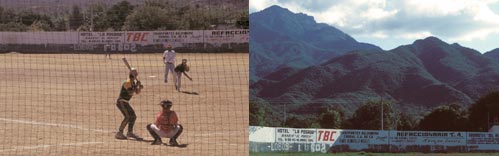
Build it at the foot of Sierra de Alamos and they will come.
The warrior that is always looking up at the western sky atop Sierra de Alamos can hear the roar of fans when a run scores in a big game for the home team. The photo on the left was taken in the spring, the photo on the right was taken in the summer. This is a ball park with a wonderful view. Sierra de Alamos is a magnificent hitter’s background.
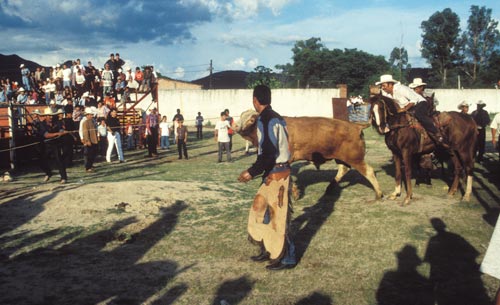
They play more than baseball at the old ball park, root root for the cowboys.
The rodeo had come to town. The event had fallen behind schedule and the crowd grew uneasy waiting for the show to begin, and they waited and milled as summer clouds came and went. And when it started it was hard to tell it had started. Unorganized is a polite term to describe the promoters. The posters around town publicized this event as a rodeo – music concert. The headline singer, who was backed up by a local band that provided the sound system and stage, also was late arriving. More clouds came and went. More drinking. More huddling. After the rodeo finished the cowboys stood in a line to thankfully pray that no one had been seriously hurt. And then it was time for music and dancing horses. For more on the band visit Journal entry 33.
A summer rodeo – music concert with trained horses dancing the two step.
Throughout the summer there are activities to enjoy in Alamos, Sonora, Mexico. On this day the rodeo came to town along with a Mexican pop singer who was backed up by the local “Halcon de Sierra Alamos” band. The stars of the show were the dancing horses. Video…
69… Estancia Crysalis: outside Alamos, inside Alamos country…
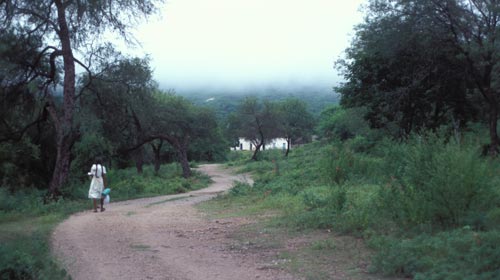
This is may not be a well traveled road but it is a long traveled through time.
If one were to close their eyes and listen to the footsteps of this old woman, with a young woman’s body, one would hear someone going back in time, retracing footprints of the ancient ones as this old woman returns to Estancia Crysalis. Here is another world where the land speaks in a dominate voice. Listen carefully, and one will hear sounds that Indians heard before the arrival of the Spanish. Here, there is a purity of all things nature.

And there is Chihuahua, and there are Sierra Madre foothills and there is...
It is a short, invigorating walk from Plaza de las Armas to Estancia Crysalis on paved road, the old El Camino Real. The slight incline, as you rise into rolling Sierra de Alamos foothills, stirs the minds and exercises the heart. The entrance to Estancia Crysalis is across the road from the El Mirador. The dirt road into Estancia Crysalis follows Arroyo Barranquita. Once on the ranch there is the Sierra Alamos, right there, in all her beauty, framed by 200 year old Mesquite trees.
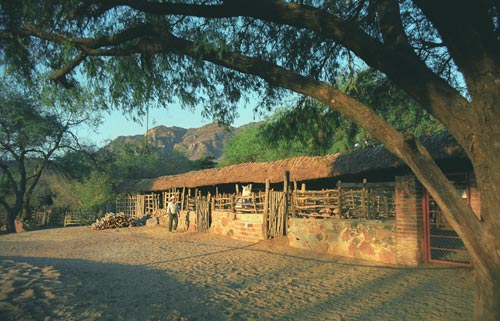
For the Arabians these were stalls for students these were shelter.
And so it was and so it is. Estancia Crysalis was formerly known as Rancho Las Crucecitas. The last owners of Rancho Las Crucecitas, Dr. Martin Dale Edwards and his wife Zora Tyler, raised a select herd of 22 purebred Arabians. These rustic stalls were the horses homes. Sharon Bernard is the current owner and changed the ranch name to Estancia Crysalis. A group of college students on a field trip from the USA stayed at Estancia Crysalis and used these stalls for lodging. And so it was and so it is.
A Ranch on the outskirts of town, looks forward to the future.
Estancia Crysalis, along the El Camino Real, is a mile southeast of the Plaza in Alamos, Sonora, Mexico. The 175 acre ranch, on Sierra de Alamos sloping foothills, is focusing on a new day, and listening for opportunities floating on tropical breezes. Video…
The above video is from summer. The following video is spring. Estancia Crysalis experiences the seasons in all their dramatic changes. Life in Centro Alamos is dominated by man’s structures and gardens. Life on Estancia Crysalis is dominated by nature.
In another era, Estancia Crysalis was a working horse ranch.
Today, the spirits of these departed steeds, proud Arabians, are present, be it a sound of a branch breaking under weight or a small flurry of dust. Shut your eyes and listen, they are still here. Video…
68… At the Alameda’s western edge is the gas station…
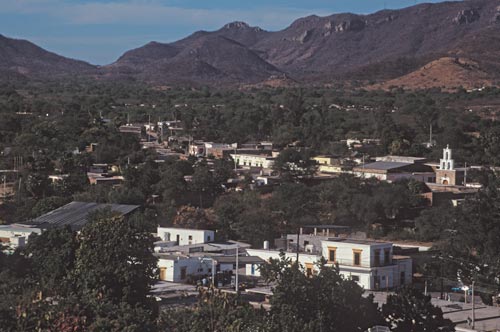
A summer view looking northwest from the old jail on Guadalupe Hill.
Three busy centers of Alamos can be seen above: the gas station is at the photo’s bottom left, just to the left of the two story building. The Asoc. Ganadera local de Alamos is seen to the left of the gas station with its large angled metal roof that is behind and part of the local cattlemen and ranchers association’s office. The roof’s design acts like a speaker broadcasting music from dances held here across town and off the mountains. In the middle near the right edge is La Capilla Zapopan. Chapel Zapopan was built in 1841 for Dona Juana Mallen by Don Ignacio Almada y Alvarado.
The nature of my documentary efforts is capturing an area’s geography and events during a certain time period. There has been numerous times while I edited history films that I wished someone had taken a picture that benchmarked a landscape in a specific era. My photos will, hopefully, be accessible to future film makers as they look back and interpret the past. The body of my work is not commercial photography: these images were not made for someone or something. They are part and parcel of a time-capsule-database-puzzle driven by my quizzical eye. This Journal you are now reading is my attempt to make it less a puzzle by providing information about the photos and the context that they were produced in. As example, Alamos’ population has nearly doubled since I last visited and I am sure that many of these scenes have changed just as I am sure that many remain the same. I have heard for years that the jail on this hill would become a cultural center, a wonderful idea for a substantial structure with million dollar views right in the middle of town. The question becomes, is this same vantage point in 2011 a view from a cultural center or is it a photo from the old jail? All I know is this is what it looked like in 1996 and behind me was a jail with armed guards wanting me to buy inmate handcrafted horsehair products.
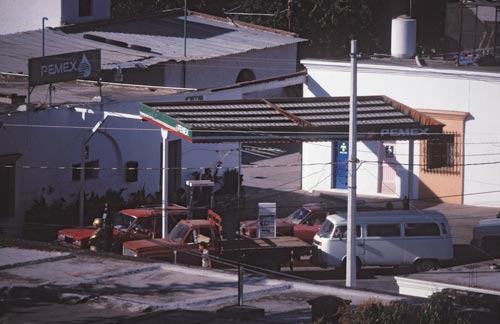
The only gas station in town is part of a Federal monopoly.
On March 18, 1938 the Mexican government nationalized foreign oil companies operating in Mexico. This was the birth of Petroleos Mexicanos, Pemex. Today it is the second largest state owned country in the world as well as the second largest company in Latin America. Pemex has 138,000 employees and pays taxes that cover 40% of the federal government budget. The Mexican petroleum industry has come a long way from Tampico in 1876 when oil was first successfully refined into kerosene. Modern Mexico and Pemex, with assets worth USD $416 billion, are tied at the billfold.
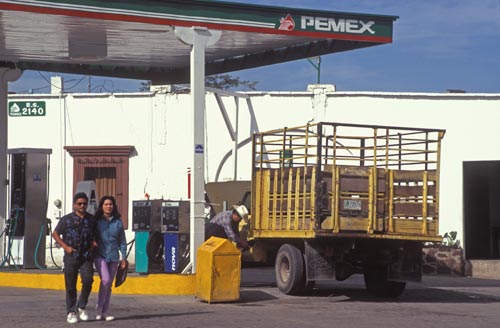
Need gas? Need air? Need directions. Here is a good place to go.
If one was to spend a day watching the comings and goings at the gas station they would learn much about what makes Alamos go. People pull in for gas and air all day long: on foot with gas cans, bicycles, motorcycles, cars, trucks, big trucks and buses. Conversations take place between customers, attendants, people passing by and folks hanging out. Locals, tourists, ranchers from out back, North American community members, employers, workers, poor and rich all show up if they need gas here and now. Waiting in line can be a social event.
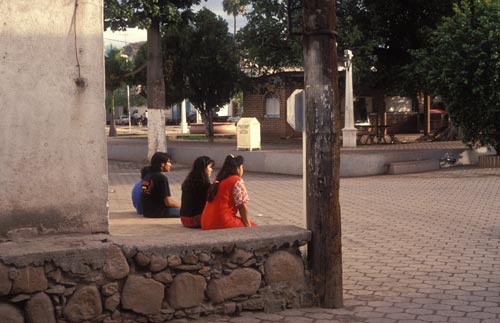
Another day is coming to an end, a time of reflection and preparation.
These kids are sitting across the street from the gas station. What are they thinking? And where are they today? Did they they know of Carlos Slim Helu? Currently, Carlos Slim Helu is thought to the wealthiest man on planet earth. His father, Julian, emigrated to Mexico from Lebanon at the age of 14 in 1902. Julian began his business career, and long lasting family fortune, with a dry goods store and Mexico City commercial real estate investments. Today, Carlos is chairman and CEO of Telemex and America Movil. His conglomerate Grupo Carso SAB has extensive holdings in other Mexican Companies. All together, his corporate holdings in 2011 are thought to be worth USD $74 billion.
Soon it will be time for these kids to say goodbye to each other and return to their families for dinner. The future of Mexico is tied to Pemex, the likes of Carlos Slim Helu, these kids and the kids who are now sitting in this very same place. I wonder what the kids of today are thinking?
67… On being young in a land time forgot…

Enjoying a summer tropical storm's aftermath as waters recede.
Erik Oriel Caro Corral and Carlos Eduardo cool off in mountain rain runoff rushing through town headed east for Rio Cuchujaqui. For a week this arroyo was a community swimming pool used by boys and girls of all ages. The river had come to them, for these moments, there was no need to go to the river for summer relief, Erik and Carlos were identified by someone in the audience at one of our summer open-air slideshows presented as dark fell. Antonio Figueroa produced a handful of these shows in several barrios. We would show an image, let the crowd react and then ask if anyone knew who was in the photo. A good time was had by all and most of the images now had names. Win – win.

Boy in blue huddles in the early morning coolness waiting for work.
This is a troubling image. The boy in blue with a shaft of sun against a blue wall was one of the few people that were in projected images that no one recognized. I had seen him several times sweeping and moving cases at the liquor store on the Alameda. Here, he is waiting for someone to arrive and open up the store so he could start working. This photo was taken in the Spring while school was in session. It seemed odd that none of the kids recognized him. I could only surmise he did not attend school and he had no established family roots in Alamos.

Hilario Cano takes a break from riding around the Plaza in the rain.
Hilario is dressed for rain. Few avoid getting wet during summer showers. Children play in the cool rain and adults spend a moment letting the moisture refresh their skin before finding shelter. Once the cloud has moved on the reemerging hot sun will quickly dry whatever is wet. Another shower passes through and those who want to get wet get wet again. Everyone loves the rain. It is life.

There are few people in, or passing through, the Alameda at this early hour.
The unknown boy is watching a couple of men walking to the bus station. In the summer the boy was no longer working at the liquor store. I still wanted to know his name. I took a photo over to the store and all of the employes said they had no idea who he was. This was strange. I had seen him with them. Later, I met the owner-manager while he was singing in the Plaza at night, see Journal entry 65. I showed him the photograph. I thought now I would be able to put a name to the face. Not to be. The man had no idea who this boy was, a boy that I had seen working at the man’s store while the man was there. And that was that, there was no one else to ask. I felt as if I had visited the Twilight Zone and it was time to leave. Until now.
66… Painting, sweeping, shopping, street repair, waiting, shopping, painting…

It is a beautiful day to begin painting trim on the Mercado.
I met the Mercado on my first visit to Alamos in the Spring of 1984. It was an unpainted shell surrounded by vendors displaying their wares on side streets: narrow busy bazaars under collages of tarps, blankets and open sky. I was told it had been like this for awhile as frustration grew over unresolved issues that would not allow businesses to move inside. The Mercado was open when I returned in the Winter of 1993. I have a memory that some of the stall areas were empty at the time. On this Summer day of 1996 the Mercado was filled with retail and food businesses. A painter was at work with his trim brush, a produce truck unloads and customers came and wento as a street sweeper looked for trash to remove.
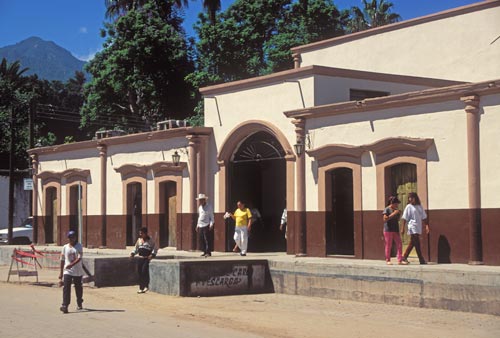
Sierra de Alamos rises regally above the freshly painted Mercado.
A common occurrence on all my visits to Alamos was someone painting something somewhere, everywhere. Here, the Mercado looks as if it has been repainted, again, Climate, dust and automobile exhaust are several of many contributing factors for new paint jobs. Paint, besides adding color and newness, is another layer of skin protecting the past from flaking off with the elements. Paint is labor intensive and provides needed work in challenged economies. Paint is good.

Is this another color scheme or has the paint faded?
The Mercado has stores with exterior doors along its outside walls and four entrances into an enclosed open space with a two story ceiling. The large space is divided into stalls selling everything from cowbells, school supplies, clothes to boom boxes. Fresh produce, canned and dry goods, breads and meats fill the floor. Voices, music and aromas bounce off walls. Friends buy from friends, and family, as children and dogs navigate the aisles. Several counters serve hot food. Small tvs, up high on shelfs, entertain no one in particular.
65… In the night, streets provides space and boys will be boys…

On summer nights outdoors at night is a place to be cool with friends.
Sitting on the sidewalk-porch of a house on Calle Galenna were Miguel Alfonso Ayala Sayas, Jesus Antonio Ayala Sayas, Ivan Vincio Zavala Lucero and Carlos Enrigue (Alcentar?) Verdugo. I am not sure of the order. I am researching my pocket Alamos workbooks where folks signed their names and in some cases indicated where their parents came from. The hand writing, as in the case of Carlos, at times is difficult to read. For this photo the page read “night photo taken at House of Chriyscolia King” and these four names. No name for the cat.
Outdoors on a summer night, if it isn’t raining, is a good place to be. Many homes have three generations living in small spaces. It is difficult to invite friends over for a variety of reasons including privacy and adding additional body heat. The streets at night become an extended living room.

Erick Osvalda and Vardes Valensuela enjoying Christmas vacation.
It is late December, 1993, few cars are traveling on the one-way street which old maps named Calle Aurora and Google shows as an extension of Calle Francisco Madero. The crisp winter night air has a bite to it. Most folks are indoors watching television or celebrating each other’s company. In contrast to summer, the doors are closed, now holding the heat in. Thick walls, high ceilings, doors and windows are the primary climate control systems in Alamos. Tis the season to be jolly.

They would sing for hours in the Plaza, their songs echoing off of history.
Martin Alonso Sanchez Silva, Juan Gabriel Hurtado Vla., and Victor M. Robles L. could be found in the Plaza on many summer nights. Martin, on the left, worked on a crew I filmed building the Straw-bale House at El Pedregal the previous spring. As for other two gentlemen I am not sure who is who. The gentlemen on the right owned, or managed, the liquor store at the corner of Calle Rosales and Aquiles Serdan on the Alameda. Both sang in the church choir. Here, their melodic voices, and practiced harmony, filled the Plaza with humanness and added to the sweetness of a summer night.
64… Two churches, two bells, two men and two towns…

Tino and his beloved Bishop Reyes Cathedral face another sunset.
I knew this would be an interesting photograph. A man, who, in his face, had seen much of what life has to offer, a church bell framed by its belfry and a natural backdrop stretching from Mirador to Sierra Madres. All were lit by a low brillant sun whose golden rays were diffused by humid shimmering heat waves. We only had a moment to take this photo, as we were speaking he was summoned to fix a pressing property emergency, this is what maestro Tino did. I asked him to look towards the sun and pressed the shutter button. One click and done, another moment saved for the future, this is what Anders does.
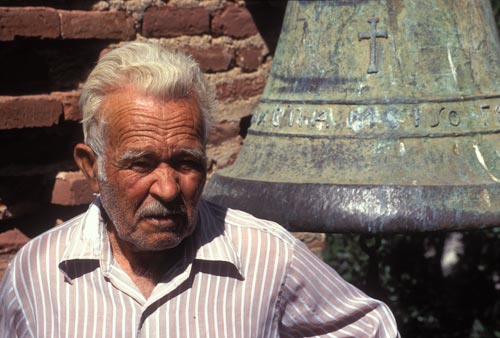
Caretaker of Nuestra Senora de Balvanere Church in nearby Aduana.
La Aduana on a midweek day in late Spring is peaceful. Take away the sounds of birds, insects, burros, dogs and a handful of kids and it is really quiet. Few cars will be heard for hours.
This is a place where the past lingers on, mining sites and ruins litter hillsides, a lonely plaza’s dry fountain surrounded by buildings once busy including a store where customers’ shoes for hundreds of year have cut a groove into the floor. I visit the small church and met the caretaker who takes me on the roof so I can see the town from where the bells of Nuestra Senora de Balvanere are. The church has an interesting story involving a beautiful maiden, Indians and some rocks, but that is for a coming journal entry. It is hard to imagine what it is like when
thousands of pilgrims arrive in La Aduana, many walking along arroyos from Alamos, to honor the Virgin of Balvanere every November 21st. A breeze kicks up dust on an empty road, a crow calls, three boys in a dry creek bed laugh and the day moves on. Life in Aduana 1996 is much different than life in Aduana 1700, one can only wonder what it will be like in Aduana 2020.

A tale of two bells, one old, one new, and how they toll.
The bells of Bishop Reyes Cathedral are part of Alamos’ daily fabric, they are a prominent voice in a complex orchestral sonic landscape. Here are old and new: a cracked bell was replaced by a shinny bell. I was raised to believe if you don’t have something good to say about something don’t say anything. This is a good rule of thumb, especially in small rural communities. There are always exceptions: this new bell didn’t make me feel good. It wasn’t inviting me, its clang was more of a warning. It is possible that the bell vibrates discordantly only to me, but I find this hard to believe, I have a good ear. Maybe it was the bell ringer’s technique. 14 years have passed, maybe it has mellowed with age. I hope so. A town so culturally rich should have a bell that touches the heart and inspires the imagination. Maybe it does now.

Dr. Ortiz Tirado is another Alamos native that touched the world.
Dr. Ortiz Tirado was born in Alamos and spent his early tears in Culican, Sinola before moving with his newly widowed mother and family to Mexico City. He became a successful doctor specializing in plastic surgery and was Frida Kahlo’s bedside doctor. He made vast contibutions to the medical world. And he could sing. His beautiful tenor entertained audiences across continents. Alamos hosts a grand music festival in his honor, The Festival International Dr. Arturo Ortiz Tirado, that includes dance, art and music with workshops, lectures and concerts. The festival entertainment, centered in Alamos, also performs across Sonora visiting venues in Nogales, Hermosillo, Ciudad Obregon, Hutabampo and Navojoa.
The ten day event is held each year in late January.
63… A little village of potters do as it has been done…
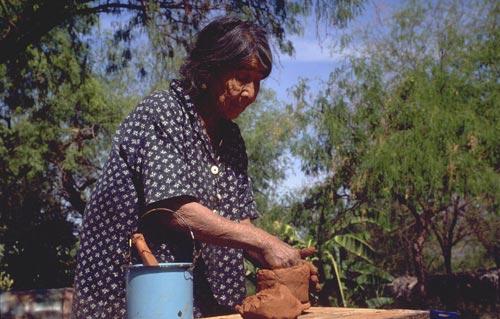
Carmen Portillo at work in her La Colonia de Uvalama studio-home.
Carmen Portillo, matriarch of her Uvalama pottery family, died in 2004. She had been making pots since she was 12. Her grandaughter, Carmen Tomasa Ayala, continues the traditional craft, selling her own creations from the studio and at Uvalama Pottery in Alamos on Calle Obregon and Guerro near La Casa de los Tesoros. Years of taking clumps of clay and creating shape and function has it rewards. Artists know when they have got it right, and this moment of recognition and acceptance, priceless, warms the soul and perpetuates the process. Carmen Portillo had this moment, handfuls of times every day, for each day, each year, each decade and each generation of her life as a potter. And she was one with all those from the past who took clay in their hands and formed balanced objects for reflection and service.
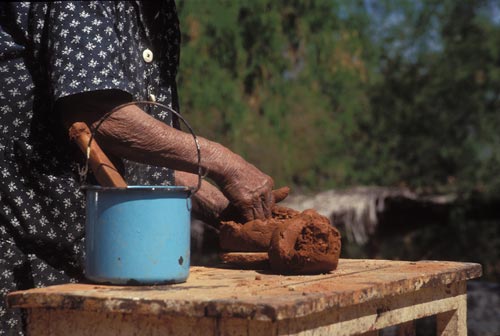
Carmen's pottery is the product of water, earth, fire and handed down traditions
The car ride to Carmen’s house, a couple of miles west of Alamos and south a mile off the highway, in La Colonia de Uvalama was a drive back to another era. The Uvalama turnoff, as I am consulting with a Google satellite map, may be Arroyo Encanto. La Colonia de Uvalama was a small community with a house here, a house there, a primary school, countryside and a road that was a wash. When we arrived at her house a younger woman came to greet us. She went back into the house and Carmen, along with several family members, appeared moments later as we all converged at the work table in the front yard.
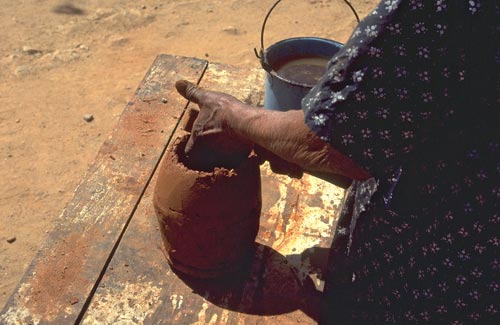
How many years, and pots, had Carmen worked-created at this table?
The clay Carmen uses is this land, Uvalama clay, these potters live at the source of their material. There is no need for electricity. The clay is hand coiled and shaped. It is then fired for nine hours in a wood oven that can reach 1000 degrees C. So simple. So universal. So true.
Prayers of labor, meditations of perfection: each finished pot joins a long procession of pots as the skills, desire and discipline are passed from one generation to another. It is the Mexico way. It is the human way.
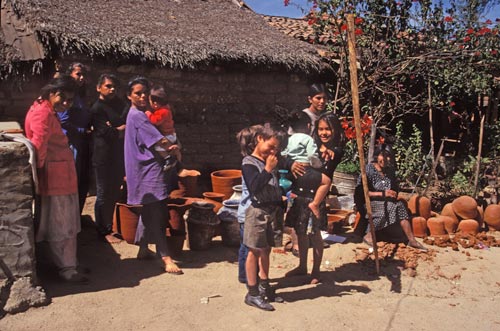
This is a Portillo family portrait from the new Alamos slide scanning effort
One of the reasons I am writing this journal is to identify what slides will be in the next batch of scanned images, and what stories, of the thousand of stories and photos, will need further illumination and illustration. In this spirit, today, I will look for a couple of family portraits of those who posed for my camera on this day in Uvalama. And above is one of these newly processed images. This is a good example of the Journal being a work towards an end.
62… Working in wood is a long standing Alamos tradition …
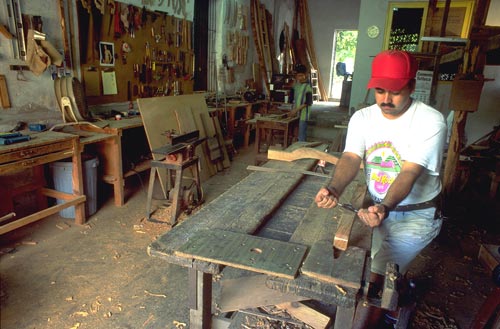
Martin Rosas at work at his families' Carpenteria Rosas.
Martin Servando Roas was a busy man on a mission. He taught carpentry at the elementary- junior high school. He managed the well-laid-out Carpenteria Rosas, off of Calle Galeana, where his brothers Germain and Carlos worked. Martin was involved with the “Hands across the Border” program which took 20 to 40 kids north for two to four days and a Discovery tour program that involved ten adults at a time. He was running a business, hand crafting wood and sharing his experience-skills with the next generations. Martin expressed his faith in Mexico’s future through his strong belief of the necessary good community service provided. As I was leaving Carpenteria Rosas I turned back and saw Martin focused on a project at hand, there was a production schedule to be met.
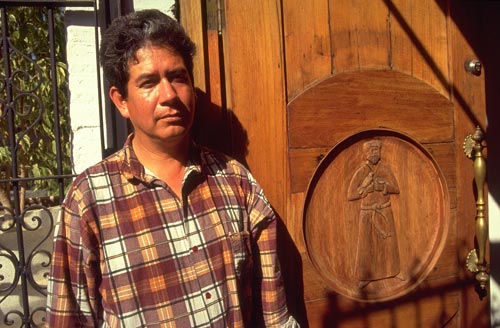
To have a wood door built and carved by Ramon Figueroa was a big deal.
Ramon Nicholas Figueroa Castro was one of the most respected artists-craftsmen in Alamos. Members of the North American community spoke of him in hushed tones reserved for masters and maestros. Any visitor that asked about local creative talent would learn about Ramon and his growing reputation outside of Alamos. Many locals recognized a Ramon carved door as a collectable piece of art, hard to come by for a variety of reasons: he works slow, he is busy with a growing client waiting list, needed materials were hard to find, he is expensive because of his rising profile and, or… If one managed to purchase a Ramon it became the opening to countless conversations.
The Ramon I met was quiet spoken with a soft smile and simple gestures. It seemed he did what he did because it was what he did, there was a simplicity to his movement. Everything else surrounding his work was what other people did because it was what they did. Ramon hoped they would pay him what they had agreed to pay him and he would be left to his work, after-all, it is what he does.
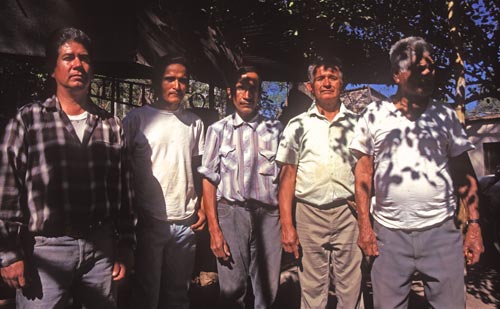
Ramon together with his wood working brothers at their shop.
The brothers Figueroa all worked with wood on their family property on Calle de las Delicias.
Manuel, Wilson, Paul, David and Ramon, not in the other of the above photo, shared a sprawling work space both open air and under roof. There were few walls: nature came in and their wood creations went out. Trees provided shade for craftsmen making tables, chairs, windows, doors… On this day Ramon was finishing a beautiful bureau. Its elegant turnings and graceful details stood out in sharp contrast to the dirt floor.
Art and music is a family thing in Alamos. Many of those around the Figueroa brothers probably will work in wood themselves. The creative skills are past down from father to son, mother to daughter, uncles and aunts to nephews and nieces. As an example, the Quartet de Alamos performed at Casa de los Tesoros for as long as I had known Alamos. On my last visit the bass player’s son was playing bass for Estudiantina de Alamos. I could imagine the son replacing his father in the Quartet, or playing in his own band, someday, somewhere in Alamos or…
61… The man who would be El Presidente becomes El Presidente …

Dr. Joaquin Navarro on steps leading upstairs to his home.
Dr. Joaquin Navarro’s term as Alamos Mayor-El Presidente runs from 2009 to 2012. On this day in 1996, men were in the courtyard-driveway of his home preparing trucks for a political campaign tour of the towns and ranches outside Alamos. The rural population, important votes and a political base for Navarro, was more twice that of the city and any elected Mayor oversees a vast geographical region with its governmental hub being the Palacio. He was in the midst of another run as the PAN mayoral candidate after a close, and contested, defeat in 1994. I wonder if he campaigned every election until he won in 2009. Here is a man who didn’t take no for an answer if he felt it was the wrong answer. His government website
His home-compound was striking. There was nothing like it in Alamos. Light was a dramatic centerpiece no matter where you looked. Outdoors, indoors, living space and work space flowed from one area to another. The orange wall, which today may be covered by ivy, was a modern monumental gesture.

Emiliano, Joaquin, Joaquinto, Luz and Natalay in their sun-drenched living room.
The Navarro family as photographed in late September 1996. Today, Dr. Joaquin Navarro and his wife, Dr. Luz Maria Fernandez, both have General Medicine practices and operate a medivac ambulance service to Tucson. Everyone I spoke with, whether they agreed or disagreed with Joaquin’s political thoughts, had wonderful comments about medical care they received from Dr. Navarro. Joaquin, whose English is excellent, had a friendly demeanor and attentive focus during our conversations, good traits for a doctor, and a politician. When I became ill the first person I contacted was Dr. Navarro’s office. He was’t in and his wife was not available, they were busy in Navajoa giving birth to Joaquinto.

Dr. Navarro at his desk as the opposition's observer in the Palacio.
I spent a summer morning in the Palacio documenting the range of government offices on its two floors surrounding a large courtyard. In each small dark space there were a couple of people at work with occasional typewriter chatter and muffled phone rings. I came upon Dr. Joaquin Navarro, alone, neatly attired, sitting in his office behind a clean desk. He spent time here each working day to monitor what the present government was doing. His presence, in a harmonic way, continued a long standing traditional of Alamos political rivalries and discord. Visit Journal entry #06 Friends, and morning sun, converge outside-inside Palacio Municipal to learn more about events that led to Dr. Navarro and this vigil.

A modern frame for a classical landscape, Anders painting in progress.
This is a painting, soon to be finished, of the dramatic northern wall of Dr. Navarro’s home. Joaquin indicated he was responsible for the design, it spoke of a modern mind.
A time-lapse study of this image, rich shadows racing across the wall as light changed on the scene within the circle, would make a wonderful short film. Today and yesterday are one, together they foretell the future. To see more Anders Alamos artwork visit Alamos paintings .
Return to Journal entries 51-60 or forward to Daily Journal
©2011 Anders Tomlinson, all rights reserved.


