Modern Times and Human Nature
Last modified: April 17, 2012Spanish Conquistadors… 1920 – 2020… Anthropocene… Human populations…
Otra Lado – the border… Cooking fires, mining, El Mirador, gangs, municipal dump.
72… Forces of change challenge human nature at every turn…
Part One of Three on an Eternal Debate.

In days of old, man moved by foot paths through sparsely populated lands.
There was a time and a day that Indigenous people, speaking one of 18 Cahita dialects, were those who knew this land as their own. They numbered 115,000, the largest Indian group in Northern Mexico, and lived along the lower reaches of the Sinaloa, Fuerte, Mayo and Yaqui rivers. The Spanish called these agriculturalist Indians, spread out across the region in small groups, “rancheria people”. They had come from Asia, and possibly Europe, thousands of years ago. We know that those that came from these distant places were in turn descendants of those who started the great human migrations out of Africa and the Middle-east. There is truth in the belief that we are all, under the sun, brothers and sisters. Various cultures and traditions, if they helped people survive, will be adopted by others. This is a hallmark of human nature – adaptability.
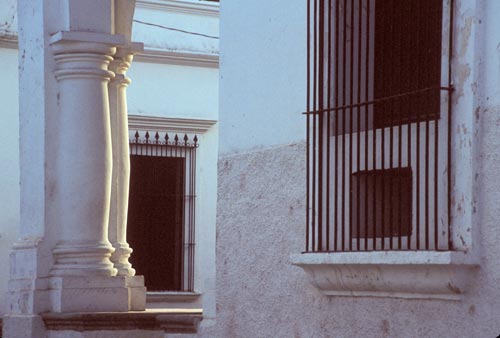
End of day's sun illuminates a classical column of another time and land.
One day the sun came up and menacing rattles of Spanish Conquistador swords, moving fast on old Indian trails, grew louder. December of 1529, Nuno Beltran de Guzman, once a lawyer, led an army of 500 Spanish and 10,000 Tlaxcalans, Aztecs and Tarascans into Sinaloa. March of 1531, Guzman defeated 30,000 Indians in present day Culiacan. Many that survived were captured and enslaved. Later, Guzman’s Amerindian army was wiped out by epidemics and hunger. His was a reign of terror. Spanish colonialization was approaching Alamos.
And then Silver was discovered near Alamos. And the world was attracted by the riches:
miners from Europe, merchants from India, silk makers from Japan, coin makers from China, Philippine sailors and to work the mines: African slaves, local Indigenous people, free mulatos and Indians from other parts of Mexico. Globalization arrived in Alamos.
And the riches brought in the finest goods from around the world. An international settlement was growing along the arroyos. Cultures and traditions blended together as did the people. Apexes of personal consumption were reached by those who could pay the price. The poor observed the rich and knew they were the human engines that made the rich richer. Lessons on modern times were there to be learned and mastered, the art of supply and demand was at hand. Consumerism flourished in Alamos.
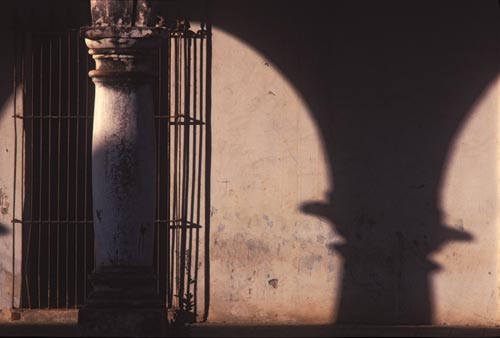
The shadow of Southern Spain spread across Alamos and the Southwest.
Alamos became a valuable resource to fund California coastal settlements along with emerging political movements – militias throughout Sonora and Sinaloa. Alamos was now helping export traditions and customs that not long ago had arrived here.
And then, things change like things do. Much of the International mining community left Alamos for gold and silver discovered in Central California’s Sierra Nevada foothills. Miners come and go to where there is buried treasure and international prices high enough to make mining profitable. Alamos experienced economic fluctuations that is the nature of mining boom towns. Many of these become ghosts towns and others continue on. Some Alamos families faithfully remained and made their livings amongst the aging architecture in a village that was a reduced footprint of its former self. The world had touched them. It could be seen in the art, furniture, books, and music left here and there, and so it was and so it is. Alamos was one of the mining towns that accepted, adapted and continued on. Over the next hundred years Alamos had a couple of small economic upturns and several longer downturns that turned into dust covering ruins of once grand mansions. The silver boom and busts had come and gone.
73… An ethnic accounting, human nature and life in the Southwest…
Part Two of Three on an Eternal Debate.

Roofs collapsed into debris filled patios once filled with laughter and song.
Why did Alamos continue on after the mining bust(s)? There is no simple answer because there are always multiple causations. Here are a couple of my theories. First of all, Alamos was once a huge city that served as a regional center that thousands of people people passed through on their way to settle the southwest. The natural beauty of Alamos was unforgettable, it spoke to many in a clear and convincing voice, “here is a wonderful place, priceless”. Immense silver riches remained in the hands of a few families as they moved away to discover new opportunities. They stayed connected by keeping Alamos property and coming back to visit relatives and, or, sending support. When the mining industry closed down there was still workable land, and water, to raise cattle and crops. Four or five thousand people could get by with what was available. Alamos sustained itself by marshaling its resources, energy and lowering its expectations. Beautiful, historic Alamos was, and is, a survivor.

Life can be reduced to bare essentials and survive with grace and dignity.
400 years earlier there were as many as 115,000 indigenous people in Sonora and Sinaloa. And then a monumental migration began. and continues, as traditions and cultures came and left with each passing day. Spanish colonization had extended to north beyond San Franciso, California. What had been Mexico would become the United States and what was the United States’ would become Mexico’s in more ways than one. This is the essence of human nature: discover resources, adapt, reproduce, accumulate and, sadly, hold grudges. If there is a possibility of making a profit by importing-exporting customs and traditions, here, anywhere, will influence there and there will influence here. And…
Now, we are going to look back at 1920: that year’s census found 275,127 people living in the state of Sonora. 13.8% were of pure indigenous backgrounds, 37,914, of these 6,765 spoke an indigenous language. 40.4% were of mixed backgrounds, 111,089. 41.9% were of white backgrounds, 115,151. The 2000 census indicated that 2,183,108 people were living in 72 municipios, like Alamos, that make up the great state of Sonora. The 2010 census population was 2,662,440, and increase of 480,000 in ten years. Also, 3.9% of Alamos’ population, and 5.9% of Navajoa, are of indigenous backgrounds and across the state 55,609 speak indigenous languages. What will be Sonora’s 2020’s population and where will they be coming from and going to? And what will be the impacts on Alamos?
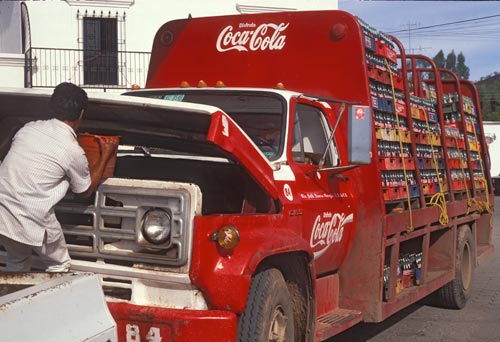
Even Coca-cola trucks get thirsty, and when they do, they drink water.
I have spent various degrees of time in San Diego, Ensenada, Tijuana, El Cajon, Encinitas, Escondido, Los Angeles, Santa Barbara, Monterey, Alamos, Santa Cruz, San Jose and San Francisco. Since the 1950’s, I have lived in neighborhoods along side Mexican-American families, many who did not speak English inside their own homes. I never really knew where the border between USA and Mexico began or stopped, it didn’t seem to matter. Currently, this mixed nation has migrated as far north as Alaska and as far south as Chile. The ever increasing human population is pressured to go somewhere, to do something, to survive.
People, throughout time, have entertained the pros and cons of change. Today, is no different. But there is a difference, the last 200 years has seen a global human population explosion that is expanding change at a exponential rate. The planet reached one billion humans around 1800, six billion in 1999, seven billion in 2011 and… This is change driven by a constant: human nature wants more humans. More humans means more opportunities, more consumers, more taxpayers, more soldiers, more followers and more believers. More and more and more and then…
The planet could care less if humans ultimately over-produce, over-extend, over-consume and experience a population crash by their own hands or natural events with global impact wipe out major population centers. More is less predictable, less has better odds of more sustainability. In summation, change is a product of human nature and population growth.
74… on modern times, anthropocene and human nature…
Part Three of Three on an Eternal Debate.

Old and new as a family walks past the airport towards the campo.
The recently revised U.N. population estimate for 2050 is 9.3 billion people A projection for the USA in 2100 is 478 million. Challenging times are ahead but this is nothing new, survival is challenging for individuals and societies of all species.
Driving across the Mexican Sonoran desert on a star-filled 1984 spring night listening to a Hermosillo rock station’s uninterrupted presentation of Jethro Tull’s Aqualung was the best of two worlds. Music is universal. Friends are universal. Traveling is universal. Being is universal.
In the USA there are 78 million baby boomers aged 45 to 64. This is a force of change. They will go where they can get maximize their resources for survival and comfort. How many will leave the USA for retirement is dependent on the USA’s ability to cope with growing pressures and increasing challenges.

1984, directions and graffiti painted on a school wall along Calle Rosales.
September 1775, De Anza is leaving with a Spanish expedition to create a fort in San Francisco to head off the Russians coming down the west coast. George Washington and his Continental Army have besieged the British in Boston as Colonel Ethan Allen is captured at the Battle of Montreal by the British. Much has happened in the following 236 years leading up to 2011. Some say this is part of a new epoch, the Anthropocene, as human events, consequences of collective actions, alter-change the planet.
Human impact is equal to the population times affluence times technology. Global affluence in 1900 was 2 trillion dollars, 5.3 trillion in 1950 and 55 trillion in 2011. These are all in 1990 dollars. The population in 1900 was 1 billion, 2.4 billion in 1950 and will reach 7 billion in 2011. As for technology, there were 141,000 patents in 1900, 412,000 patents in 1950 and 1.9 million patents in 2011. The growing human biomass is 100x greater than any large animal species that has walked and faced extinction on planet earth. Currently, 65,000 text messages are sent every second. This is the Age of Great Acceleration.
This three part series was prompted by an internet group created in late 2002 for North Americans interested in Alamos. This group, 613 members as of 5-7-11, communicates needs, haves, events, thoughts, desires, alerts, recognitions, questions and answers. Here, at the end of April, 2011 a discussion started about influences that are changing Alamos. It began with a post by a recently arrived American who had started a dance studio in Alamos. She was coordinating a community participation dance, as part of an international event, to Michael Jackson’s Thriller. Another group member responded that this was inappropriate and bad for Alamos. A digital conversation with several North American members began: who is doing what to whom? Why, what, when, where? How?

T-shirts, wearable bumper stickers, make contemporary statements.
A tale of two T-shirts, one celebrates Selena, the Queen of Tejano, born and raised in Texas and a superstar in Spanish speaking countries. Shortly before the release of her first album featuring songs sung in her native language, English, she was murdered by her former manager. The other shirt promotes the American dream, everyone own their own home. Unrelated but related, today, the world’s largest military, and consumer of oil, is the United States. It spends nearly as much on its armies, navies and air power as the entire world collectively. Meanwhile, the Mexican army is engaged in a war with ruthless drug gangs fighting, with weaponry smuggled from the United States, over distribution routes to meet growing heroin, cocaine, meth and pot market demands in places like Fairfield, USA.
5% of the world population speaks English and 5% speaks Spanish. There are 50.5 million Hispanics in the United States, 14 million in California and 4.7 million in Los Angeles County. On Cinco de Mayo, 2011, a presidential commission declared a need for a museum devoted to Latino and American history. A Smithsonian study in 1994 stated that Hispanics were the only major contributor to American civilization not recognized in the museum.

Here is Alamos, east to west, on a spring morning from the north.
At one time, the 1770’s, there were two to three times the population as seen here in 1996 which is half the population of 2011. When I first visited Alamos there was talk of building a freeway from Navajoa through Alamos to El Fuerte and Sinaloan farm land. The United States was interested and engaged because food would arrive in Southern California hours faster. Since I last visited, roads from the west, Navajoa, and southwest, Masiaca, are new or rebuilt. Now it is easier and faster to drive to Alamos if one is headed north or south on the Navajoa-Las Mochis section of Highway 15. Roads are a major stimulus for change – expansion both at the destinations and en-route. Once there was Indian foot paths and then El Camino Real and now improved auto routes to, and through, Alamos. Pave it and they will come.
One can only wonder what the population of Alamos, Sonora, Mexico will be in 2050.
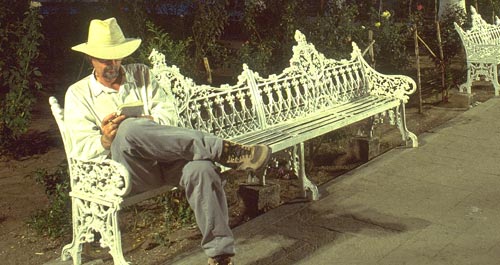
Anders reflects on the day's work notes, photo by Antonio Figueroa.
Human impact on planet earth is equal to population times affluence times technology.
A climate change report commissioned by the Vatican, issued 5-5-11, indicates there are three things we need to do: “reduce worldwide carbon emissions by stopping deforestation and other initiatives: reducing the amount of warming air pollutants such as methane and soot by as much as 50 percent, and preparing for chronic and abrupt changes that cannot be avoided.” No mention of population. It is human nature to promote growing populations, this is a “healthy” economic condition. Cities that grow are doing well, cities that are lose people are doing poorly. New homes being built is good, ghosts towns are sad. This human nature was present yesterday when we lived in caves and present today in urban super-sprawl. And tomorrow?
In my mind, the big issues in the future are women’s role in society, abortion and sex-education. I know these are long standing ideological battles. It is human nature to reproduce to save-replace oneself and the species. We will be dealing with Anthropocene consequences because stopping population growth is the same as trying to stop a super volcano from erupting, or is it?
Human impact, and change, is equal to population times affluence times technology.
55… Talking population: past, present and future…
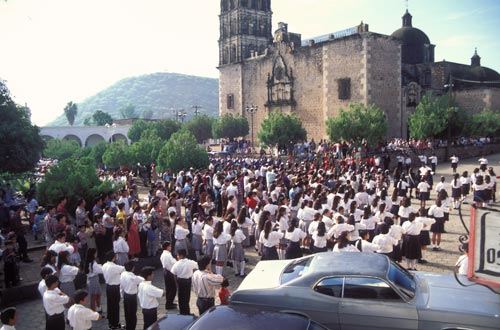
Alamos school kids attend Independence Day celebration in the Plaza.
When I think of Alamos I think of its history and my first question is how many Indians were in the area when Diego de Guzman, nephew of Spanish explorer Cortes, passed through the region in 1533 on well traveled native trails. Mexico’s Indian population was estimated to be as high as 25 million in 1519, most living in the great valley of Mexico. By 1523 the considered Indian population had been reduced to 16.8 million and further cut to 6.3 million by 1548. The Indian population continued to decline in 1580 with a thought of 1.9 million and one million in 1605. If these numbers are any way close to what actually happened they speak of apocalyptic times for Mexico’s Indians.
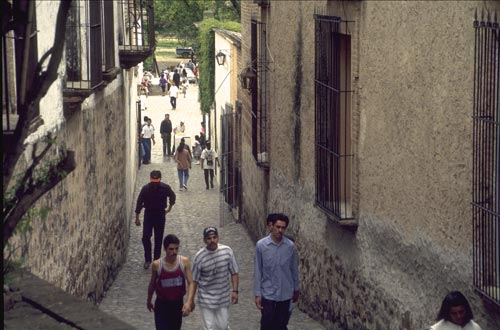
People from many nations have walked, for centuries, on these cobblestones.
The population of Alamos through the years is sketchy at best. The first information I could find was for 1760 when Alamos had an estimated 800 families and a population of 3,400 with 5 – 6 priests. At this time the world’s population was 846 million.
6,000 are estimated to have died from the plague in 1770.
1780 Alamos reaches its largest population, 15,000 to 30,000. Can you imagine what the lifestyles of both rich and poor were in this protected valley at that time?

The stories of population are the stories of birth, migration and death.
Alamos populations fluctuated during the 19th Century as mining and political interests rising rose and fell, came and left.1800, Alamos estimated population was 9,000.
1803, there are some 7,900 folks here.
The world’s population reached one billion by 1804.
1825, Alamos population is an estimated 5,000 to 7,000.
1837, an interestingly specific figure of 2,872 people is noted.
1849, 4,300 inhabitants call Alamos home. At this time many miners have, or are, leaving for the California gold fields.
1850 – 1880, the population apparently remains a steady 5,000.
The first official Mexican census was accomplished in 1895.

Through feast and famine there has been a Sunday promenade in the Plaza.
Here is an outline of the population in 1908: 10,000 for the region. This figure is then broken down to 3,000 in Alamos, 1,000 in Aduana, 1,000 in Navajoa, 1,000 in Promontories, 1,000 in Minas Nuevas and 1,000 in Camoa.
The world’s population reaches two billion in 1927.
The population estimate for the region in 1940, official census count, was 21,477: 11,543 men and 9,835 women. I found another from another source that the population of the city at this time may have been 5,369 hombres and 4,848 mujeres over the age of six.
The world’s population reaches three billion in 1960, four billion in 1974, and five billion in 1987.
The census for 1990 has Alamos with 6.132 inhabitants and a total of 13,000 for the municipality.
The world’s population reaches six billion in 1999 and is forecasted to reach seven billion in 2011.
Today, Alamos population estimates are 13,000 for the city and 30,000 in the municipality.
And here is a thought for the future, the largest migration across the USA – Mexico border may not be south to north, as it has been in the past, but retired baby boomers heading south during the coming decades. Planet Earth is always in motion, always changing.
82… The border between where, who, what and why …
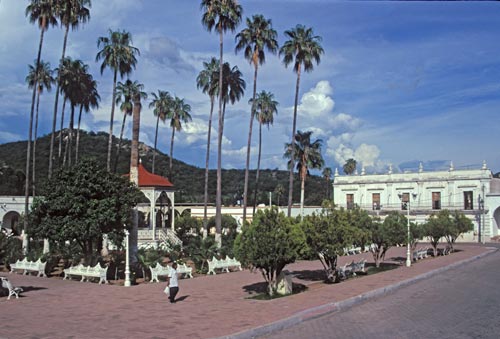
Summer afternoon in the Plaza, two story Hotel Alamos is in the background.
This is a simple moment in a complex world. A woman of Indian blood crosses an empty Plaza as she returns home from her daily shopping trip to the Alameda. The lack of people goes hand in hand with siesta time on a summer afternoon. Stepping back, taking a satellite view, she is surrounded by Sonora, Sinaloa, Chihuahua, Sea of Cortez and not far to the the north, the US – Mexico border. She is in the middle of a violent and costly battle moving drugs across the border to feed growing addictions in the United States: an estimated 660,000 pounds of cocaine, 44,000 pounds of heroin and 220,000 pounds of methamphetamine were sold on America’s streets last year. The first question that comes to my mind is why is there a need by so many addicted people to escape their realities and cross a internal border that has no borders? Why? What would be the Indian woman’s answer to this question?

The Plaza from the Church looking north and beyond to the other side.
The US-Mexico border fortifications have grown over the years: 650 miles of prison grade fencing and sheer concrete walls, 17,600 Border Patrol Agents, 1,200 National Guard soldiers, 165 truck and train x-ray machines, thermal imaging devices that turn night into day, 467 remotely controlled surveillance cameras feeding control bunkers, 4 predator drones overhead – along with helicopters and light aircraft, 10,800 ground sensors and… The border separates families, towns, valleys, histories and futures. Last year 254,000 pounds of cocaine, 3.6 million pounds of marijuana and 4,200 pounds of heroin were captured trying to smuggled across the border. None the less, drug gangs are to have made $25 million dollars last year fulfilling some of America’s many addictions. This is Big Business: an industry of logistics and persuasion serving markets that demands networks and complicated systems to feed its escalating needs. At some level it becomes, “hey, it’s just business – nothing personal.”
There are other costs. On the US side it is estimated that the drug addictions’ health services, interruptions of economic and social progress, crimes and legal systems, jails, court rooms and prisons total $193 billion a year. This is RBB: Really Big Business. Guarding the border over the past decade has cost $90 billion alone, a train x-ray machine costs $1.75 million. Many unsuspecting peace-loving famalies, on both sides of the border, owe their livelihoods, directly or indirectly, to the drug lords, these titans of greed and their investments, corruption and violence. And what is the cost to Mexico? Again the question must be asked, why do so many Americans need drugs to answer their physiological and psychological addictions? Why?
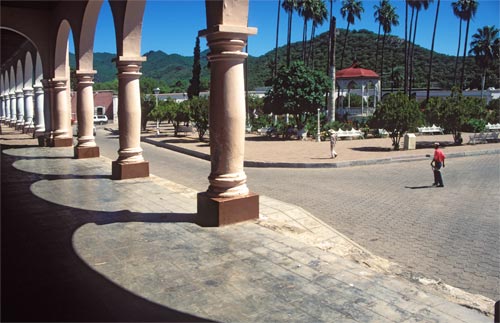
The Plaza framed by a classical world: timeless, enduring, thankful.
The border is many things to many people: It is neighbors, economies, opportunities, sovereignty, entrance, exit, hope, pride, burdens, politics, law enforcement and… Most of the two dozen counties that are on the US side of the border have Hispanic majorities. On one side is San Diego, Yuma, Nogales, El Paso, Del Rio, Laredo… On the other side is Tijuana, Mexicali, Cuidad Juarez, Laredo, Matamoros… On a map it is is hard to tell by place names where the US or Mexico begins. When on the border, the poverty- lack-of-consumerism on the Mexico side is stunning compared to just across the border before, and after, the barriers went up.
Hispanics made up half the USA population growth in the past decade. New York, according to the 2010 census, has 2.3 million Hispanics, Los Angeles – 1.8 million, Houston – 920,000, San Antonio – 840,000, Chicago – 780,000, Phoenix – 590,000, El Paso – 523,000, San Jose – 313,000 and San Diego – 376,000. The USA is turning a little Hispanic. And the southwest, for so long the nation’s frontier and place to go when there was no more room or opportunity back East, was part of New Spain before the United States was the United States. Today, the border region, north to south, from San Francisco to Alamos is its own world, and Hispanic influence is spreading nationwide. Workers, from foreign countries have always made, and make, the USA rich compared to the world. There must be something in the Constitution that supports cheap labor.

A mountain, cathedral, bandstand, hotel and a heartbeat, priceless.
Ten years ago 1.6 million people, without documents, were caught at the border trying to cross into the United States. After 9-11-2001 the concept of secure borders began a national mandate as border fortifications, protection strategies and assets were developed. In 2010, 463,000 souls were apprehended attempting to cross to the “other side”, in many cases to join relatives. There are several causes for the decrease: controlling, with military precision, populated sectors along the 1960 mile border, growing dangers while passing though Mexico from the south, crime against “crossers” at the border, difficulties of crossing in remote mountains and deserts and… And there was the Great Recession that lingers on, the slow moving elephant blocking the way for paying jobs, especially in the construction industry.
The Great Migration across the US – Mexico border has been going on for decades and the economy took advantage of the resulting population increases: more workers, more consumers, more home owners, more citizens, more tax-payers, more possibilities and…
Migration for many species is the meaning of their lives, they are their migration. The history of the United States is one of migration, we are a nation of migrants: Asia, Europe, Africa, Central and South America, Middle East, East to West, South to North, rural to urban, city to suburb and… Migrations into, out-of, up-down and across will continue in search of water, food, resources, work, comfort, security, education, retirement… Migration is the human way. This is true for Vancouver, Chicago, Shanghai, London, Baghdad, Melbourne and Phoenix as well as Alamos, Sonora, Mexico.
Any Politics' continuity most focus on child development to ensure its future
Let us look into the future by understanding today. 45% of children aged 5 to 17 in San Diego County are Hispanic. Baby Boomers, mostly white, in ten to twenty years, will need Hispanics to keep the economy going. And today, the Hispanics kids, who are the majority and in many schools almost all of the student population, need an excellent education to be in the position to function in a productive work force. There will be a huge population, they are already here aging, of Baby Boomers who will need this large trained work force to make their retirements comfortable. The Hispanic school kids need these Baby Boomers to vote, today, for better educational resources. In an era of I, Me and Mine it is nearing a time to consider You, We and Ours. What happens in Los Angeles is important to Alamos, Sonora, Mexico and what happens in Alamos, Sonora, Mexico is important to Los Angeles. It has always been so, and it will always be so, it is the human condition.
Three school girls, good friends – sisters in life, walk across the Plaza and into the future.
94… The day starts off and continues into tomorrow…

Burning wood for cooking and warmth provides comfort on a chillyl morning.
Alamos, at sunrise, seen from Tecolote Hill high up the Sierra de Alamos foothills. Off to the east the Sierra Madre foothills climb into rising mountains and plunging canyons. The gauss like smoke blanket over town will linger through the early morning stillness and move off with the first breezes. One can hear the church bells ringing from this vantage point and an occasional loud vehicle. other than that it is the sounds of insects and cold air turning warm. I wonder how many people have shared this view over the centuries and eons. This up close and personal view of Alamos was made possible with a 800mm lens.

A proud sign marks an intersection-entrance into Alamos from the southeast
The sign says it all: Sonora is Mexico’s premier copper producer and second in gold. Mexico, overall, is rich in natural resources. It is the world’s second largest silver producer and eleventh in copper production. Alamos is seven kilometers east of the historic Aduana and Minas Nuevas mines which produced some 40 million ounces of silver. Alamos is what it is today because of the silver from nearby mining camps that began over 400 years ago.
Today Alamos is surrounded by mining interests. 21 kilometers to the north-northwest is Frontera Copper Corporation’s Piedras Verdes open-pit, heap leaching copper mine.
40 kilometers to the south-east Pan American Sliver began construction in
April 2005 of its open pit Alamo Dorado silver mine. In 2010, according to their website this mine produced 16,749 ounces of gold and 6,721,358 silver ounces.
7 kilometers to the west Silver Pursuit Resources is exploring silver mining options at the historic La Quintera Project.
When I was last in Alamos, 1997, there was no actual mining in the region. There was talk that someday mines might reopen if the global prices were right. If one stood by this sign long enough it is possible one would see a municipal garbage truck coming from town and headed south to the dump, following the direction of the truck in the photo along the El Camino Real.

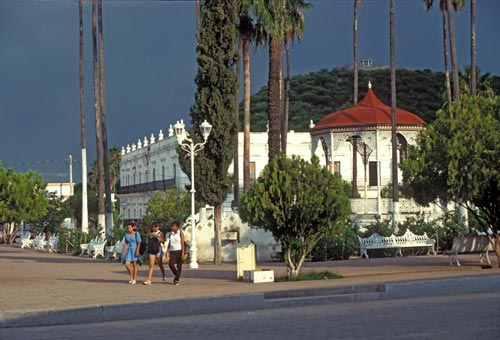
It is a fine day in the Plaza. The town is alive with the sounds of summer.
Plaza de las Armas on a brillant summer day in the Cuidad de los Portales. The Plaza is bewteen Juarez and Victoria streets, on the corner of Cardenas street. The Moorish style bandstand came in 1904 from Mazatlan. Bishop Reyes Cathedral, or Cathedral of Our Lady of Conception, was built between 1786 and 1804. Alamos is considered by many, thanks to the skills of.early architects from Andulusia, Spain, as being the most colonial city in Mexico.
The Plaza, with the church, Museo Costumbrista de Sonora, hotels, tourist office, convent, Alamos Hotel Ruin, bank, juke box, art gallery and private homes was the center of social activities. surrounded by buildings of culural and historic importance.

If you can clearly see the Mirador the Mirador can clearly see you.
The old days are always with Alamos, Sonora, Mexico, they are in the details, textures and patinas. They can be seen in the work that has been done over and over throughout the years. East of the Plaza, rises Cerro del Perico, hill of the parrots, and the inspiring 360 degree panorama from El Mirador, the Viewpoint. The Mirador provides an understanding of where one is when they visit, or live, in Alamos, Sonora, Mexico.

The trash container near the top of Mirador's wonderful 360 degree view
It would be hard to miss this trash enclosure as you go up the road to the top. One fine 1993 winter evening Anders conducted an informal poll with a small group of young school girls taking in El Mirador vistas. The question was what did they want to do in the future? They giggled and answered mafia wifes. A fringe benefit of being a mafia wife, they thought, was that their husbands most likely would die young and the gangs was obligated to take care of the widows for life. These were the days that the drug gangs did not show up the government. They had a place, their place. They were there, certainly not invisible, but ignored if they stayed out of the headlines. As contextual background for this story, in 1996 the Alamos police chief, a retired Sonora State highway patrolman, proudly told me Alamos had the lowest crime rate in Sonora.
Ramon Salazar, raised in Alamos, was a big gangster in the region at this time. I was told he was involved with marijuana and his soon to be wife, Poppy, was involved with opium. Their large wedding reception was held at the old Alamos Hotel, on the Plaza, during the 1993 Christmas holidays. A large big band was hired and arrived from Mazatlan in their painted bus with sparkling sequin-studded band uniforms and bright shiny instruments. A couple of our film crew dropped in, and filmed a couple of songs, at the reception. Later, I heard Ramon skipped payment on the band, hotel and beer. And that was that. What are you going to do?
Ramon Salazar died a couple of years later traveling with his mother and brother on a back country road near the Sonora capital of Hermosillo. After being shot, Salazar got out of his car and walked towards the police with one of his arms blown away. The police asked if he was spending lots of money. Salazar asked them to ” end me now”. They did. He died, of seven gunshot wounds, in his mother’s arms. He is buried in the Alamos cemetery. There was probably a song written about the life and times of Ramon Salazar. What is, and what was, depends on circumstances, times, places, relationships and everything moves and changes with the winds of history.

The Municipal dump is a short distance to the southeast of Alamos.
One can tell much about a civilization by examining its dump. During the summer, Antonio Figuerroa and I walked to the Asoc. Ganadera local de Alamos building next to Pemex gas station off the Alameda.. Here Ernesto Alcorn, a veterinarian and ranching association officer, had his office. We hopped in his small pickup and headed for the dump. Soon we were headed south of town driving on the dirt old El Camino Real. Antonio and Ernesto wanted to make a video about the dump and its black water that reaches the Cuchujaqui River. Their goal was to send the video to a Mexican TV channel contest. The winner would receive a video camera, VCR and TV set. Both young men were concerned about the dump’s environmental impacts and wanted to bring attention to its condition.
I wonder about the dump today. I went on the internet to find any current information. There wasn’t any. But in the search I came across a book by David Yetman, Sonora, an Intimate Georaphy, which begins with a 24 page chapter, Alamos. The opening sentence is “Go see see Alamos, David, there’s no goddamn place like it.” The 264 page book was published November 1, 1999 by University of New Mexico Press. I enjoyed visiting Alamos through David Yetman’s experiences.

Down in the valley Alamos begins another day in the circle of life.
The smoldering dump, directly above El Mirador, can be seen tucked up against a distant foothill. Its smoke plume, for the moment, is headed in a south-easterly direction. On the hike to this vantage point we followed two men and a supply loaded burro. They were headed to their mining interest. At a fork in the trail we went left where they had went right. The quiet became louder.

Journal entries 71 – 80… Summer rains… four Almada women… Nuzum rooftop garden… Jacoby gardens & tequila… Plaza kiosk-bandstand… traveling hypnotist… anthropocene & human nature… ethnic accounting… Spanish Conquistadors… and Pueblo Magico….
Journal entries 61 – 70… Beisbol, rodeo and dancing horses… Estancia Crysalis… Pemex… kids in the summer… painting the Mercado… kids at night… two churches, two men, two bells… Uvalama pottery family… woodworkers… and Dr. Joaquin Navarro…
Journal entries 51 – 60… Security devices… dry tropical forest… good cop, bad cop… Sadnah and San… Doug Riseborough… population history… ode to the “mother range””… human condition, Hotel La Posada,… Los Tianguis… and reflections from high ground…
Journal entries 11 – 20 … Windows treatments… cats, sheep… Bishop Reyes Cathedral… summer floods… fiber optics and Mexican mechanics… Estudiantina de Alamos… Aduana… Pantheon… peeling paint… and a tale of two seasons…
Journal entries 1 – 10 … Middle school and Independence celebration… youth church choir…
making adobe bricks… crucifixion… workers… curio shops… men on ladders… umbrellas… Plaza de las Armas… Palacio… old train tunnel… and jumping beans…
©2012 Anders Tomlinson, all rights reserved.


