Calimaya Meets Coronado
Last modified: February 13, 2014Back before there as an Old West
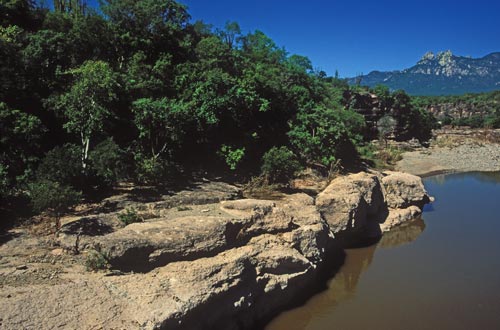
Looking west, explorer Coronado was struck by this mountain and landscape.
Tucked away in a picturesque valley in the foothills of the Sierra Madre is an enchanted Shangri-La that sings of other eras. Indians called this region Calimaya long before Spanish Explorer Vasquez de Coronado noted in 1540, ” here is something special…”
The Spaniards called this land Real de los Frailes because of some tall white rocks resembling hooded monks overlooking a small Indian village shaded by cottonwoods. This is Alamos, Sonora, Mexico.
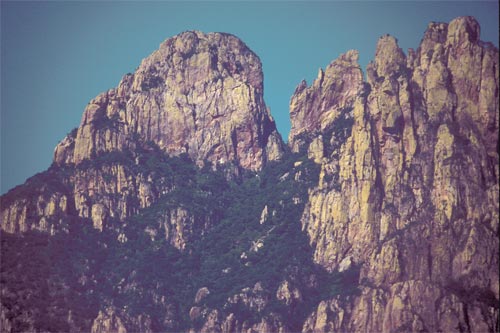
These towering rocks speak loudly. They call for, and command, our attention.
In 1683, 143 years after Coronado, two abundant veins of silver were discovered seven miles to the west of present day Alamos. The mines of Aduana and Minas Nuevas, in a zone 4.5 by 1.5 miles, produced an estimated $100,000,000 in 1910 dollars.
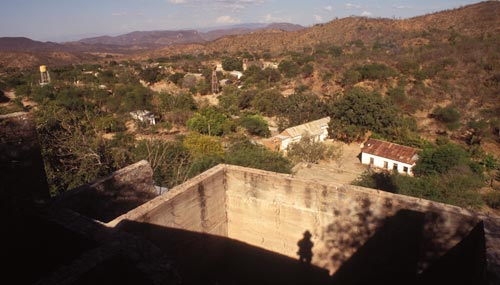
Aduana is now a sleepy little village amid silver mine ruins.
Soon, Alamos, Sonora, Mexico was the richest and most important city on the El Camino Real. Juan de Anza departed Alamos in September 1775 with local families and freshly mined silver to settle San Francisco. Alamos money and citizens were also vital for expeditions that settled Monterey, Santa Barbara and five years later, Los Angeles. Father Kino used the Royal treasury to finance a chain of missions in northern Sonora and southern Arizona. The Bishop and Governor resided in Alamos, as did the first high school, printing press and newspaper and important trading center.

A bird-eyes view of Plaza de Las Armas as seen from Mirador.
The lure of silver brought international miners from Europe and other continents. On the Sea of Cortez galleons from Asia, Phillipines and Europe called on the port of Huatabampo loaded with cargo, a week by burro from Alamos. They brought luxuries such as silk and satin and the world’s finest furniture. Opera Companies visited. China minted coins here. Merchants came from India and Japanese supervised a silk factory. The indigenous population included Mayos, Yaquis, and Tarahumaras. Hordes of miners and traders, who endured great hardships in their travels, overran Alamos.
As many as 30,000 people made Alamos their home during the peak of its glory in the 18th century. Here, new Spain was pomp and circumstance with a beautiful Church, grand haciendas built in the style of Andalusia, Spain, flower-filled patios, romantic serenades, elegant carriages, flourishing commerce, and mines that ranked amongst the most productive in the world.
Here was Silver
Here, seven miles west of Alamos, at 2,500 feet elevation with surrounding mountains as high as 4,700 feet, Aduana has a few hundred people where once there was 5,000. A church, country store, cemetery, a small restaurant-inn, a plaza with a dry fountain in its center are surrounded by the past. Spanish conquistador Vasquez de Coronado camped here during the winter of 1540-41. He was searching for gold in what turned out to be mountains with veins of silver. The mines closed in 1906 after nearly 400 years of continuous mining. La Aduana was the “custom office”, it was all about taxes and royalties.
View from Above
Mt. Alamos is some 6,500 feet above sea level. It towers 5,000 feet above the town of Alamos. It is another world, wild parrots, dry tropical forest, granite and… Up and down is a day’s effort, it is well worth it. To reach the top it is recommended to start hiking early while it is still dark and cool.
Bishop Reyes Cathedral
Bishop Reyes’ Cathedral takes up the entire southern side of the Plaza de las Armas. Its three tiered belfry towers above town and touches low passing clouds. Along with multiple daily services the church is also a religious classroom. Religion speaks of yesterdays, todays, and tomorrows. It speaks of better days and better places. Religious followers are asked to endure and conceptually, eventually, benefit from their days of survival and struggle on this small planet.
To see more Alamos Journal pages.
To return Home.
©2013 Anders Tomlinson, all rights reserved.


