Gardens and Giving Ground
Last modified: April 17, 2012Flower details… executive control system… Rancho El Palomar… rooftop gardens…
Christina Vega… Judith Jacoby garden… Roberto’s Casa Obregon 18…
2 Calle Comercio garden… Pember Nuzum music…
83… Life’s details float away like flower petals on a breeze…

There are many reasons why North Americans have chosen to call Alamos home.
One of the healthy aspects of living in Alamos, or anywhere, for bilingual speakers is the byproduct of using two, or more, languages on a consistent basis. The Executive Control System of the brain manages information while focusing on what is relevant at the moment and discarding unnecessary distractions.
“Bilinguals manifest a cognitive system with the ability to attend to important information and ignore the less important,” Ellen Bialystock, cognitive neuroscientist.

With all that can be seen the focus turns to a summer blooming vine.
Every time a bilingual speaks, both languages popup and the executive control system determines what is relevant and how to respond. This process rewires the brain. In a study of 400 Alzheimer patients, bilinguals, on average, show symptoms five or six years later. The bilingual can cope with the disease longer. When one actively uses two languages they are performing healthy brain calisthenics. All in a day for bilingual ex-patriots.
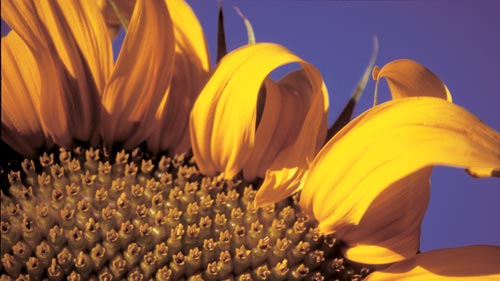
Unfolding miracles are there to be seen in the exquisite detail of living matter.
Alamos, Sonora, Mexico is a wonderful place for native English speakers to exercise a second language, Spanish, as they go about their daily routines. It is also beneficial for their native Spanish speaking neighbors and friends to use English whenever the opportunity arises. During my stays several residents saw me as someone they could practice their English with, or on. They were extending their English vocabularies by speaking and listening. I took part in some very entertaining, and humorous, conversations when the languages became intermixed: juxtaposed meanings, mutated intents and convoluted requests. The art of verbal communication is a forgiving trial by fire for burgeoning bilinguals. Where there is a word, or gesture, there is a will, or connection.
89… Life in the country, life in the old world…

One's world changes depending on where they are in Alamos at that moment.
Flora, fauna, sounds and smells vary as one travels through the barrios, hills, arroyos and surrounding mountains. This is a gentle land that has moments where the forces of nature can change the landscape in an instant. All roads lead somewhere if nothing more than to an end. The road to El Palomar Guest Ranch introduces one to hosts Felipe and Cherisse Acosta, their family and staff. Felipe- sportsman, cattle rancher, wildlife enthusiast, naturalist- shares his enjoyment and skills for bird hunting, fly fishing and horseback riding. Cherisse is a wonderful chef, certified yoga instructor and mountain biker and all-around cowgirl. Both are fluent in English and Spanish. At the end of the road, Rancho El Palomar offers stress-free sanctuary and Sonoran serenity with lodging for 12. Each room has its own fireplace and bathroom. Wakeup to fresh brewed coffee.

Rancho El Palomar Guest Ranch is three miles west of Alamos.
Rancho El Palomar, three miles – 15 minutes west of Alamos, sits on 1200 acres that were originally a land grant to the Acosta family in the 1700’s. In the 1960’s the main ranch house with bricks formed and fired on the ranch. Mexico Norte, a well-known Mexican film was shot in 1976 on the ranch. Here are 360 degree views of Sierra Madre mountain range to the east, all-surrounding foothills, Cacharamba to the west and Sierra de Alamos to the south. Here is a place to watch a moonrise and connect with all things natural. The hunting season runs from the first week in November to the first week of March.

ooAHH cooo coo coo is a serene song sung by the mourning dove
The grounds surrounding Rancho El Palomar include citrus orchards, a large patio, pool, echo cactus, tropical flower gardens and mesquite trees. There are miles of horseback riding, horses are available, hiking and biking trails to explore on the 1200 acre ranch with mountains, canyons, and grassy fields. There are guides available to take one off the beaten path.
Rancho El Palomar has a well earned reputation as one of the best dove hunting areas. Felipe has hunting grounds throughout the region, so there’s lots of variety. The Sonoran hunting season begins in the first week of November and runs to the first week of March. Speaking of birds, Alamos in the foothills of the mountains between the deserts to the north and the tropical areas to the south is a fantastic bird watching area. At the rend of the road there are opportunities for activities, enjoyment and relaxation. Away from town, life in the gentle valleys and rugged canyons is a step further back in time. It is a place where time is measured by sunrises and sunsets. “ooAHH cooo coo coo”… “ooAHH cooo coo coo”… “ooAHH cooo coo coo”…
For more information visit Rancho El Palomar website.
78… A rooftop that lives and breath all things Alamos…
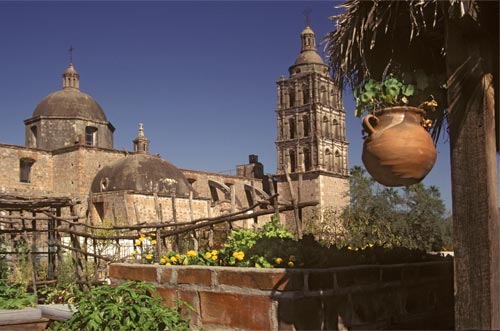
Elizabeth Nuzum's garden across the street from Bishop Reyes Cathedral.
Here, in the shadow of cathedral bells and angelic choirs was a multi-purpose rooftop garden. A narrow wrought iron caracol, snail, spiral staircase led one up from a back patio with a small pool to an expansive array of raised planter boxes. Elizabeth Nuzum enjoyed people, her home, her gardens and life in Alamos. For many, her husband Pember and Elizabeth were Alamos greeters, welcoming visitors inside the old wood doors on Calle Comercio. Elizabeth designed and managed her gardens while Pember kept an eye on the household finances.
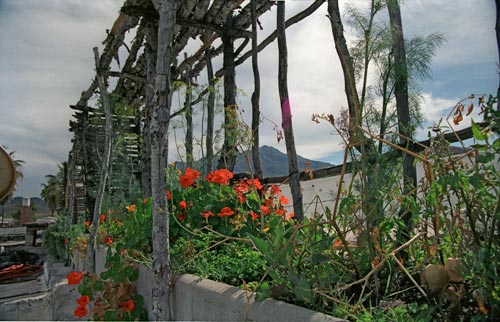
20 feet above the street one can hold a conversation with passing clouds.
The roof top garden and its 360 degree views was a special place. The sky at night, with stars there to be touched while one laid back on a substantial Sonoran cot, was a connection to all things in all places. Rooftop eavesdropping on the comings and goings along Calle Comercio and Calle Guadaloupe Victoria tuned one in with the heartbeats of Alamos: Bishop Reyes Cathedral, Palacio, Plaza de Las Armas, Mercado, all points of the compass and all events past and present.
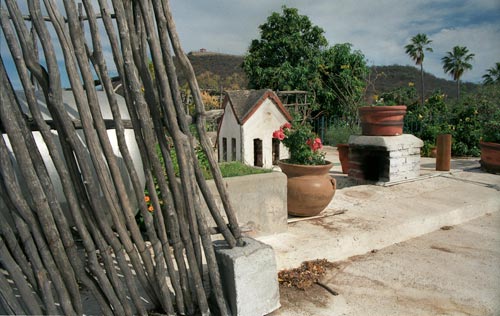
Mirador voices, at times, arrived here with a favorable wind.
Let me count the sounds I heard up on the roof: uniformed school kids walking in groups, talking, laughing, singing, stepping off rhythms, kicking balls, kids being all things kids. Occasional horse hoofs echoing on cobblestone streets. Music from rattling car and truck radios ricocheting off narrow streets. Surround sound bird songs and calls punctuated by barking dogs, working hammer and saws and distant braying burros. All combinations of people passing by: one, two, or three generations together talking, workers, errand runners, neighbors en-route to visit neighbors or hang out in the Plaza, shop at the Alameda and Mercado or attend to business at the Palacio or… This garden overlooked the center of Centro Alamos’ rainbow of expression: joy, surprise, acceptance, expectations, anger, yearning, anticipation. greetings, farewells…
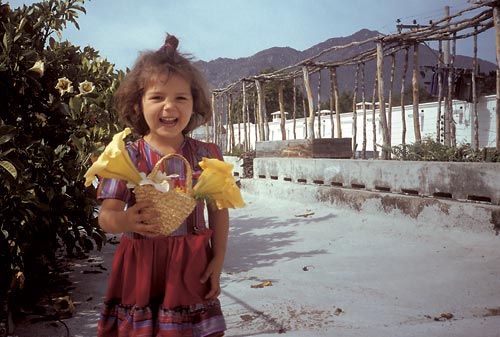
A young girl picks flowers on the roof, a simple moment, a simple smile.
Christina Vega, daughter of Chacho and Cammie, sister of Gaspar, walked in all worlds Alamos. Her Mexican blood was Chaco’s large family and her American blood was Cammie’s parents Elizabeth and Pember and brother Kit who came to visit from his world travels. Cammie and Chacho lived modestly on Calle Ninos Heroes, a short walk from the grand roof top garden on the the other side of Guadaloupe Hill.
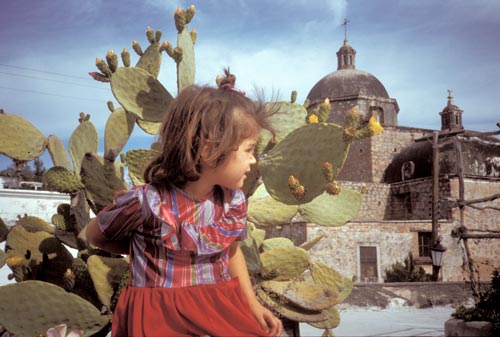
What does Christina see, and hear, on this spring day in 1984?
The roof’s northwest corner, with a view into the Plaza and Gazebo, was across the street from the bank. At opening time a line of people would be waiting sharing conversation. Daily masses brought people to the church’s eastern door. Funerals processions would leave the church and passed by as they headed east to the Panteon – Cemetery. Police headquarters, at times busy, were three houses to the east on Calle Comercio. Tourists speaking English, French, German and other languages would stop and chat as they headed to and from surrounding lodging. At night, one could listen to quitar playing coming from Polos restaurant’s kitchen as well as the Estudiantina practicing at the Museum. At this moment Christina is listening to the public serenade that is Alamos.
77… A garden that fills the land with grace and majesty…

A tale of two sides of a fence, one managed by Judith Jacoby and the other?
I remember Judith Jacoby as a charming graceful petite woman. On each side of her house were gardens taking advantage of what was there before, or left behind, and drawing inspiration from the landscape backdrops; Sierra de Alamos to the south, Cerro Cacharamba to the west, the northern mountain ridges and a long formal drive way in from the town to the east. I am sure she knew every inch of this land.

Jacoby gardens' design, detail and power to transport one to another place.
When I visited Mrs. Jacoby she was there by herself, a captain maintaining a property that was her ship on the vast Sonoran way of life. She would ask me what I knew, knowing that all I did was walk. look and listen with cameras in hand. She would intently attend my interpretation of events, rarely commenting other than a nod of her head or small smile. At the time, she must have had the largest Alamos garden in acreage. Laid out on what was once a tequila factory warehouse, the gardens, with wild lands on the other side of tall walls, were always ready for presentation as if today there was to be a party.

Here is variety, scale, year-round color, pride, love and stewardship.
Knowing the human condition there is a good chance the original tequila factory was successful. Men have long sought distilled drink for company. And in the mining days of Alamos there was a large population of hard working men, certainly there was a need for tequila. Questions rise: how many gallons were produced yearly and when was the height of production?… how far was it exported – did bottles make their way to San Francisco, Mexico City or Europe?… what did the bottles look like?… was all the agave grown locally?… how many workers were involved?… was this a profitable enterprise for the Urrea family?… were these the tequila makers that had a ranch near the top of Sierra de Alamos?.. and?
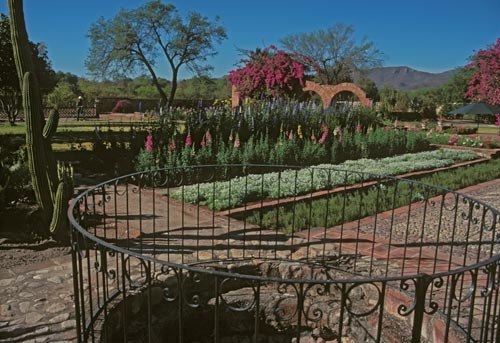
Was tequila stored underground in these large brick clad chambers?
The Aztecs made a fermented drink from agave. After their arrival in the 1500’s Spanish Conquistadors created, when their brandy ran out, the first North American distilled drink from the agave and tequila was born. Alamos is at the northern edge of Mexican agave production. In 1944, Mexico declared that tequila could only be produced in the state of Jalisco and certain areas in Guanajuato, Michoacan, Nayarit and Tamaulipas. The agave plant is related to the lilly and amarylilis and is considered a succulent. A healthy drink, pulque, rich in nutrients and vitamins, is made from the plant. Stringy fibers from the long leaves were woven into clothing, mats, rope and paper. The tequila ruins-history of Jacoby gardens became elements anchoring views, drawing the visitor into an enchanted landscape. Were there gardens here when the Urrea family lived on, and or, worked this land? The answers to all our questions are blowing in the wind.
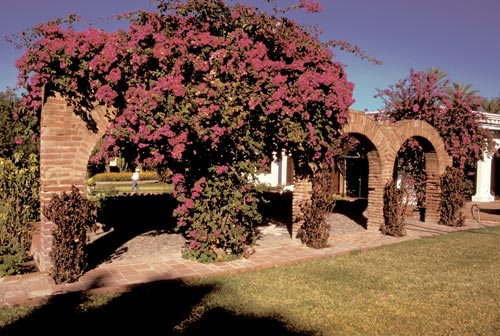
Ruins covered with climbing bougainvillea brilliant with cascading flowers.
Are these gardens in the same magnificent state as they were when I visited? Judith Jacoby has passed on. What I saw was the product of her imagination and discipline. It takes a leader to oversee and maintain gardens at this level of grandeur. That visionary was Judith Jacoby. She touched the land and the land responded.
38 … A fanciful garden in Alamos, where art, humans and flora-fauna coexist as one …

The hanging address sculpture says it all - through this door expect the unexpected.
Welcome to Casa Obregon 18, now known as Casa Roberto. It is mid-morning on a cloud free summer day. I will meet the owner, Roberto, for a cup of coffee, and then photograph his yard.

Meet Roberto and his trained parrot sitting on his shoulder or is that a...
I did not know much about Roberto. I was told he came to Alamos with a back pack and stayed to be the hotel Casa de los Tesoros’ cook. After many years at the hotel Roberto took ownership of Casa Obregon 18 and began his creative adventure. As we sat talking in the sala we were surrounded by Roberto’s mosaic paintings. Our conversation was interrupted by a couple of phone calls. It sounded like they were October room reservations. And then he was gone to oversee work taking place in one of his two garages. Roberto seemed to have time only for things that would benefit Roberto, time management is an excellent small business tool. I was left alone to wander through the courtyards.

O.K. We have arrived in Robertoland and there are no lines to wait in..
Casa Obregon, a colonial mansion on hotel row, was built in 1800, and written about in Ida Luis Franklin’s book, Ghosts of Alamos.
The Inn is 4,000 square feet with four bedrooms and four baths. And then there are the yards. Everywhere you look the unexpected appears, lurking or jumping out at you. The checkerboard lawn, with squares made of brick and alternating grass, is a page from Roberto in Wonderland.

The fountain is dry. A broken pipe has cut off water to Centro Alamos.
This was the third day of no water to central downtown east of the Church. It would be another two days before service was be restored. Today, 2011, Casa Roberto is for sale. The gardens, colors, sculptures and eccentric design can be yours for $550,000 USD. Ghosts are included – free of charge.
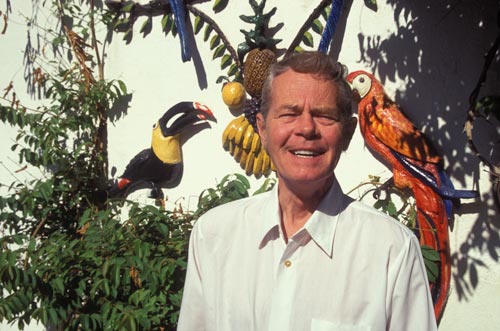
Roberto in between two of his birds of art serenading one another.
It was easy for Roberto to take a moment and flash a big smile for my camera and then go on his way, managing another day, talking to himself under his breath.
26 … Learning what, how, when and why all these plants and trees grow.

As close as one looks there is always more to see.
Gardening and passion are one in the same for many that embark on horticultural adventures in Alamos. There are right ways, wrong ways, and the ways of trial and error. There are friends, neighbors, hired help, books and the internet to help one plant, raise and blossom. It is about design, texture, color, creating and life itself.
It is better to have planted and lost than never planted at all.
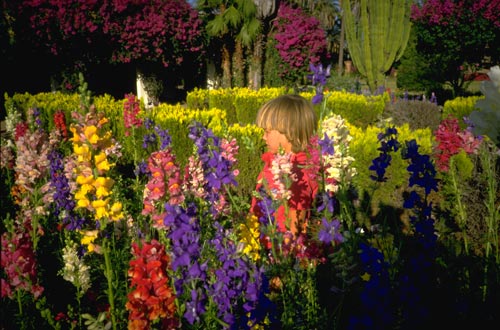
There are gardens and there are gardens and there was the Jacoby gardens.
I took this photo of Judith Jacoby’s gardens in 1983 with Gaspar Vega standing amongst an explosion of spring blooms. This property was once a tequila factory warehouse owned by the Urrea family. The many Jacoby gardens start in court yards surrounding the house and spread out into large open areas. These are formal gardens set in a landscape that changes dramatically with the seasons. I will return to further explore her gardens in future posts. Gardens, in general, provide Alamos, hopefully, controlled splashes of color.
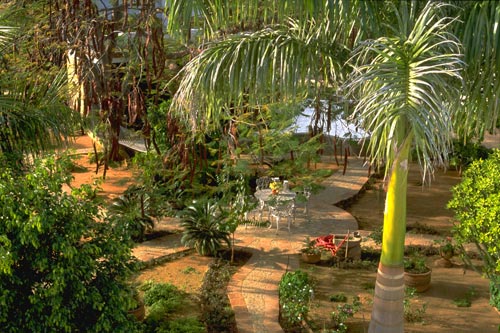
Gardens come in many colors, sizes, budgets, time commitments and intents.
The flora of Alamos is the many splendors of Sinaloan tropical forest and Sonoran desert living together in unexpected harmony. Many properties have gardeners watering, pruning, consulting, planting, cutting, raking, commiserating, trimming and… year round. Flowers and vegetables are planted in November for winter blooms and crops that last until May or June’s heat… Mangos, papayas, bananas, palms, amapas, orchidias and other trees provide food and shelter for native and migrating birds. Cascades of colors come from flowering vines: blue veracruzana, orange trumpet, red, magenta and orange bougainvilla and… And the smells and scents that envelope one’s senses… Formal, informal… it all contributes to this symphony and riot that is the passing seasons in Alamos, Sonora, Mexico.
Behold a Cornucopia of Color, Shapes, Textures and Scents.
Alamos has six seasons a year and a diversity of native and imported flora. Gardening is both a passion and industry. It can become all consuming. It can be an mental oasis, freedom from the outside world’s cares and concerns. And it is something to share with those who visit, be it bug, bird, mammal or human. Video…
25… Location, location, location: there are places that are more than places.

The morning begins with seeing where we will be in a couple of hours.
Today, summer of 1996, would start with a hike to the top of Tecolete Hill, seen here sun capped. Sierra de Alamos rises up in the background. We are at El Pedgral standing near a beautiful palapa, the first structure Elizabeth Nuzum built after buying three acres outside of Alamos to the west. This was her project, her dream to bring art, community and nature together under the out stretched limbs of a magnificent fig tree. She would sell the property to Jennifer and David MacKay in 2005. They added another 17 acres to what is now El Pedegral Nature Lodge and Retreat Center. One of my twelve Alamos short stories will be about how Elizabeth’s strawbale studio was originally painted with a palette of color made from dirt in the surrounding hills.
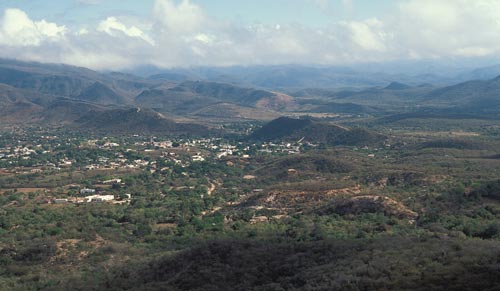
And here we are. It is wise to climb with morning coolness.
Two hours later, after a relaxed hike, we were breathing in mentholated vistas east and north. And there is Alamos, Sonora, Mexico, seen for what it is, a village on the pathway to tomorrow. And directly below, in the overgrown seasonal jungle, there is El Pedregal, “place of rocky terrain“. Off to the right, there are rainbow veins of colors that abstractly paint the ground: orange, green, blue, yellow, grey, white, ochre…

Natural elements comforts the city soul across the street from the Cathedral.
Pember and Elizabeth Nuzum lived on Calle Comercio off the Plaza de las Armas. This is the center of town and visitors came from around the world and from different times, like myself. El Pedregal was Elizabeth’s Shangri-La. Here, she visualized and directed the effort to accomplish what could be. The Nuzums, like many of the North American community, were involved with the daily fabric of Alamos life. Their house help and workers became extended family, each casa a little village unto its own. From here, behind these walls, Elizabeth conjured a new frontier and blazed a trail that included landscaping, constructing and crafting her El Pedregal. These dreams are shared by many in Alamos, be it envisioning a new wall, choosing and planting a plant, determining a color, supporting a civic interesting, developing and sustaining a community project…
Alamos, Sonora, Mexico is a place for being.
Pember told Anders, “always call us Alamos, Sonora, Mexico.” And Anders has.
Pember and Elizabeth Nuzum were a major part of the North American Community for decades. Their casa next to the Church on Calle Comercio #2 greeted many who visited Alamos, including Anders. It is not uncommon to have rain squalls in December. And it was common to hear Pember playing his theater organ in the Nuzum music room. Those days are gone. But the spirit lingers, it always does. Video…

Journal entries 71 – 80… Summer rains… four Almada women… Nuzum rooftop garden… Jacoby gardens & tequila… Plaza kiosk-bandstand… traveling hypnotist… anthropocene & human nature… ethnic accounting… Spanish Conquistadors… and Pueblo Magico….
Journal entries 61 – 70… Beisbol, rodeo and dancing horses… Estancia Crysalis… Pemex… kids in the summer… painting the Mercado… kids at night… two churches, two men, two bells… Uvalama pottery family… woodworkers… and Dr. Joaquin Navarro…
Journal entries 51 – 60… Security devices… dry tropical forest… good cop, bad cop… Sadnah and San… Doug Riseborough… population history… ode to the “mother range””… human condition, Hotel La Posada,… Los Tianguis… and reflections from high ground…
Journal entries 11 – 20 … Windows treatments… cats, sheep… Bishop Reyes Cathedral… summer floods… fiber optics and Mexican mechanics… Estudiantina de Alamos… Aduana… Pantheon… peeling paint… and a tale of two seasons…
Journal entries 1 – 10 … Middle school and Independence celebration… youth church choir…
making adobe bricks… crucifixion… workers… curio shops… men on ladders… umbrellas… Plaza de las Armas… Palacio… old train tunnel… and jumping beans…
©2012 Anders Tomlinson, all rights reserved.


