El Pedregal

99… Elizabeth’s experimental place – garden, El Pedregal… first of two parts…
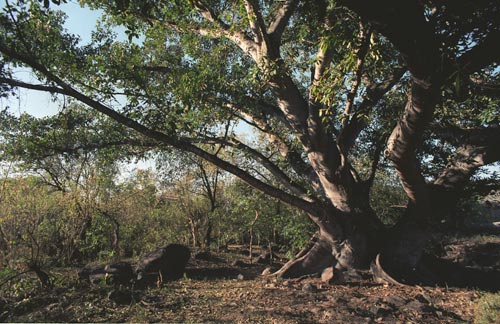
Big Fig tree at the Pedregal, Alamos, Sonora, Mexico. Photo by Anders Tomlinson.

In a magnificent setting there is this fig tree to admire and celebrate.

Pember and Elizabeth Nuzum owned a lot off a dirt road in the Chaleton area, place of the fig trees, west of Alamos. They planned to built a tennis court on it. One day Elizabeth traveled further west on the road and came across this fig tree. It was love at first site. She coaxed Pember into selling their lot, and it sold unexpectedly quickly. Elizabeth, on her own, purchased the undeveloped three acres with the fig tree from Martha and Al Haywood. Elizabeth christen the property El Pedregal, the stoney place. This was her project, her experimental place to build and plant what she wanted. It was her dream to bring art, community and nature together under the out-stretched limbs of a magnificent fig tree.

El Pedregal's front gate, Alamos, Sonora, Mexico. Alamos, Sonora, Mexico. Photo by Anders Tomlinson.

Elizabeth loved her big green door that was El Pedregal's entrance.

The first thing Elizabeth did at El Pedregal was build a meandering road leading through and around the property to the fig tree. The heavy green gates at Pedregal’s entrance, where the public dirt road comes to its end, were made from old doors Elizabeth collected in town. She had put them together by Nemecio Figueroa in his family’s carpenter shop on the way to the Panteon, cemetery, at the eastern edge of town. Behind these green gates there were, and are, worlds of natural wonder. The seasons pass as birds, insects and mammals come and go.

A straw-bale studio

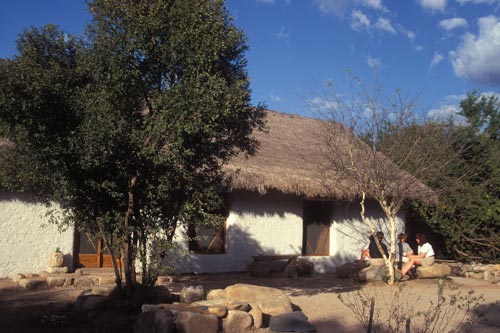
A small group gather outside the strawbale house built by Elizabeth Nuzum on El Pedregal, Alamos, Sonora, Mexico.  Photo by Anders Tomlinson.

Elizabeth Nuzum wanted to build a straw-bale house in Alamos. She did.

Elizabeth had read the book Out on a Limb by Peter and Victoria Nelson. It was about tree houses and other construction such as straw-bale houses. Elizabeth decided she wanted to build a straw-bale in her garden of experiments. She contacted the Nelsons as they were preparing to visit Russia and demonstrate straw-bale technology. They recommended that she talk to the authors of The Straw-Bale House, Bill and Athena Steen. Elizabeth felt it was important to build a straw-bale structure as an example of what could be a relatively inexpensive home concept for Mexico. Unable to have an expert come down to build the straw-bale studio she relied on the Steen’s book and hired her son-in-law Chacho Valdez and his brothers to start the project. Chacho would build the basic structure: roof, walls and an unfinished floor.

A palapa for all seasons and reasons

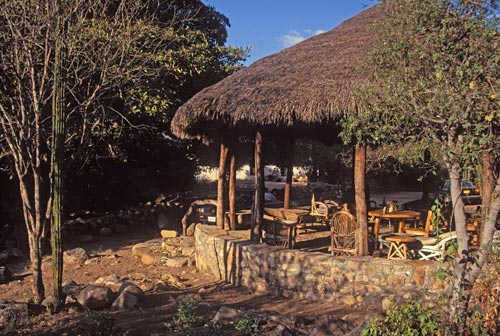
Looking from the south at the Pedregal's Palapa and the Straw bale studio in the background, Alamos, Sonora, Mexico. Photo by Anders Tomlinson.

The Palapa was the first structure built at El Pedregal. It was a work office.

Before the Straw-bale studio was started Elizabeth and Chacho took a stick and scribed out a large circle as the palapa’s floor-plan. Her intent was to have a place where people could socialize and admire the fig tree. She wanted it to have two entrances and no center pole. Chacho said it could be done and he went about construction.

The amazing hand-woven palapa roof took a crew five months to put together as they had to wait for after full moons to collect the palapa leaves. As work continued on the property the fig tree was host to shamanic dances, earth renewal ceremonies, sweat lodges, barbecues, coffee parties, art classes and…

Chacho Valdez, man of mystery

Chacho Valdez, builder of the Pedregal's palapa, Alamos, Sonora, Mexico.  Photos By Anders Tomlinson.

Chaco Valdez, renaissance man, making a spiritual point and jump starting a car.

Chacho Valdez stands in front of his new home under construction, Alamos Sonora Mexico. Photo by Anders Tomlinson

I always thought of Chacho as a rock n’ roll medicine man. He looked like a pirate with long flowing hair and beard, bandanas and hats. One day Chaco looked at me with one eye somewhere else and stated, ”if you stare at a cloud long enough it will disappear…” This is an anthem-theme that I use whenever I speak of Alamos.

Chacho and Cammie, his former wife, were instrumental in creating the Children’s Kite Festival held in the spring. Chacho, a bit of a mischievous child himself, loved children. He also loved to sing in his big booming voice. The last time I saw Chacho he was building a circular two-story house on the well-traveled entrance road up to the top of El Mirador. The site doesn’t seem like it would be conducive for privacy during park visiting hours but, my oh my, what a magnificent awe-inspiring view! …

98… Returning to El Pedregal’s ever-present spirit… second of two parts…
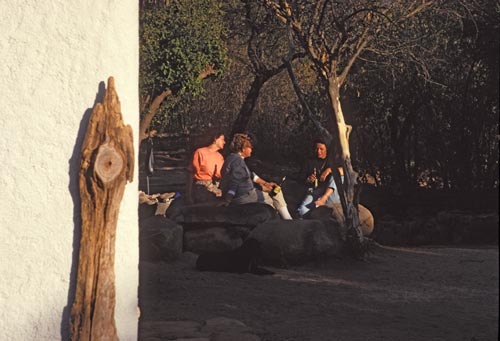
Drinking beer in the late afternoon outside El Pedregal"s strawbale house, Alamos, Sonora, Mexico.  Photo by Anders Tomlinson.

Here is a place to come together and be a warm late afternoon dream.

Liliana Carosso, on the right, and Ginny Brown, along with an unidentified woman in the middle, enjoy a natural moment. Lilliana is a prominent Alamos real estate agent. Here, one is in another world. Time loses importance and nature, and a couple of beers, encourages relaxed deep breathing.

Kit Nuzum returns to Alamos

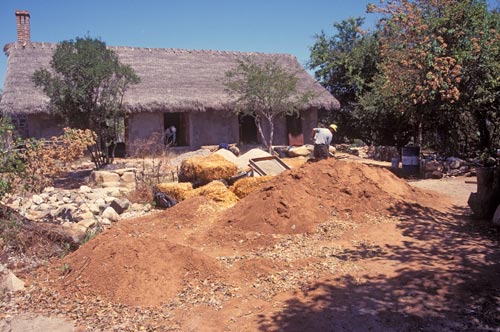
Pedregal under construction, Alamos, Sonora, Mexico.  Photo by Anders Tomlinson.

From dirt and straw and other natural elements a large studio is born

Elizabeth’s son, Kit, returned from one of his many global travels and took over the task of finishing the straw-bale studio. He also managed the digging of a well at the spot chosen by a water dowser. A solar pump was installed and irrigation began with water from beneath El Pedregal”s surface. Elizabeth purchased indigenous and rare trees and plants. And as the nature is for these parts some took, and some didn’t as any Alamos gardner has experienced.

Elizabeth Nuzum and her son Kit with the construction team and the Friedlobs, Alamos, Sonora, Mexico.  Photo by Anders Tomlinson.

Most of construction team and advisors gather around Elizabeth Nuzum.

Kit had no prior working knowledge of straw-bale construction and “just went for it” with the help of Chone, a cousin of Chacho. They poured an earthen adobe floor with the help of Steve Frielobs. The windows were made by Angel Rosas. The adobe interior walls that made the kitchen and bathroom was there but unfinished. Kit and Chone, along with several others, finished the walls and the loft decking as well as the grand stair case, designed by Alamos resident Irmine Stelzner, with wood from the old Boors monastery on the southwest corner of the Plaza. The original douglas fir came by train from Oregon in 1910. Irmine’s husband Allen Stelzner designed and made the iron latch on the front door.

Creating color pigment from nearby hills

Finished exterior of the straw bale studio at El Pedregal, Alamos, Sonora, Mexico.  Photo by Anders Tomlinson

The finished exterior blended in with the surroundings.

Elizabeth’s straw-bale studio was originally painted with a palette of colors made from dirt in the surrounding hills. The soil that would be used to make the paint came from a spot that was along a long walk that Chacho took me on the last day of my first visit to Alamos. Chacho said it was a local custom. As we were returning to Alamos I asked Chacho if the earth was purple and he nodded yes. In this one area there was literally a rainbow of dirt. Fifteen years later, Kit and I, along with a couple of assistants and a wheel barrow, set off to find this magical place. We found it not far from El Pedregal along with shards of am old pottery. The work crew spent the morning gathering earthen colors from the area as I filmed. Later, Kit mixed the earth-toned dirts – pale green, red, blue, green, ivory, white and lavender with prickly pear and agave goo called baba. The solution sat for a week before glue was added and wiped onto the interior walls: home made paint.

Later, author Paul Molyneaux, seeking a quiet harbor from his noisy young children, finished his book The Doryman’s Reflection, a Fisherman’s Life in the serene straw-bale studio. Tony Estrada, director of the Museo de Costumbrista and artist, sculpted a centaur for Elizabeth that was placed beneath the fig tree.

View of Tecolote Hill from El Pedegral, Alamos, Sonora, Mexico.  Photo by Anders Tomlinson.

The morning begins with seeing where we will be in a couple of hours.

On this summer day in 1996 I would go on a hike with Chacho, his young son Sereno, his girlfriend and Chone to the top of Tecolete Hill, seen here sun-capped. Sierra de Alamos rises up in the background. We would leave from El Pedregal at sunrise and be atop Tecolote Hill in a couple of hours. This turn out to be a day of exercise and aroma therapy in Alamos, Sonora, Mexico.

El Pedregal today

Elizabeth sold El Pedregal to Jennifer and David MacKay in 2005. They added another 17 acres to what is now El Pedregal Nature Lodge and Retreat Center. They have also upgraded the infrastructure and added a couple of casitas. Today, they offer lodging, nature tours, sunday brunches and yoga lessons amongst many other activities that they are involved with.
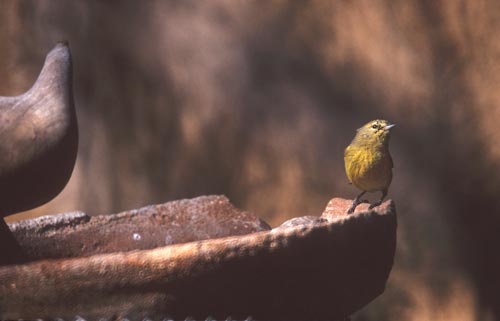
Bird bath at El Pedregal, Alamos Sonora, Mexico

Elizabeth's intent was to have both a nature preserve and artist studio

I recently enjoyed watching David Wilson’s Big Birding Day on PBS’ POV, point-of- view, series. The 2011 12-minute film features David Mckay as a birding guide for several birders intent on a big birding day. The film documents the world of competitive bird watching where one tries to see, or hear, as many bird species as one can in 24 hours. The opening scene takes place under the Pedregal’s palapa as they prepared for a day of ambitious adventure. I was struck by David’s curiosity and connection to his environment.

I had spent nine years filming wildlife on the Tulelake, Lower Klamath, Clear Lake, Upper Klamath Lake and Klamath Marsh National Wildlife Refuges along the California-Oregon border. If David had come and spent a couple of days in the field with me he would have had a wonderful time. And I am equally sure I would enjoy spending a couple of days with David Mckay in Alamos and surrounding habitats. Both of these regions are known for diversity of flora and fauna, especially numbers of bird species. There are birds that visit both Alamos and Tulelake on their yearly migrations.

Elizabeth Nuzum placed this bird bath on Pedregal’s giving ground for her small friends to use, just as she built the straw-bale studio and palapa for friends to visit with friends, even if it is only communing with one’s self, alone.

This entry was aided by notes from Elizabeth Nuzum, Kit Nuzum and Joan Winderman.

©2013 Anders Tomlinson, all rights reserved.

Alamos Horses

100… An Alamos moment with some horses…

A horse on Calle Comercio, Alamos, Sonora, Mexico.  Photo by Anders Tomlinson

A solitary horse stands in the middle of Calle Comercio.

A man in the background is working on repairing a drain spout Calle Comercio. Behind the horse is the former Governor’s mansion. Why is this horse here? Because it is here. In the bigger picture the answer could be that Christopher Columbus brought the first domesticated horses on his second voyage to the new world. His expedition selected 25 horses from Andalusia including the Spanish Jennet, know for their athleticism, medium size and comfortable gait. The Spanish royal architects who laid out Centro Alamos as it is found today were also from Andalusia.

Hernandez de Cordoba in 1517 brought horses to Yucatan. Conquistador Cortez set sail with 16 horses, 500 men and 11 ships in February 1519. He landed on Mayan territory in the Yucatan peninsula and marched inland to what is now Mexico City. Today, Andalusians are bred with quarter-horses and Mexican Criolla to produce the Mexican Azteca, beautiful and durable. The horse above, living in the moment, is unaware of all of this.

Horse near buckets of food scraps put out for trash pickup, Alamos, Sonora, Mexico.  Photo by Anders Tomlinson.

The lone horse knows there is food in the trash buckets waiting for pickup.

The horse has found food scraps to rummage through. Food is food. While taking this photo I wondered if someone realized this horse was possibly not where this horse should be? And, would they go looking for the horse or is this a regular occurrence and the horse returns unassisted? A horse on its own in Centro Alamos is not a common sight but it should not be a surprise given Alamos, Sonora, Mexico’s old west nature.

Posts for hoses to tie up to, Alamos, Sonora, Mexico. Photos by Anders Tomlinson.

Looking through the Museos' window at the old Alamos fort's front door.

All of Centro Alamos is a museum as illustrated by looking out Museo de Costumbrista de Sonora’s northern windows and seeing La Ciudadella, one of the oldest and best kept buildings on the Plaza. This was the town’s original Spanish fort. It is said that a Spanish soldier’s ghost is here protecting hidden treasure. This ghost is not alone. There are reports of ghost throughout Centro Alamos, purchase a home and a ghost, or ghosts, come along in the deal.

Detail of horse head to tie up horses, Alamos, Sonora, Mexico.  Photo by Anders Tomlinson.

Small details tell stories and events that transcend time and space.

Mystery and magic are in the details seen from the street. Events are recorded in the weave and pattern of old sidewalks. Pride can be found in the well-intended performances of skilled workmen and artisans. Days of old remain with the care and respect of today’s owners and helpers. It is community mindset and municipal dictate that perpetuates past legacies.
The streets of Alamos are living history.

The old fort off the main Plaza in Alamos, Sonora, Mexico.  Photo by Anders Tomlinson.

Maria Louisa, the first owner of La Ciudadella, died from a loose ceiling brick.

La Ciudadella went from a government fort to a private residence to two residences and then restored back to one 22 room mansion. In the early days this was a fortified mansion to securely store silver bars from the Aduana mines. Behind these doors Important business was conducted that had implications as far north as San Francisico. Inside the compound there were ramps to move the treasure along with a dungeon, deep well and secret emergency escape tunnels.

When I visited La Ciudadella in 1995, David and Jennifer McKay were living there. I sat down with David at a big old table from the soldier’s mess hall and had a glass of water and a brief conversation. Today La Ciudadella, 15 Cardenas, is owned and watched over by Margo and Richard Howell. During the winter and spring seasons La Ciudadella is often included on the Saturday house tour that gathers at 10 or 11 a.m. in the Plaza. The modest house tour fee benefits local charitable organizations, this is a long-standing tradition.

Four horse scenes in Alamos, Sonora, Mexico. Photos by Anders Tomlinson.

Horses can be seen on the streets and arroyos of Alamos, Sonora, Mexico.

Counter clockwise from upper left: Independence Day celebrations feature horses, music, food and beer in the arroyos. A grandfather and grandson ride together on a quiet weekday in downtown Aduana. A summer rodeo and music concert is staged in the baseball park, nothing started on time. A young man walks his horse in front of the church.

Horse drawn tours of Centro Alamos started in the Plaza, Alamos, Sonora, Mexico.

A private entrepreneur started a tourist horse drawn carriage ride around town.

And now for a little horse history in Mexico. In 200,000 B.C. Equus Mexicanus were common in North America. Starting around 136,000 B.C. they began to leave for Asia. Some 76,000 years ago Toba, one of the world’s four super volcanos, errupted in Sumatra and wiped out many species on earth. The human population, reduced to a thousand breeding pairs, barely survived. In recent times the onager, a wild ass, was common throughout North America. And then the Spaniards arrived. In the background are the steps leading up to the Monastery, formerly the Boor’s mansion. The pink building on the corner is now the Alamos hostel.

four horse scenes on the streets and roads of Alamos, Sonora, Mexico.  Photos by Anders Tomlinson.

Be it for transportation or recreational activity the horse is part of Alamos.

Counter clockwise from upper left: A couple of charros, horsemen. pass Calle 5 de Febrero as they ride eastward in Arroyo La Aduana. Horses and riders gather and celebrate Independence Day in Arroyo La Aduana. A woman and child on horseback near the cemetery along Calle de Las Delicias. Man and horse rest as the Plaza fills with summer tourists.

Rock walled stables on

A magnificent Arabian purebred stands in the high noon warmth of spring

Dr. Martin Dale Edwards and Zora Tyler owned Rancho Las Crucecitas, a 15 minute walk from the Plaza, when these photos were taken in 1995. They had two large houses, with two caretaker families living in one, two barns and 23 corrals. Water was provided by an abundant well and a dam behind the main house which caught and stored runoff from Mt. Alamos. They had an Arabian breeding program that used the son of Fadjur as their primary stallion. We are not sure where Arabian horses came from: northern Syria, southern Turkey, northern edge of the Fertile Crescent, Iraq, across the Sinai, Egypt, southwestern Arabia… We do know that around 1500 B.C. records begin to appear talking of the impacts these powerful “hot blooded” Arabian horses were making.

Horses in front of the main house on what is now Estancia Chrysalis.

Soon the mountain behind the main ranch house will be vibrant green

These horses lived a different life than the horse on Calle Comercio that began this scene-segment-post. Life in the undisturbed country is much different than the narrow streets and homes wall to wall in downtown. These city homes do have their walled-in courts – patios where outdoor living, and privacy, is a given. But in the countryside, wide open spaces present an all encompassing freedom. Here, the sounds are of surrounding wildlife and of your own making. I believe Rancho Las Crucecitas was named for a murder that took place on the property where an old woman is buried. The herd of Arabian horses would die years later at Las Crucecitas from bad food or disease or? Something had gone terribly wrong.

Las Crucecitas’ 175 acres was purchased from Zora by Sharon Bernard and renamed Estancia Crysalis. Frank Bernard, her father, had owned a 1200 acre ranch that was three miles northwest of Alamos and might have been named Estancia Crysalis. He was a hotelman and a former Spanish Consul to Vancouver. After he sold the ranch its name was changed to Rancho El Palomar. Frank, and his second wife, Atie, then purchased Calle Comercio 8, the Bishop’s mansion in Alamos Centro. I met briefly with Frank in 1993 and he told me that I had brought a talented crew to film Alamos over the Christmas holidays. Horse spirits and ghosts are everywhere.

©2013, Anders Tomlinson, all rights reserved

Carmen Portillo

63… A little village of potters do as it has been done…

Carmen Portillo at work in her La Colonia de Uvalama studio-home.

Carmen Portillo, matriarch of her Uvalama pottery family, died in 2004. She had been making pots since she was 12. Her grandaughter, Carmen Tomasa Ayala, continues the traditional craft, selling her own creations from the studio and at Uvalama Pottery in Alamos on Calle Obregon and Guerro near La Casa de los Tesoros. Years of taking clumps of clay and creating shape and function has it rewards. Artists know when they have got it right, and this moment of recognition and acceptance, priceless, warms the soul and perpetuates the process. Carmen Portillo had this moment, handfuls of times every day, for each day, each year, each decade and each generation of her life as a potter. And she was one with all those from the past who took clay in their hands and formed balanced objects for reflection and service.

Carmen Portillo making pot in La Colonia de Uvalama near Alamos, Sonora, Mexico.  Photo by Anders Tomlinson.

Carmen's pottery is the product of water, earth, fire and handed down traditions

The car ride to Carmen’s house, a couple of miles west of Alamos and south a mile off the highway, in La Colonia de Uvalama was a drive back to another era. The Uvalama turnoff, as I am consulting with a Google satellite map, may be Arroyo Encanto. La Colonia de Uvalama was a small community with a house here, a house there, a primary school, countryside and a road that was a wash. When we arrived at her house a younger woman came to greet us. She went back into the house and Carmen, along with several family members, appeared moments later as we all converged at the work table in the front yard.

Carmen Portillo at work, La Colonia de Uvalama near Alamos, Sonora, Mexico.  Photo by Anders Tomlinson.olonia de Uvalama

How many years, and pots, had Carmen worked-created at this table?

The clay Carmen uses is this land, Uvalama clay, these potters live at the source of their material. There is no need for electricity. The clay is hand coiled and shaped. It is then fired for nine hours in a wood oven that can reach 1000 degrees C. So simple. So universal. So true.
Prayers of labor, meditations of perfection: each finished pot joins a long procession of pots as the skills, desire and discipline are passed from one generation to another. It is the Mexico way. It is the human way.

Carmen Portillo family in Uvalama village, Alamos, Sonora, Mexico.  Photo by Anders Tomlinson

This is a Portillo family portrait from the new Alamos slide scanning effort

One of the reasons I am writing this journal is to identify what slides will be in the next batch of scanned images, and what stories, of the thousand of stories and photos, will need further illumination and illustration. In this spirit, today, I will look for a couple of family portraits of those who posed for my camera on this day in Uvalama. And above is one of these newly processed images. This is a good example of the Journal being a work towards an end.

©2013 Anders Tomlinson, all rights reserved

Cobblestone Crew

97… The cobblestone crew in action…

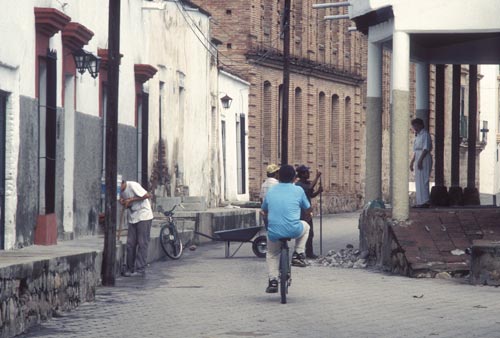
Road is closed for repairs, Alamos, Sonora, Mexico.  Photo by Anders Tomlinson.

A rock blockade warns, do not continue on, there is road work ahead.

This is a cobblestone section of the old El Camino Real headed west out of Centro Alamos and then turning northwards. The airport runway is to the left and an open field is on the right. It would be interesting to learn when this important Spanish highway to the Californias went from dirt to cobble. Another time, another way exemplifies a grand human tradition of using materials at hand, and experienced intuitiveness, to create function and design.

Road repair crew working on road to San Bernardo by the Alamos, Sonora, Mexico airport.  Photo by Anders Tomlinson

They are out early on the road to San Bernardo near the airport terminal.

This is a special crew, a few men selected to continue road building and repair customs that go back centuries. These men spend days, weeks, months and years digging rocks up and placing rocks down. My friend Chacho’s father can be seen with a hat, or wrap, under a hat.

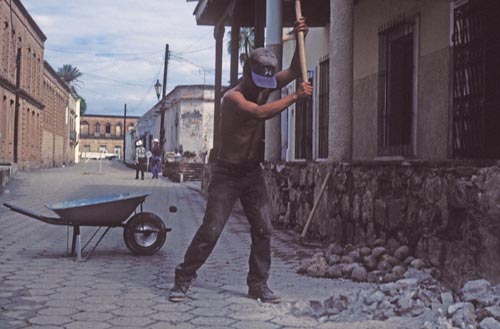
Rock, dirt, hand-tools, hard labor and minds that enjoys solving puzzles.  Alamos, Sonora, Mexico.  Photo by Anders Tomlinson.

Rock, dirt, hand-tools, hard labor and minds that enjoys solving puzzles.

This is an ultimate jig saw puzzle that when finished reveals no image or icon. Pieces, rocks, go where they fit, or are compatible, for a variety of reasons known only to those who position the rocks. I didn’t see any overweight men on this work detail, nor back-braces. It is hand labor: pick axes, shovels, wheel barrels, dirt, boulders and heavy lifting. There are percussive rhythms that come with their tools in repetitive action and layered human harmonies from their melodic conversation, singing and laughter.

Working being done on a dirt road along with power poles in the campo, Alamos, Sonora, Mexico.  Photo by Anders Tomlinson.

Two men with hats and a wagon load of dirt at work in the campo.

It is summer and dirt roads are quickly damaged by monsoon flash floods.. The hot sun and humidity is unavoidable but rural road repair goes – on fill the hole with dirt. Is it a special dirt or blend of dirts or…? The road looks like it is a good distance to the southeast of Alamos. I was probably returning from the Cuchujaqui River and asked the driver to stop so I could get out and take this photo.

Digging a trench on Guadalupe Hill to replace a waterline. Alamos, Sonora, Mexico.  Photo by Anders Tomlinson.

A large crew is busy digging a trench on a road going up Guadalupe Hill.

Municipal projects employ workers. Digging a trench by hand employs more workers than bringing on-site a fossil-fueled mechanical trencher. Employment grows with inefficiency and decreases with labor-saving-payroll-cutting devices. Alamos, like the all the world, needs job. Work crews are digging on Calle Maria Felix, a street that climbs a short distance up Guadalupe hill before coming to a stop at the front door of a cliff-backed house. This is as close to being a cul-de-sac as any road in Alamos. Calle Galeana, to the west, is in the background.

©2013 Anders Tomlinson, all rights reserved.

Woodworkers

62… Working in wood is a long standing Alamos tradition …

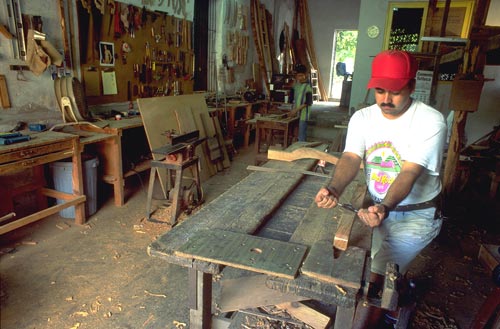
Martin Rosas in family workshop, Alamos, Sonora, Mexico.  Photo by Anders Tomlinson.

Martin Rosas at work at his families' Carpenteria Rosas.

Martin Servando Rosas was a busy man on a mission. He taught carpentry at the elementary- junior high school. He managed the well-laid-out Carpenteria Rosas, off of Calle Galeana, where his brothers Germain and Carlos worked. Martin was involved with the “Hands across the Border” program which took 20 to 40 kids north for two to four days and a Discovery tour program that involved ten adults at a time. He was running a business, hand crafting wood and sharing his experience-skills with the next generations. Martin expressed his faith in Mexico’s future through his strong belief of the necessary good community service provided. As I was leaving Carpenteria Rosas I turned back and saw Martin focused on a project at hand, there was a production schedule to be met.

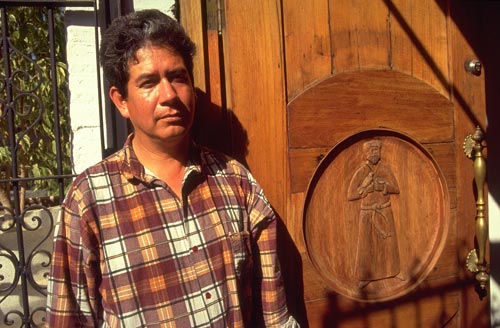
Ramon Nicholas Figueroa Castro with one of his carved doors, Alamos, Sonora, Mexico.  Photo by Anders Tomlinson.

To have a wood door built and carved by Ramon Figueroa was a big deal.

Ramon Nicholas Figueroa Castro was one of the most respected artists-craftsmen in Alamos. Members of the North American community spoke of him in hushed tones reserved for masters and maestros. Any visitor that asked about local creative talent would learn about Ramon and his growing reputation outside of Alamos. Many locals recognized a Ramon carved door as a collectable piece of art, hard to come by for a variety of reasons: he works slow, he is busy with a growing client waiting list, needed materials were hard to find, he is expensive because of his rising profile and, or… If one managed to purchase a Ramon it became the opening to countless conversations.

The Ramon I met was quiet spoken with a soft smile and simple gestures. It seemed he did what he did because it was what he did, there was a simplicity to his movement. Everything else surrounding his work was what other people did because it was what they did. Ramon hoped they would pay him what they had agreed to pay him and he would be left to his work, after-all, it is what he does.

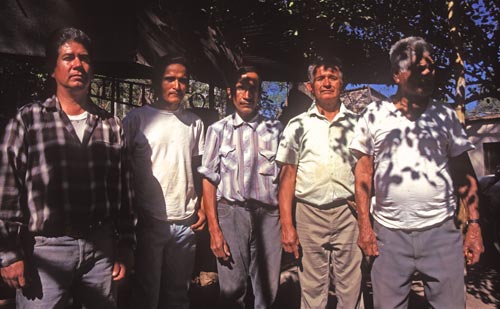
Figueroa brothers, master wood workers, Alamos, Sonora, Mexico.  Photo by Anders Tomlinson.

Ramon together with his wood working brothers at their shop.

The brothers Figueroa all worked with wood on their family property on Calle de las Delicias.
Manuel, Emir Yonolan, Wilson, Paul, David and Ramon, not in the other of the above photo, shared a sprawling work space both open air and under roof. There were few walls: nature came in and their wood creations went out. Trees provided shade for craftsmen making tables, chairs, windows, doors… On this day Ramon was finishing a beautiful bureau. Its elegant turnings and graceful details stood out in sharp contrast to the dirt floor.

Art and music is a family thing in Alamos. Many of those around the Figueroa brothers probably will work in wood themselves. The creative skills are past down from father to son, mother to daughter, uncles and aunts to nephews and nieces. As an example, the Quartet de Alamos performed at Casa de los Tesoros for as long as I had known Alamos. On my last visit the bass player’s son was playing bass for Estudiantina de Alamos. I could imagine the son replacing his father in the Quartet, or playing in his own band, someday, somewhere in Alamos or…

Margo Findlay & James Wilson

24 … Two studios, two artists, two approaches, one town, one world…

http://jamesfwilson.com/index.php

Margo Findlay with her art exhibited in her home - gallery.

This is what one was greeted to as they entered Margo’s home from the street. The space was her work, her moments. Here, Margo had all she needed. The expansive walls and high ceilings of Alamos provide wonderful studio – gallery space for artists.

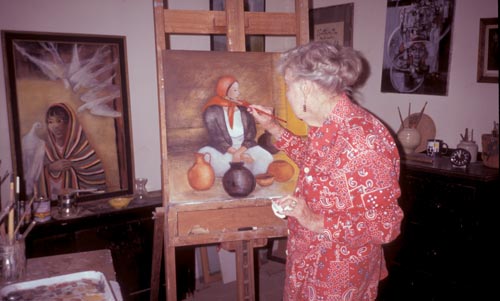
Margo Findlay painting, Alamos, Sonora, Mexico. Photo by Anders Tomlinson.

Far removed from the outside the artist goes inside..

Margo Findlay was born in Lewiston, Montana, 1906, and spent her childhood on cowboy ranches in the American old west. At the age of 17 she started to illustrate children books and then across a life that lasted 104 years she traveled, danced, and did what she what she did. After knocking on her door and coming in for a brief visit, and these photographs, I understood her way was not to talk about art, it was to do.

Margo Findlay at her easel, Alamos, Sonora, Mexico.  Photo by Anders Tomlinson.

She is in control, she paints her world, her imagination, her colors...

I could not find much written about Margo Findlay. In one piece she was described as “expressionist artist”. She came to Alamos in 1964 with her artist husband, Harold Findlay. She never left. She is buried in Alamos, she is part of Alamos. Think of all the hours she spent painting, alone in her thoughts and technique. The artistic life requires self-discipline. A drive to create-make-reflect-share-react. An artistic life is one of being the art. Margo.

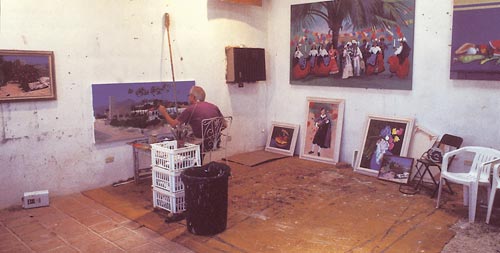
James F. Wilson painting in Alamos, Sonora, Mexico. Photo by Anders Tomlinson.

Here is the office, workspace, and kingdom of a productive artist.

James Fenimore Wilson escaped from the New York art scene to spend six months in Alamos, Sonora, Mexico. The year was 1990 and he felt a need to recharge his creative powers. Here he found another life. He met his future wife Lourdes, born and raised in nearby Navajoa, at the Plaza while she was visiting Alamos. They had two children and left Alamos in 2000 for Jim’s college teaching – painting position in Missouri.

James F. Wilson and painting, Alamos, Sonora, Mexico. Photo by Anders Tomlinson.

Alamos became a part of Jim and Jim became a part of Alamos.

When I visited with Jim during the 90’s he was the most visible of the town’s working artists. His work was seen in homes throughout Alamos. His portraits became integral to the families that commissioned them. Jim’s extensive art background allowed him to talk with in-depth knowledge of art. Over the hundreds of years, Alamos has given refuge and wings to the creative spirit. It is as much a part of the landscape as the mountain.

To see more Alamos Journal pages.

To return Home.

©2013 Anders Tomlinson, all rights reserved.

Sadnah, Chivo, San, Karen and T.J.

57… Music in Alamos is a many rhythmic thing…

Home of painter-musician Sadnah, Alamos, Sonora, Mexico. Photo by Anders Tomlinson.

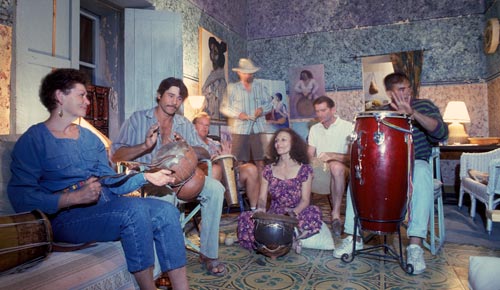
Thursday night in Barrio Las Higueras, at Sadnah's home, is drum night.

Every inch of Sadnah’s casa was textured, patterned, colored, imaged and emotionalized. Her paintings were everywhere as were her drums. Barrio Las Higueras – The Trees, was on the southern side of Arroyo Agua Escondida. Sadnah’s casa was on the personal side of human expression, a ride into something ruled by the creative spirit, itself driven by a love of humanity. Call it a hippie house if you wish, but it is “hippie” in the best sense of the word and world – Sadnah was more a creator than a consumer. These drum sessions were spirited and brought folks together from different elements in search of the universal one-and-two-and… much like Alamos itself.

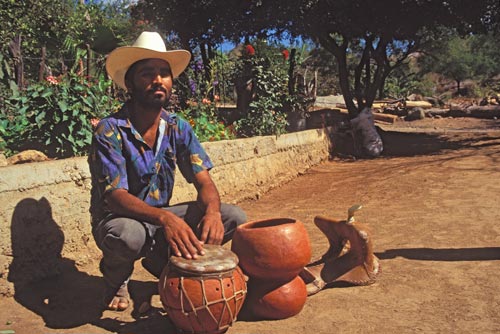
Drum maker Eusevio Cortez, Alamos, Sonora, Mexico. Photo by Anders Tomlinson.

Many of the drums at Sadnah's were made by Eusevio Cortez.

I met “Chivo”, Eusevio Cortez, near the cemetery in Barrio La Compana on a bright Spring mid-morning to photograph him with a couple of his handmade drums. “Chivo” was highly respected by Sadnah, they were part of the same set of intersecting social groups. Being a drummer myself, one in a hundred people are, I respected what he was producing, the craftsmanship was excellent and the resulting tone strong and true. We were in the northwest corner of La Compana which is higher up a slope from the arroyo. It was as if I was in another land from where I awoke on Calle Comercio. Alamos Centro has an international – Spanish vibe. La Compana was Mexico. An Alamos experience is defined by where one is staying, who they are visiting, who they are related to and the activities-interests they are pursuing. Serendipity occurs if the spirit is willing and if one wants to shut out the outside world they can, it is their call. One barrio is a world separated by arroyos, roads, and hills from other barrios, they are little villages.

Painter-Musician Sans Sanchez, Alamos, Sonora, Mexico. photo by Anders Tomlinson.

San Sanchez looks up to the mountain he loves, hikes and paints.

San could reach the top of Mt. Alamos faster than anyone else who accompanied me to the highest of high grounds. He flew across the trails, along with his dog, with the grace of the colorful parrots he admired and painted. It was a thrill to see this majestic birds flying across the canyons, a daring red flash of movement with bright rainbows of shimmering accents that caught any eye’s attention.

San lived with his girlfriend Karen in La Compana, lower and closer to the arroyo and cemetery than where I had met Eusevio Cortez earlier in the day. San was living the Mexican existence, life was hard, one had to maximize all available resources and waste none in a modest home with a couple of rooms in a neighborhood of working class casas. When I visited he was working on a panoramic detailed painting of being atop of Mt. Alamos looking southwest. It was a view that few have seen and there, of course, he had his beloved parrots flying.

San and Karen were also getting ready for a band practice with their bass player, T.J. Cook. T.J. had a long walk to La Compana from the other end of town west of the airport. This was serious business. They had a booked a gig to play at a gringo party. San showed me their playlist of ambitious and challenging tunes. It was if they were getting ready to play at Carnegie Hall and they wanted to let the world know they were at the top of their game. The heat of a late Spring mid-day hit me in the face as I left their darken house, dark to protect and preserve every bit of cool they could, on many levels.

To see more Alamos Journal pages.

To return Home.

©2013 Anders Tomlinson, all rights reserved.

Doug Riseborough

56… Art in Alamos is a many splendor thing…

Doug Riseborough in his art studio, Alamos, Sonora, Mexico.  Photo by Anders Tomlinson

Artists and their studios share a relationship where one becomes the other.

I was always interested in the progress a space was making one block off the Alameda on my favorite Alamos thoroughfare, Calle Francisco Madero. The narrow gently rising one-way street leading to the plaza has an old world sensibility, all homes are connected rooms sharing a common hallway, the street. And here on a corner was a place that had colorful trompe l’oeil beach murals on its walls. My first thought was these heroic scaled figures were part of Mediterranean scenes, but on lingering examination I realized it was Southern California. I could see through the partially opened wood shutters that the space’s floor was always empty, as if it was waiting for a business to move equipment in and entertain its patrons. Was it going to be an intimate disco-bar? An upper-end beauty salon? A self-help retreat run by transplanted beach gurus? So quiet. So strange. So… well, Alamos where many worlds can be one.

Doug Riseborough at home with his mural, Alamos, Sonora, Mexico.  Photo by Anders Tomlinson.

Doug Riseborough, noted international muralist, relaxing at home.

Sharon Bernard Harrison, aware of my interest in documenting artists of Alamos, arranged a morning coffee meeting with the painter Doug Riseborough. A dapper gentlemen dressed in white greeted me at the door and welcomed me into his home. His art was everywhere, including a large work on canvas over a couch seen in the photo above. The painting style was familiar, I had documented a couple of days earlier a mural at the Palacio by Doug featuring interaction between Conquistadors and Indians. One of Doug’s famous commissions was a mural displayed on the Avenues of Americas for the 1962 World’s Fair, The Ascendance of Stone Age Man to their Present State…. In it Chief Tarire was depicted severing the umbilical cord that connected him to his past. Doug traveled to the small Indian settlement where Chief Tarire had lived as research for the mural.

Doug Riseborough with a friend, Alamos, Sonora, Mexico.  Photo by Anders Tomlinson.

Born in Canada, living in Los Angeles, Doug is at ease in Alamos.

Doug, a small man in stature and a monumental presence with brush, projected an assured confidence. Aware of the camera, he collected his being and created a pose for each shot. I am sure Doug knew his best photographic side. One rule of thumb for an artist is make your money on the road and Doug had done his share of traveling including a four story mural in Hawaii presenting the creation of Maui. Other commissions took him to Rockefeller Center and a Saudia Arabian Prince’s palace.

Doug thought it would be a good idea to photograph him at work in his studio. We left his house and walked down busy streets. And there we were. The mysterious space I mentioned at the start of this story was his paint studio. The only furniture was his easel and a table. His studio, with tall walls, allowed his imagination to soar and his subjects to come alive with each transcendent brush stroke.

To see more Alamos Journal pages.

To return Home.

©2013 Anders Tomlinson, all rights reserved.

Tebeto

strong>43 … Tebeto, the most viewed artist in Alamos …

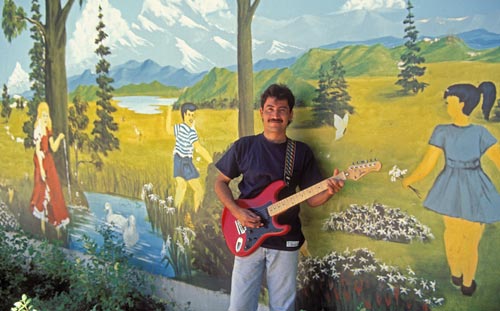
Tebeto with school kids and his mural, Alamos, Sonora, Mexico.

Every playground in Alamos had a Disney-like mural painted by Tebeto

On any given school day more people, kids are people, view Tebeto’s work than any other artist in Alamos. It is safe to say more his work is seen by more than church, museum, gallery or home art. Tebeto’s sister worked as a hospital administrator and was instrumental in getting him the playground art grants. These kids look up to, and at, Tebeto and his work.

tebeto with playground mural and guitar, Alamos, Sonora, Mexico.  Photo by Anders Tomlinson.

Tebeto loved and rocked his passion - American Rock n' Roll.

Viva Musica! Mexico is a musical lifestyle. English says music, Spanish says musica. The language is lyrical. Expressions, emotions, and gestures take on import akin to a music conductor’s energetic direction. Tebeto, a quiet man with a quick smile, expresses himself in many medias and none is more important than song. He knows his way around a guitar. His favorite bands, at the time, were Pink Floyd, Beatles and Rolling Stones. Coming off the mountain late one afternoon we were greeted by three generations of women sitting on their humble porch, first house on the trail to town, no electricity, listening, magically, to Canned Heat. Musica was, and is, everywhere.

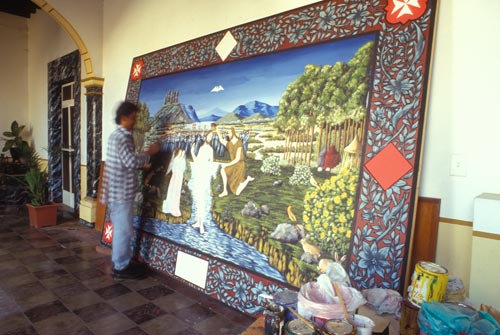
Tebeto working on the Baron's mural, Alamos, sonora, Mexico.  Photo by Anders Tomlinson.

A patron employed Tebeto year-round to embellish his mansion.

Baron Richard Flach de Flachslanden, born and raised in Minneapolis, was Tebeto’s patron. The house had Tebeto’s work at every turn, wall, nook and cranny. The gregarious, fun-seeking Baron was known around town for his yearly Costume Ball. Tebeto enriched the Baron’s lifestyle, such is art’s nature. Chon, who guided me up the mountains several of times, was Tebeto’s brother. In a future post we will visit Chon as he worked restoring a ruin on Calle Arroyo Barranquita for Tebeto to live in. Their family home, where the brothers lived, was a short distance away.

To see more Alamos Journal pages.

To return Home.

©2013 Anders Tomlinson, all rights reserved.

Keeping Alamos Clean

93… Sweeping Alamos streets and cleaning Church candlesticks…

Alamos prides itself on clean streets. For some, it is a lifetime occupation. For others, it is a family chore. For all, it is a signaling that they care and they respect all of those who have, are and will travel these streets. These are serene moments.

Street cleaner at work on Calle Aurora, Alamo, Sonora, Mexico.  Photo by Anders Tomlinson.

Keeping the streets clean by hand is an unending ptrocess.

Clean is as clean does. There is a sense of order to freshly swept streets and side walks along with a charisma of community caring and municipal pride. The post man delivers and the street sweeper taketh away. The eastward-slow-rising-tilt of oneway Calle Aurora shows off any street debris from a distance. There is no place for litter to hide. If it is there, it’s sheer presence, no matter how large or small, casts stained shadows upon aging walls – all is influenced by its reflection. Order is disturbed. The street’s two century old character is challenged by an errant plastic cup. The illusion is gone. In this way, the street cleaners are magicians: they take us back in time with each sweep of their brooms. Order, and respect, is restored.

Cleaning steps to the Bours mansion on Plaza de las Armas in Alamos, Sonora, Mexico.  Photo by Anders Tomlinson.

Another sunrise, another opportunity to tidy up the streets by hand.

It is morning in the Plaza. Women open their shops and offices for business and sweep their entrances. This woman is sweeping the street in front of the former Boors mansion, now a convent. It is a humble but gracious act. She can sweep away the trash and reveal the patina, if not spirit, of human travelers who have passed this way by foot, horse, carriage or car.

There was a 16mm film made by a North American couple living in Alamos, The Brooms of Alamos, about a girl, her true love and her eternal sweeping. It was suggested by an Alamos contact that the filmmaker’s name was Al Gordon. Anders had access to a film print, via Kit Nuzum, in the late 1980s or early 1990s.

Girl in barrio sweeping in front of her house, Alamos, Sonora, Mexico.  Photo by Anders Tomlinson.

Sweeping the front yard and your half of the street is the Alamos way.

Young or old clean the streets in front of their homes. Contrast the style of clothes, and brooms, between this young girl in pink sweater and red pants and the woman above in her paisley summer dress. No matter their differences, culturally or spiritually, as they sweep they share a common timeless experience. For as long as one is in Alamos there is sweeping, and as long as there is sweeping there are these Alamos streets, loved and passed on to the children.

Cleaning the Church's candlesticks, Alamos, Sonora, Mexico.  Photo by Anders Tomlinson.

How many people have cleaned these candlesticks over the years?

The gentlemen smiling as he works could be a cousin of Noli Ernaldo Garcia. Noli was a long time Pember and Elizabeth Nuzum employee. He was their driver and took care of household maintenance and repairs. At the time of this photo Noli had retired because of illness. The doctors’ prognosis didn’t look look good. The woman helping clean candlesticks looks like she is the same person seen in a preceding photo sweeping the street in front of the Convent on the Plaza: similar dress, shoes, and hairstyle. Working together these two are closer to God, each in their own way and each on the universal path of cleaning that is life unto death.

To see more Alamos Journal pages.

To return Home.

©2013 Anders Tomlinson, all rights reserved.

Keeping Alamos Alive

92… Restoration and repair keep buildings breathing…

Old buildings carry on with the hands and minds of people dedicated to maintaining and restoring that which has lasted centuries. For many it is their way of life. We salute the workers and the owners. For the owners it is pride, responsibility and investment. For the workers it is a livelihood that supports their families, and hopefully, moments of pride for work well done.

Worker on a winter day, Alamos, Sonora, Mexico.  Photo by Anders Tomlinson.

Restoring and repairing old structures is an unending process

This is the busy corner of Calle Allende and Calle Cardenas. The Primary school is to the left. The two story structure is the north side of what was the Governor’s Mansion in 1828. Behind the stop sign to the right is the rear, east side, of the Museo de Costumbrista de Sonora which opens on the Plaza. There is much work to do to keep these three buildings alive.

Working on Calle Comercio, Alamos, Sonora, Mexico.  Photo by Anders Tomlinson.

There is no end to doing what could, or should, be done.

Two buildings down from the Cathedral and Plaza, on the north side of Calle Commercio, a workman surveys a rain gutter. The flat roofs of Alamos have a hard time shedding water during a heavy downpour. Blocked or damaged downspouts need to be cleared and repaired before the next rain, especially in the summer when coastal hurricane remnants may pass through Alamos.

Street repairs on Calle Rosales.  Al;amos, Sonora, Mexico.  Photo by Anders Tomlinson.

It is a busy morning on Calle Rosales. Places to be, things to be done.

Work and play on the architecturally diverse Calle Rosales. This is one of my favorite streets in Alamos Homes line both sides of the streetand the two story primary school’s northern side seen in the background. A home owner discusses her plans and needs for the day with attentive workers. This is one day at a time, day after day, month after month, year after year and…

Man breaking up street, Calle Rosales, Alamos, Sonora, Mexico.  Photo by Anders Tomlinson.

One man, one pick-axe, one street, one task. Life goes on.

All great plans and achievements are created by muscles with minds. There are rhythms to hard labor starting with the cycles of breath and heart beats. There are the exertion groans and, in this case, the pick-axe moving through the air, crashing into the street and sizzle of sparks from hard metal striking rock, over and over. All of the elements in this photograph, minus modern clothing and fancy wheel-barrow, could have been here 200 years ago. This is one of many Alamos charms.

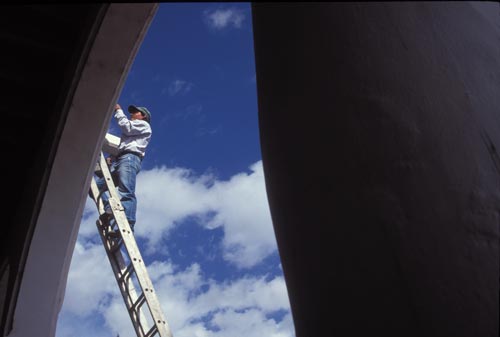
Working on the Bishop's mansion on Calle Comercio, Alamos, Sonora, Mexico.  Photo by Anders Tomlinson.

Framed by a classic arch man and sky do their thing.

The Bishop’s mansion, kitty corner from the Governor’s mansion on the south side of Calle Comercio, is having roof and rain spout inspection. King Carlos III established a new Bishopric in 1781. It would cover the territories of Sinola, Sonora and the Californias. Franciscan Antonio de Reyes was appointed Bishop and moved into this Alamos residence in 1783. The building’s two story majesty illustrates the grandeur that was Alamos in the mid 18th century. This period was the height of Colonial New Spain, an era of pomp and circumstance. Just think of the moments and secrets this perfect portales could share.

Construction crew working on Calle Allende talk about pay checks, Alamos, Sonora, Mexico.  Photo by Anders Tomlinson.

The construction crew working on the Primary school meet with the boss.

What is the kid on a bike in a red shirt listening to? Are the men discussing what needs to be done next? Is it a safety meeting? Are figuring out ways to restart the truck? Are picking straws to see who goes get tortillas? Was there a problem with suppllies arriving? Are they gossiping? Are they striking? Has the city run out of money? The correct answer is it is Friday and they are gathered to collect their paychecks. All is good. The primary school’s western entrance is to the right and the south side of the Museo de Combrista de Sonora is in the background.

©2013 Anders Tomlinson, all rights reserved.

Cemetery – Pantheon

85… The moment has arrived and we are there…

Amongst the graves as the service begins, Alamos, Sonora, Mexico.  Photo by Anders Tomlinson.

Away from the burial service the cemetery is quiet as the dead rest in peace.

Patinas of passing time, an unavoidable ornamentation, take over the graves. Here, across the way, a new body has arrived. From this point on they will always be here. At any time they will be available for visits as their great-grand children become great-grand parents.

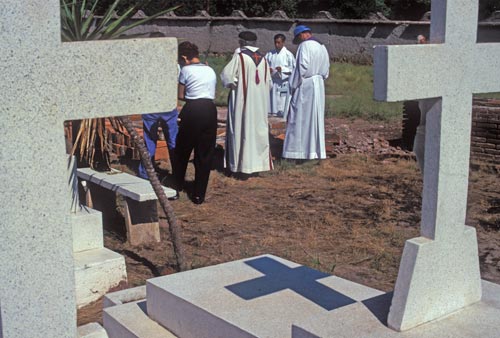
Priests and service in graveyard, Alamos, Sonora, Mexico.  Photo by Anders Tomlinson.

The new grave joins others that have been here for a long time.

It is another day in the graveyard. Not just another day… but another day. It has been this way since 1794 when this plot of land was deemed the municipal cemetery.

Services at held in the graveyard, Alamos, Sonora, Mexico. Photo by Anders Tomlinson.

Words are spoken, the moment is being accepted, a journey ends.

The priest in a baseball cap performs in an ancient tongue a ritual that goes back thousands of years. No one needs to understand the words being spoken. The need for these words to be spoken is what is understood. It is hard for most in attendance to hear anything but the thoughts swirling in their minds and pulsing with each heart beat.

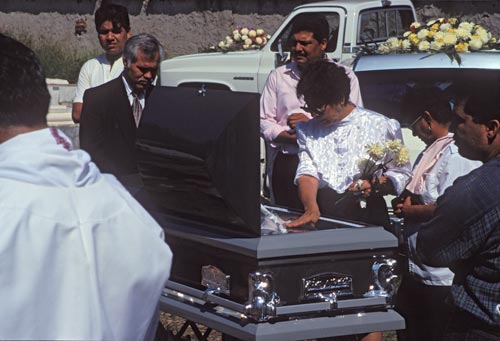
Paying final respect, Alamos, Sonora, Mexico.  Photo by Anders Tomlinson.

Reaching out to touch a departed spirit for one last time.

And they are gone… the last look says so… the last touch confirms… this is a tender moment… this is life… and life leads to one place, death, and here we are this morning…

A beam is laid across the casket's top, Alamos, Sonora, Mexico.  Photo by Anders Tomlinson.

The service has ended and a beam is placed on top of the casket.

Folks had come from far and wide to attend the services. One can see the deceased’s connections and social standing by attending the graveyard service. For some it is a throng with paid assistants and sub-contractors. For other it is a few friends and, or, family that volunteer to dig the grave and offer their regards in quiet prayer. For the dead the ride is much the same.

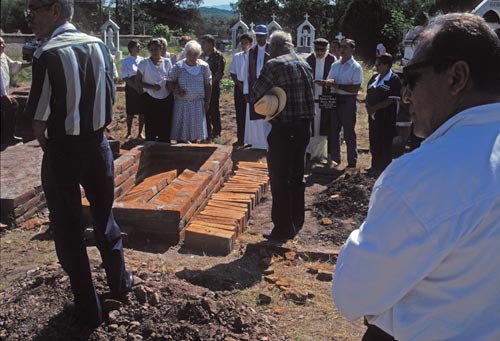
Bricks are laid over the casket, Alamos, Sonora, Mexico.  Photo by Anders Tomlinson.

All watch silently as the men placed bricks over the casket.

Each brick adds to the finality. For the living this is an opportunity to come together with friends and family. With the passing of a love one they see their own tribe standing shoulder to shoulder. The moment goes beyond the dead and becomes the living, In a way they have come to say that they are alive, “we are here”.

Bricks are placed on top of the beam lowered onto the casket, Alamos, Sonora, Mexico.  Photo by Anders Tomlinson.

Soon the grave will be covered by flowers and touched by the winds.

And soon the mourners will go their separate ways. They were united once again by the passing of one of their own. They had stopped what they were doing and made the time and way to come together, once again, as one.

Flowers on a fresh grave, Alamos, Sonora, Mexico. Photo by Anders Tomlinson.

After all have taken their leave flowers remain in a temporary respect.

From dust to dust, the world goes on, today becomes another footnote in the wind. The flowers will wilt and dry away under a tropical sun. At some graves there will always be fresh flowers until the day no one is left to bring flowers.

Looking at the cemetery from Mirador, Alamos, Sonora, Mexico.  Photo by Anders Tomlinson.

After all these years there is still available ground for graves in the cemetery.

Graveyards are a special place: they are public art, they are public history and they are markers of their own civilization. And another day begins… and somewhere out there someone is dying and somewhere near here someone is being born. In the end it is all about this precious balance we call life.

13 … A place where the Living and Dead and Memories converge…

Crows and Crosses in Alamos, Sonora, Mexico.  Photo by Anders Tomlinson.

Can you find the black crows spending their morning perched on crosses?

Existence in the Pantheon, Cemetery, is a many layered thing. November 2, the Day of the Dead, is one of these moments as relatives bearing flowers light candles at their departed’s grave sites. Some of the surnames etched and painted are Almada, Urrea, Salido, Salazar, Ortega, Lopez, Zayas, Ibarra, Santoyo, Palomares, Lara, Acosta and…

Granite tombstone in Alamos, Sonora, Mexico.  Photo by Anders Tomlinson.

Touring the Graveyard is an art experience as a variety of religious icons are repeated in many variations and materials.s.

And the names keep coming: Rosas, Parra, Valenzuela, Esquer, Boors, Ramos, Garcia, Robles, Campoy, Zavala… The earliest dated grave I found was for Antonio Alamada – 8 de Octubre, 1786.

Tarnished metal Jesus, Alamos, Sonora, Mexico.  Photo by Anders Tomlinson.

This tarnished Jesus stands as a gatekeeper to the eternal blue skies above.

There was the day I listened from across the graveyard to the piercing wails of a woman and sister who had lost their grown son and brother. And there are the sounds of birds and dogs as countryside meets town, past meets present and the future is there for all to see.

A mourning mother’s deep wails, crows cawing – perched on white crosses…
It is a warm spring day as we explore the “Pantheon” – (Cemetery) on the road to the Sierra Madres, minutes east of the Colonial Center. The ages speak here. Be it ancient mountain sounds or human voices, mourning and celebrating since 1794. All is timeless, and all thoughts are a point on our circle of life.

To see more Alamos Journal pages.

To return Home.

©2013 Anders Tomlinson, all rights reserved.

Antonio Figueroa

90… Part One: On Easter Sunday in the Country…

There are some days one never forgets. Easter Sunday 1995, on the Figueroa family ranch was one of those days for me. Unfortunately my workbook for this period of time is not to be found, so the names of Antonio’s parents, wife, daughter, brothers, sisters, nieces and nephews are not at hand. It will be hard to tell a story about a large family without their names but I will do the best I can. This story will be told in two parts.

Alamos photographer Antonio Figueroa, wife and daughter outside his home.  Alamos, Sonora, Mexico.  Photo by Anders Tmlinson

Antonio invited Anders to join his wife and daughter for a weekend trip.

Antonio Figureoa had been inviting me for several weeks to spend part of Easter weekend at his family’s ranch east of town. I appreciated Antonio’s friendship and was honored by his hospitality but I would not confirm that I would make the trip. I explained to him that I was dealing with a couple of health issues that would such a trip problematic. Antonio persisted. On the Wednesday before Easter he asked me again. He talked of his family, ranch, countryside, history, views and the… I answered yes. Antonio flashed his big Figueroa smile and thanked me. I learned the plan was we would take a taxi from the Alameda Saturday afternoon and return Sunday afternoon. And off he went, a happy man crossing the Plaza on his way to his home at the northern foot of Guadaloupe Hill. At the time, Antonio was renting a three room apartment with a large backyard on Calle Aquiles Serdan for 400 pesos a month, $60 or so.

Taxi stand in the Alameda, Alamos, Sonora, Mexico.  Photo by Anders Tomlinson.

From here all of the town and surrounding countryside can be reached.

Immediately I started to have reservations. Over the next couple of days I went back and forth in my mind, should I go or should I stay? I was not feeling good and the concept of being in close approximation with four people inside a cab, including a sniffling kid did not bode well. In defense of the sniffling child, everyone here in late spring had a sore throat, cough, sniffles, or all of the above. Late Friday night I decided I would go. Saturday afternoon was noisy and colorful in the Alameda, as is it is on most weekends. There was much to see and many to be seen by. The bus station was extra busy with relatives coming and going to join their families and friends for Easter.
Street carts cooked fragrant food. The cab reserved by Antonio was waiting for us. We all hopped in the cab. The trunk lid and doors were closed, the engined started up and we headed east on our journey away from today and towards yesteryears.

Unfinished water treatment facility upended by Summer storm.  Alamos, Sonora, Mexico.  Photo by Anders Tomlinson.

Unfinished, upended, water treatment facility rests in arroyo east of town

As we left the cobblestone streets of Centro Alamos and traveled on dirt roads that connected the surrounding barrios and campo I thought of the arroyo we would be crossing that carried raw Alamos sewage towards the Cuchujaqui River. I looked up and there in the Arroyo de la Aduana, east of Arroyo Agua Escondia, Arroyo la Barranca and Arroyo la Aduana’s confluence, was the beached remains of a future-to-be wastewater treatment plant that was under construction when Hurricane Fausto destroyed it the preceding summer. I understood that when completed it was designed to reduce raw sewage that had been free-flowing east for a couple of centuries. And so it was, the technological future had yet to arrived as we prepared to travel back in time to when and where Spaniards irrigated their 18th century orchards with foot-wide-brick-lined aqueducts.

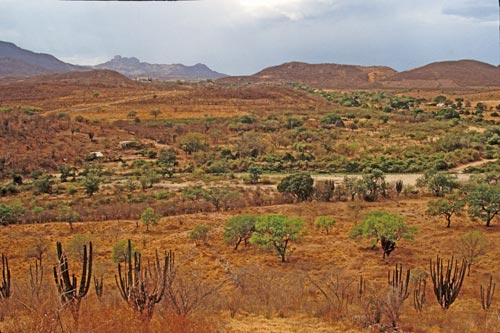
late spring in Alamos, Sonora, Mexico is a hot, dry, dusty season.  Photo By Anders Tomlinson.

The arroyo, carved by seasonal rains, snaked through dry dusty hills.

We passed the cemetery and Ida Franklin’s house and made a turn to the right on the narrowing road and we were immediately in the country. The town was behind us, the Sierra Madre foothills ahead. The rutted road traveled next to the arroyo that we would have to cross from time to time. When we did I would hold my breath to avoid sewer gas wafting up from the tainted runoff. Every once in awhile we would pass modest dwellings. The farther east we went the greater distance between humble ranches. After a fifteen to 20 minutes ride we arrived at our destination, gathered up all our bags and started a short walk through dried orchards up to the house. We were greeted by Antonio’s mother and two brothers. One brother was the family comedian who worked in town as a laborer and the other Moro who lived on the ranch. Moro spoke only to animals. Antonio’s father was there but I never saw him in person. One of Antonio’s sisters and her husband and daughter would arrive later from Navajoa. And here we were, here where Antonio was raised as the youngest of 17 children.

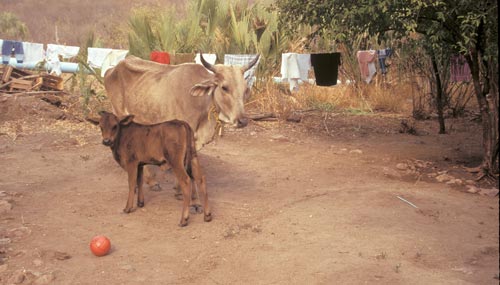
Clothes line and blue pipe bring water to Alamos, Sonora, Mexico.  Photo by Anders Tomlinson.

Cows are interested in a little one on one football as the clothes dry.

We were here, unconnected from the 20th century. The Figueroa ranch was above and a good distance from the arroyo. Behind it was a large hill that we would climb the next morning. One of the points that Antonio made was we would have a good high ground view of Alamos from the east. Though the house was not connected to any wires or modern sewer lines it was connected directly to the big blue water pipe that brought water a good distance from the Cuchujaqui River to the east near Sabinitos. An author’s aside: this is the same Cuchujaqui River that Alamos sewage was headed towards. When the blue pipe reached the Figueroa ranch the builders wanted to keep it running in a straight line run through a barn and corrals behind the house. The workers put a faucet into the pipe in exchange for damaging Figoeroa property. When we arrived I was cautioned to be careful when I turned water on because of the great pressure coming from the big blue pipe, unrestricted, to the sink or shower. On being connected, one can always be disconnected.

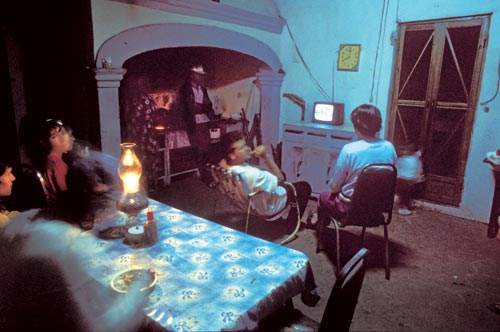
Watching TV powered by solar panel on a ranch outside Alamos, Sonra, Mexico.  Photo by Anders Tomlinson.

Time for a hour or two of solar panel powered TV. Grandmom keeps cooking.

The brothers and I went out to watch the sunset and arriving stars. They were playing a game they always played when together on the family ranch. Who would see the first passing satellite that evening? As we searched the heavens for the hand of man I noticed how quiet it can be away from the city. Centro Alamos is not a quiet place: church bells on the quarter hour, radios, televisions, cars, trucks, humans, dogs, cats, burros, city bred farm animals, native birds, insects… Here at the ranch, warm soft breezes rustled dry grass and branches as crickets fiddled. We concentrated on the sky. And the game was done, Moro spotted the first satellite. The comedian brother turned to me and said Moro always wins this simple but cosmic game. We retired to the house and awaiting dinner. Antonio’s mother was dishing up food off the big wood burning stove. The women and daughters were watching, more listening, to a TV. This was courtesy of a small solar panel provided by a government program intending to give all the rural off-line ranches access to solar generated electricty. Modern times allowed this household to chose between a radio for eight hours, a light for three or four hours or the small black & white television for an hour or two. Or some combination of electrical appliances at night for as long as there was stored energy. Choices, choices, choices.

I knew I would have a good sleep and I looked forward to Easter morning with the Figueroas in the Campo.

91… Part Two: On Easter Sunday in the Country…

There are some days one never forgets. Easter Sunday 1995, on the Figueroa family ranch was one of those days for me. Unfortunately, my workbook’s location, for this period of time, is unknown, so the names of Antonio’s parents, wife, daughter, brothers, sisters, nieces and nephews are not at hand. It is hard to tell a story about a large family without names but I will do the best I can. This story is told in two parts.

Figueroa family ranch east of Alamos, Sonora, Mexico. Photo by Anders Tomlinson.

Step outside from under the supported roof and one is in thick outback

The morning began with a tour of the brothers’ bedroom. While going to school the brothers had lived on the ranch and the sisters lived in town. It was a long country walk to and from town for the boys. There had been seventeen sisters and brothers. Now it was the father, mother and Moro. Over the years, mother, who could not read, had acquired a large library of books and drafting tables for the boys. As I walked into their room, isolated from Alamos by distance and geography, the world was in their hands by picking a volume off the book shelfs. Antonio and his brothers were proud of their childhood bedroom. They knew this was a special place. I remember the moment as a hopeful dream with knowledge being the coin of the realm and all that is good in command.

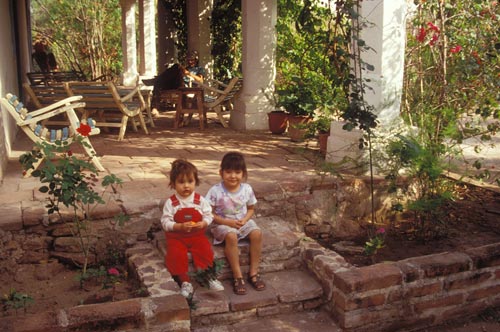
Two Figueroa children at their grand parent's ranch.  Alamos, Sonora, Mexico.  Photo by Anders Tomlinson.

Two girls and their uncle, in the back rest reading, after breakfast.

We all went into the kitchen to join mother cooking breakfast. There was no TV, radio or computers but there was paper and pen. And so the Figueroas entertained themselves by drawing caricatures of each other. There was an innocence in the room as they showed their cartoons and the others laughed. Joyous home entertainment without electricity.

Outside, the only sounds were time passing by as these humans reenacted a common thread throughout all of mankind from the creation of paper to the power grid. So much had changed so quickly. The world Antonio knew is not the world his father knew. Many call this progress. Few ask of unintended consequences. I felt at home in a world I understood.
You can see Anders art at artfeats.com.

Grandfather on his daily walk to town from his ranch.  Alamos, Sonora, Mexico.  Photo by Anders Tomlinson.

Every day he walks the long walk from the family ranch and returns.

Antonio’s father, as a young man, held a infant girl in his arms. This baby grew up into a young woman and the now aging man married her. Together, they would have seventeen children. Antonio was the last born born to an elderly man who now hardly, if at all, recognized his youngest child.

I had seen the father in the late afternoon walking into town. I asked Antonio where he was going and he answered ” to church and then he turns around and walks back to the ranch.” Walking is the form of transportation that most people use in Alamos. Elderly people on their daily walks are a common site. In many cases one could tell time by their passing by. The father’s walk from the ranch is another leap, as far as walking goes, in magnitude order. I am sure there are well-worn foot paths through arroyos and over hills, as old as man, that cut the actual distance compared to the many miles our taxi negotiated in reaching the ranch from town.

Spring time, looking west from a dry distant hill at Alamos, Sonora, Mexico.  Photo by Anders Tomlinson.

It is late Spring looking west at Alamos from the ranch's high ground.

Antonio and I hiked after breakfast to the top of the hill the ranch sat on. The hills and valley were dry. The sky was dirty with dust and smoke from burning farm fields surrounding Navajoa to the west. This is the way it is in late spring. Alamos is two hills to the west and Cacharamba crowns the western horizon. Beyond that the Sierra Madre foothills descend to the great agricultural flood plains and the Sea of Cortez. In the distance a young boy was playing stick with his dog. It could have been Antonio’s ghost from 15 years past. From here, a place to take in what living really means, the struggles and rewards travel on the wind. We, as one, are the past, present and future.

Two Figeroa Brothers, one a photographer the other an architect-artist.  Alamos, Sonora, Mexico.  Photo by Anders Tomlinson.

Two brothers raised on the ranch, a photographer and an architect-artist.

The seventeen Figueroa children went their own ways. A brother became a priest, a sister worked in the Vatican. Some became teachers. Some did not marry and those that did planned to have two children, no more. It is an amazing step forward in one generation, 17 children to two. Much of this deals with economies. Modern children are an expensive investment and for some marriage is an economic challenge. Above, Antonio poses as a drunk outside an Alamos bar and his brother, an artist-architect working in Guadalajara, stands next to one of his murals he painted while in Alamos. Both of these brothers are skilled and accomplished. I think back to their bedroom on the ranch. This is where they came from, a room of books and drafting tables.

Antonio Figueroa taking late afternoon pictures of Alamos, Sonora, Mexcio.  Photo by Anders Tomlinson.

Antonio Figueroa doing what he loves, taking pictures with nature's warm light.

A photographer and his town. A man in the moment. A father seeing the future. A husband embracing the present. A son understanding the past. This photo of Antonio, at work, is a portrait of all these moments and much more. Summer comes once a year, ten times a decade and a hundred times in a century. Each summer washes away the previous seasons and starts many growing cycles anew. Nature’s cycles are meaningful, as is Antonio taking sunset pictures of summer Alamos from high ground.

22 … Mexico’s best friends are its hard working photographers…

Antonio Figueroa, photographer in Alamos, Sonora, Mexico.  Photo by Anders Tomlinson.

Antonio Figueroa sets up for a sunset shot ending a brilliant summer day.

Antonio, I am glad to hear, remains a professional photographer in Alamos, Sonora, Mexico. He was of great assistance during my 1996 summer shoot. His enthusiasm for what he was doing, and eagerness to try new things, made him a great working companion. Antonio Figueroa knows he lives in a special place filled with family, friends, man-made and natural beauty.

Antonio Figueroa photographing roses in the plaza, Alamos, Sonora, Mexico.  Photo by Anders Tomlinson.

From the macro to the micro it all has potential in Antonio's eye.

If American photographers think life is hard try stepping into a Mexican photographer’s shoes. The market is limited by the their customers incomes. And most of these people can only afford photos of turning points in their family life. For artists like Antonio, it is a balancing act to pursue his love of landscape, light, form – magical moments camera lens create and capture – with little market demand for these efforts. These were the days of film cameras which costed much more in Mexico than the USA. Antonio did not have access to the film stocks I was shooting. In some cases he would need to ride a bus for half a day to find film for a shoot, and there was no guarantee it was on the shelves. I hope the digital age is making life easier for professional Mexican photographers.

Antonio Figueroa and his photos on display.  Alsmos, Sonora, Mexico.  Photo by Anders Tomlinson.

It was a proud moment for Antonio to display his work at a photo exhibition.

Antonio was part of fotoseptiembre which ran for the month at the Museo Constumbrista de Sonora in Plaza de las Armas. He is seen here with his work. It took a great effort to frame his pieces as he did. No shortcuts. I have selected twelve events or people as subjects for short Alamos essays. Antonio is one of these amazing stories. More to come.

©2013 Anders Tomlinson, all rights reserved

Bishop Reyes Cathedral

88… Inside Bishop Reyes’ Cathedral where time stands still…

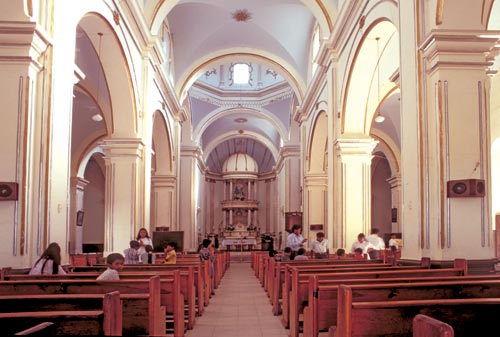
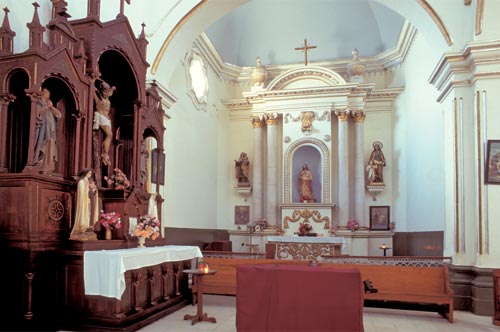
Looking down the center aisle, Bishop Reyes Cathedral interior, Alamos, Sonora, Mexico. Photo by Anders Tomlinson.

There always seems to be someone, or group, inside the church.

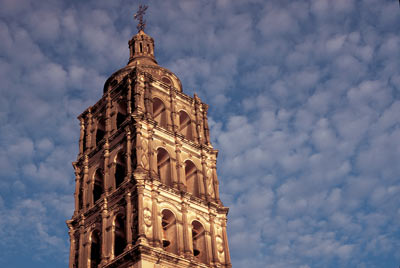
Bishop Reyes’ Cathedral takes up the entire southern side of the Plaza de las Armas. Its three tiered belfry towers above town and touches low passing clouds. Along with multiple daily services the church is also a religious classroom.

Jesuit missionaries founded missions in southern Sonora between 1613 and 1620. Early settlements grow around a mission protected by a fort. The early Jesuits brought Catholic teachings to the Indians as well as trade and farming skills.

From the balcony, Bishop Reyes Cathedral Interior, Alamos. Sonora, Mexico. Photo by Anders Tomlinson.

From up high the church looks taller and the echoes sound louder

Think of all the people who have walked on this floor and sat in these pews. Imagine hundreds of voices reverberating off these walls as they enter and leave the church and the wonderful choir filling the space with song during services. And there is always the church bells tolling time 24-7.

Here is a long history. Bachiller y Licenciado Pedro de Barecelon was an acting priest from May, 1685 to August, 1686. The first parish priest, Father Francisco Saenz de Carrissa, wrote the first recorded date in Alamos history in a “book which are entered the Baptisms, Burials and Marriages started by me on the 28th of August, 1686.”

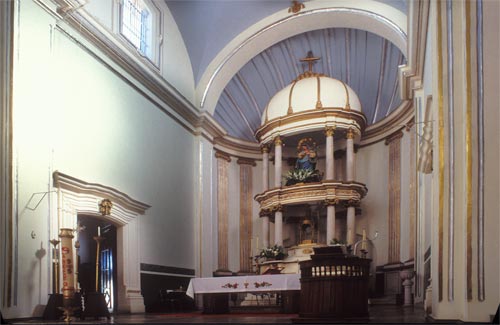
Main altar, Bishop Reyes Cathedral interior, Alamos, Sonora, Mexico. Photo by Anders Tomlinson.

The Cathedral's high ceiling atmosphere creates its own sound and weather.

Grandeur on a human scale. No matter how and where one lives this is an extension of their house. It is their communal living room. It is a place that they can come and be with others or be by themselves. It is their place in their time for all of time.

Parish Priest Don Pedro Gabriel de Arago in 1735 reconstructed La Purisima Concepcion, on the same site as of the originalt small Alamos church made from adobe and cut rock with a beamed ceiling. A 1736 inventory by visiting Bishop Martin de Elizacochea Dorre Escheverria noted all the church’s religious objects were silver except for the gold shrine and chalices.

Pulpit, Bishop Reyes Cathedral interior, Alamos, Sonora, Mexico. Photo by Anders Tomlinson.

Here one can come, rich or poor, and be part of something larger.

This is a place of words, music and prayer. As I was taking these photos I watched and listened to praying individuals scattered across the front pews. The intensity of their prayers spoke of their needs or losses. Before me was the human condition in the court of last appeals.

King Carlos III in 1781 ordered a new diocese for Sonora, Sinaloa and the Californias. Bishop Antonio de los Reyes was stationed in the then capital of Arispe in 1783. A few months later he moved to Alamos to avoid Indian raids. Bishop Reyes started to build around and expanding the old church. Services continued here, on the same site as the present cathedral.

The old church was torn down in 1794 when the new cathedral’s walls were ready for rafters and supporting columns. Don Juan Ross was, according to church records, the first contractor. He received a payment of $11,250 pesos in 1786. The cathedral was finished in 1803 under the supervision of Father Camilo Sanmartin. The silver and bronze altar rail was made in Oaxaca. A silver candelbra and lamps provided manmade illumination. This was a fine cathedral, simple but commanding on the outside and elegantly reassuring on the inside.

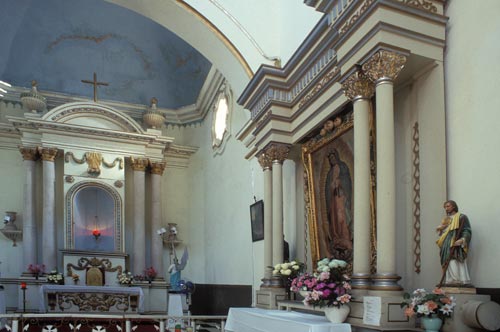
Sanctuary, Bishop Reyes Cathedral interior, Alamos, Sonora, Mexico. Photo by Anders Tomlinson.

Life is not easy, on many levels, and sanctuaries like this ease the pain.

In the home of God, there is handcrafted furniture, art, sculptures, color, gleaming metals, proportion and design. Natural light streams in. In this home of God, Catholics gather and take on life together as a huddled mass. Outside, it has been forever changing as modern times evolve. Inside, it always strives to remain being a continuum of the past, above and beyond forces of change. Life is not easy for the church-goers and it is not easy for the church.

From 1855 to 1861 the War of Reform, church against state, raged on between church members Conservatives and reform minded Liberals. Benito Juarez had created laws that limited the church’s powers, privileges and holdings. Don Jesus Gandara led the Conservatives against General Ignacio Pesqueria’s Liberals supporting the new federal laws. During the war Alamos was won and controlled by both the Conservatives and Liberals. At times, Alamos citizens were engaged against each other.

In 1859 Apaches reached the Alamos district. Alamos Mayor Manuel Salazar came to a peace agreement with the Indians in December 1859. And then the French landed troops in Vera Cruz in December 1861. Conservatives and Liberals ended their War of Reform and came together to defend Mexico from foreign invaders. These were tumultuous times surrounding church and state and Bishop Reyes’ Cathedral stood its ground, as it does today.

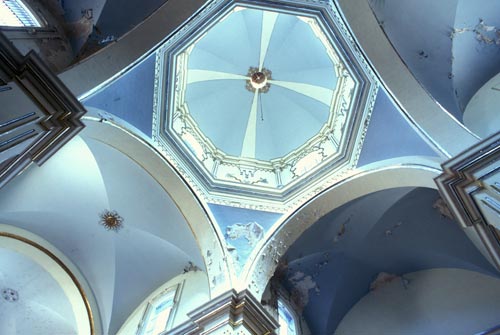
Looking upward. Bishop Reyes Cathedral interior, Alamos, Sonora, Mexico. Photo by Anders Tomlinson.

Through the years weather and armies have laid siege on this church.

It is true, it is not easy to maintain Bishop Reyes’ Cathedral. There are issues of scale, materials, gravity and weather. And warring man has shot at it, broken in and plundered over the years. The church is a symbol respected by many and held by others, through the years, in low regard.

General Angel Martinez on January 7, 1866 near Alamos defeated the Imperialists commanded by Colonel Jose Maria Tranquilino Almado. General Martinez ordered that the church stripped of any precious metal that could be melted. During the next twenty years days of peace were few and far, scattered between unending revolts, battles, wars and plundering.

And through it all, to this very day, winds and rains made life for the Cathedral a battle of man’s maintenance against nature’s forces. The original designers, builders and artisans would be proud that the Cathedral, their efforts, still stands.

87… Details from inside Bishop Reyes’ Cathedral…

Child holding hands, Bishop Reyes Cathedral interior, Alamos, Sonora, Mexico. Photo by Anders Tomlinson.

The innocence of youth looking toward a future of hope and promise.

So much of most human life revolves around childhood, children, grandchildren and…
Those needing guidance and care become those that guide and care.

Resting Priest, Bishop Reyes Cathedral, Alamos, Sonora, Mexico. Photo by Anders Tomlinson.

And we all lay our heads downs to rest and our bodies follow.

Religion speaks of yesterdays, todays, and tomorrows. It speaks of better days and better places. Religious followers are asked to endure and conceptually, eventually, benefit from their days of survival and struggle on this small planet.

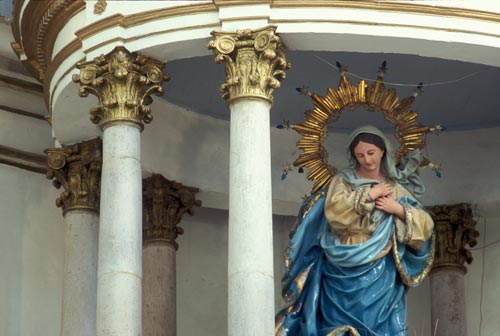
Bishop Reyes Cathedral interior, Madonna and Child, Alamos, Sonora, Mexico. Photo by Anders Tomlinson.

Moments of comfort and caring soothe the human condition.

Detail is added to detail as we near the church’s heart, the congregation’s visual focal point and cosmic backdrop. It is here, for this moment, that all are equal under a supreme and unifying force, the power of human belief and the human drive for universal understanding. Here all seek, in their own ways, answers to what life is.

Ornate Column in Bishop Reyes Cathedral interior, Alamos, Sonora, Mexico. Photo by Anders Tomlinson.

There are columns that support and there are columns that sustain.

I often wonder about the artisans and workers who made columns like this. What was their human condition as they strived for supreme beauty. What was their roof made from, what did they stand on as a floor, what food was served for dinner? How old did they live to be? How many children did they have? And who has come along to restore and maintain these columns? And how did their lives differ from the one’s that came before? I would rather ask a question than give an answer.

Christ on Cross, Bishop Reyes Cathedral interior, Al;amos, Sonora, Mexico. Photo by Anders Tomlinson.

Everyone that visualizes Christ know him in their own light and setting.

Humans seek forgiveness. Humans need forgiveness. Salvation resonates and persists across humankind. It is human to feel imperfect. It is human to seek direction. It is human to come together. It is human to leave. It is human to establish us and them. It is human to protect resources. It is human to feel superior to those outside of their own tribal social circles. It is human to war. It is human to demand retribution. It is human to accept redemption. It is human to take advantage. It is human to overlook unintended consequences. Vulnerable human psyches, looking for direction, migrate across uncharted existences. Be the humans dominate or submissive, rich or poor, all humans have hope, fear, love, hate, need, desire, doubt, confidence, triumph and defeat. And so this is what the human condition has been, is and will be as suns rise and the suns set.

18 … It is all in the details, it is all in the material, it is all in the intent…

plate in bishop reyes cathedral, Alamos, sonora, mexico.  Photo by Anders Tomlinson.

Welcome to Bishop Reyes Cathedral. Think of the scenes it has witnessed.

Ladies from the wealthy homes of Alamos were asked to contribute one of their fine china to decorate the nearly completed cathedral. These plates once sat on elegant dining tables and then they were volunteered to be hung outdoors and exposed to the elements for now over 200 years. Talk about culture shock. A lucky few remain in place.

Cathedral bullet holes, Alamos, Sonora, mexico.  Photo by Anders Tomlinson.

Here the law of equal and opposite reactions is clearly evident, etched in time..

Who fired these bullets? Was it Spanish soldiers, Federalists, Centralists, Mexican colonists, Imperialists, Yaquis, Apaches, Centralists, Conservatives, Liberals, French troops, Independents, Mayos, Reformists, Highway Men, Villistas or local teenagers having target practice? The wealth of Alamos was targeted by every political movement to finance their causes. Alamos was the place to plunder. Alamos has seen the best and worst of human nature.

Bishop Reyes Cathedral detail, Alamos, Sonora, Mexico.  Photo by Anders Tomlinson.

Strong sun highlights fervent beliefs as shadows dance across chiseled features.

Official records indicate that work on the church began in 1786. Alamos elected three town folk to supervise work and manage the budget. The church was finished in 1803. Today, as it always has, a cathedral bell announces the hour and half-hours and masses. Time marches on one bell peel after another, one year after another, one century after another. This is Alamos time.

64… Two churches, two bells, two men and two towns…

tino, caretaker of the church, Alamos, Sonora, Mexico.  Photo by Anders Tomlinson

Tino and his beloved Bishop Reyes Cathedral face another sunset.

I knew this would be an interesting photograph. A man, who, in his face, had seen much of what life has to offer, a church bell framed by its belfry and a natural backdrop stretching from Mirador to Sierra Madres. All were lit by a low brillant sun whose golden rays were diffused by humid shimmering heat waves. We only had a moment to take this photo, as we were speaking he was summoned to fix a pressing property emergency, this is what maestro Tino did. I asked him to look towards the sun and pressed the shutter button. One click and done, another moment saved for the future, this is what Anders does.

Bishop Reyes Cathedral

Bishop Reyes’ Cathedral takes up the entire southern side of the Plaza de las Armas. Its three tiered belfry towers above town and touches low passing clouds. Along with multiple daily services the church is also a religious classroom. Religion speaks of yesterdays, todays, and tomorrows. It speaks of better days and better places. Religious followers are asked to endure and conceptually, eventually, benefit from their days of survival and struggle on this small planet.

To see more Alamos Journal pages.

To return Home.

©2013 Anders Tomlinson, all rights reserved.

Conquistadors

72… Forces of change challenge human nature at every turn…
Part One of Three on an Eternal Debate.

Summer vegetation in the surrounding hills, Alamos, Sonora, Mexico.  Photo by Anders Tomlinson.

In days of old, man moved by foot paths through sparsely populated lands.

There was a time and a day that Indigenous people, speaking one of 18 Cahita dialects, were those who knew this land as their own. They numbered 115,000, the largest Indian group in Northern Mexico, and lived along the lower reaches of the Sinaloa, Fuerte, Mayo and Yaqui rivers. The Spanish called these agriculturalist Indians, spread out across the region in small groups, “rancheria people”. They had come from Asia, and possibly Europe, thousands of years ago. We know that those that came from these distant places were in turn descendants of those who started the great human migrations out of Africa and the Middle-east. There is truth in the belief that we are all, under the sun, brothers and sisters. Various cultures and traditions, if they helped people survive, will be adopted by others. This is a hallmark of human nature – adaptability.

Columns and window details, Alamos, Sonora, Mexico. Photo by Anders Tomlinson

End of day's sun illuminates a classical column of another time and land.

One day the sun came up and menacing rattles of Spanish Conquistador swords, moving fast on old Indian trails, grew louder. December of 1529, Nuno Beltran de Guzman, once a lawyer, led an army of 500 Spanish and 10,000 Tlaxcalans, Aztecs and Tarascans into Sinaloa. March of 1531, Guzman defeated 30,000 Indians in present day Culiacan. Many that survived were captured and enslaved. Later, Guzman’s Amerindian army was wiped out by epidemics and hunger. His was a reign of terror. Spanish colonialization was approaching Alamos.

And then Silver was discovered near Alamos. And the world was attracted by the riches:
miners from Europe, merchants from India, silk makers from Japan, coin makers from China, Philippine sailors and to work the mines: African slaves, local Indigenous people, free mulatos and Indians from other parts of Mexico. Globalization arrived in Alamos.

And the riches brought in the finest goods from around the world. An international settlement was growing along the arroyos. Cultures and traditions blended together as did the people. Apexes of personal consumption were reached by those who could pay the price. The poor observed the rich and knew they were the human engines that made the rich richer. Lessons on modern times were there to be learned and mastered, the art of supply and demand was at hand. Consumerism flourished in Alamos.

Column and shadow on Calle Comercio, Alamos, Sonora, Mexico.  Photo by Anders Tomlinson

The shadow of Southern Spain spread across Alamos and the Southwest.

Alamos became a valuable resource to fund California coastal settlements along with emerging political movements – militias throughout Sonora and Sinaloa. Alamos was now helping export traditions and customs that not long ago had arrived here.

And then, things change like things do. Much of the International mining community left Alamos for gold and silver discovered in Central California’s Sierra Nevada foothills. Miners come and go to where there is buried treasure and international prices high enough to make mining profitable. Alamos experienced economic fluctuations that is the nature of mining boom towns. Many of these become ghosts towns and others continue on. Some Alamos families faithfully remained and made their livings amongst the aging architecture in a village that was a reduced footprint of its former self. The world had touched them. It could be seen in the art, furniture, books, and music left here and there, and so it was and so it is. Alamos was one of the mining towns that accepted, adapted and continued on. Over the next hundred years Alamos had a couple of small economic upturns and several longer downturns that turned into dust covering ruins of once grand mansions. The silver boom and busts had come and gone.

©2013 Anders Tomlinson, all rights reserved.
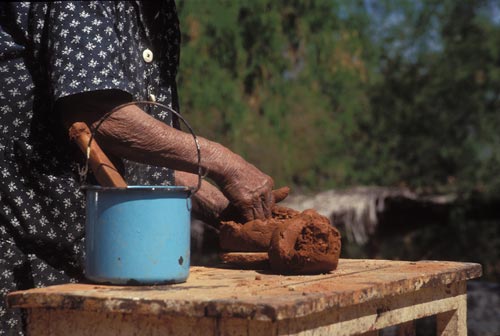
Moorish influences

95… A mysterious building on Calle Gral Antonio Rosales and Mariano Matamoros…

Red brick two-story Moorish style building, Alamos, Sonora, Mexico.  Photo by Anders Tomlinson

Looking down from Red Cross hill at a two-story red brick building.

There, north of the Plaza, or below in this photo, is an interesting L-shaped building. The red- brick building in the bottom right corner is this entries’ subject, Each of its many doors opening to the street must have had stories, history, take place within. The rock outcropping in the photo’s foreground can be clearly seen from town.

Walking to town on Calle Rosales, Alamos, Sonora, Mexico.  Photo by Anders Tomlinson

Walking from a barrio to central Alamos for any of a variety of reasons.

Here, a Calle Antonio Rosales runs into a building. These two women are only a block away from the Mercado and the Alameda. They most likely are out walking about doing their daily food shopping. On the other foot, they could be going to the bus station, or visiting a doctor or dentist, doing errands, visiting friends, picking up repairs, or shopping in various stores, stalls and carts comprising the business, retail and service center of Alamos. The woman on the right is carrying a large bag, a good clue shopping will be included on this walk.

The jog where on Calle Cardenas, Alamos, Sonora, Mexico.  Photo by Anders Tomlinson

Calle Gral Antonio Rosales jogs across Calle Mariano Matamoros.

A woman walks west on Calle Gral Antonio Rosales which runs east-west through the northern part of central Alamos, one street south and parallel with Arroyo de La Aduana. Calle Mariano Matamoros, left to right, is three blocks long with the northern end beginning at Arroyo de La Aduana and the southern end running into the Museo Costumbrista de Sonora’s north facing wall. In the background a hardware store displays its wares on the street. Marketing, marketing, marketing… location, location, location…

it is a wonderful day to out walking on Calle Gral Antonio Rosales and Calle Mariano Matamoro near the Alemada, Alamos, Sonora, Mexico.  Photo by Anders Tomlinson.

It is a wonderful day to be out walking and visiting on Calle Rosales.

An old woman with walking stick, dressed in grey, baby blue and pink, stands at the red brick building’s entrance as another woman walks by in the street headed east. One would think all the shuttered doors, so near the Alameda, once had vendors inside. This does not look like a typical residence, it being without a single window treatment at street level and also one of the few two story structure in Alamos, Sonora, Mexico.

Sunrise shadoes on the red brick building, Calle Gral Antonio Rosales and Calle Mariano Matamoro, Alamos, Sonora, Mexico.  Photo by Anders Tomlinson.

The architectural shadow of one building cast upon a sun blazoned building.

Early morning sunlight music plays on the moorish details of this building which are similar in spirt to the municipal government building, the Palacio, also made of red brick. History is here to be comprehended as one looks at textures and patterns of the old buildings. Think back to the day when the stones and bricks were being laid in place. Pause, look and listen.

Detail with sleeping pup, red-brick building on Calle Gral Antonio Rosales and Calle Mariano Matamoros, Alamos, Sonora, Mexico.  Photo by Anders Tomlinson.

What a wonderful vantage point for a dog to take a morning siesta.

A resident of the red-brick building rests in the warm sun. At this time, 1996, the owners of the town’s printing shop, which had a sign I remember as ” Impresta F. Hernandez, Sucn,” managed by Elena del Carmen, lived here. The printing shop was working with letter presses that could have been over a hundred years old. The shop was planing to purchase a computer and move into the digital era. History is forever changing for history is the record of change.

Plaza de las Armas, Bishop Reyes Cathedral, the Palacio are all seen from Red Cross hill.  Alamos, Sonora, Mexico.

The Municipal Palacio and the brick building look as if they are related.

We return to the northeastern hill overlooking Centro Alamos. From here the Palacio, in the upper left-hand corner, and this two story brick building, which resembles a mercado from another day, in the bottom right-hand corner, bookend the plaza and church.

©2013 Anders Tomlinson, all rights reserved.
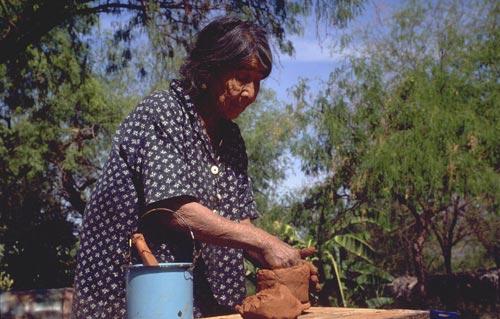
History: Time Marches On

An introduction to a Short History of Alamos, Sonora, Mexico.
“Here is something Special”, Spanish explorer Vasquez de Coronado noted in 1540 as he headed north, passing by tall white rocks on Alamos de Sierra. This is the opening chapter to “A Short History of Alamos” written, filmed and edited by Anders Tomlinson. Narrated by Bruce Miles. Soundtrack by AtomicSonics and Estudiantina de Alamos.

Alamos shares a strong maternal bond, steeped in history, with all the Southwest.
Juan Batista de Anza departed Alamos in September 1775 with silver, and local families, to settle “Monterey and the Californias”, including San francisco. Another expedition, five years later, left Alamos to settle Los Angeles.

The conclusion to a Short History of Alamos, Sonora, Mexico embraces the Sierra Madre.
Here, Bishop Reyes’ Cathedral in the Plaza, a three-tiered belfry, shines gold in morning light. Here, looking east, one’s imagination is stirred by the forbidding beauty of the Sierra Madre Occidentals. Together, they shape the Alamos experience.

Special thanks to the following contributors:

Pember, Elizabeth and Kit Nuzum, Puerta Roja Inn, Estudiantina de Alamos, Quartet de Alamos, Los Angeles Cathedral Choir, Museo Costumbrista de Sonora, Antonio Estrada, Francis Curry, Antonio Figueroa, Teri Arnold, Sharon Bernard, Rudy Hale, Chaco Valdez, Dr. Joaquin Navarro, Ernesto Alcorn, Antonio Mendoza, San Sanchez, June Ray, Swickards, Meisenheimers, Frielobs, Cooks, Stephanie Meyers, Bruce Miles, Earle and Joan Winderman, Doug Reynolds, Robert Ganey, Gary Ruble, AtomicSonics, William Brady, R. Harrington, Donna Beckett, Del Mar TV 38, Robyn Ardez and all the people of Alamos for their grace, warmth and hospitality.

To see more Alamos Journal pages.

To return Home.

©2013 Anders Tomlinson, all rights reserved.
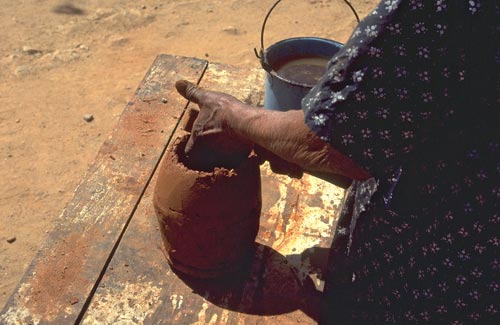
Summer: Explosion of Color

The rainy season arrives on a cannonade of lightning as surrounding hills turn to jungle and children of all ages, cooled and cleansed by spirited showers, dance on glistening streets…

An occasional summer storm floods three arroyos in Alamos with mountain runoff.
Summer is the rainy season. Occasional tropical storms, remnant of hurricanes, come in from the Sea of Cortez to the west. This is the morning after a storm hit the region hard the previous evening.

A summer rodeo – music concert with trained horses dancing the two step.
Throughout the summer there are activities to enjoy in Alamos, Sonora, Mexico. On this day the rodeo came to town along with a Mexican pop singer who was backed up by the local “Halcon de Sierra Alamos” band. The stars of the show, which started late, were the dancing horses.

To the east, the Cuchujaqui River is a nearby Alamos summer getaway.
The Cuchujaqui River is to the east of Alamos, Sonora, Mexico. Three arroyos join together in Alamos and flow to the Cuchujaqui River, on to the El Fuerte River and ultimately the Pacific Ocean. It is a cooling retreat for Alamos folks especially in the hot summer. On this day, Antonio, an Alamos dentist, spear-fished one bass, a couple of catfish and many carp.
A good time was had by all.

Summer is the Alamos season of vibrant color, rains and nights of natural magic and wonder.
Lightening on a warm Alamos summer evening is a show to remember. The romantic Plaza is a wonderful vantage point. Rolling thunder punctuates child’s play and lovers embraces.

Daybreak in the Plaza is a quiet song that slowly builds into a symphony.
As the day turns from dark to light watch Alamos come alive. Everyday is a new start, another challenge, another opportunity. The late Levant Alcorn is seen collecting bird feathers on his morning walk around the Plaza de las Armas.

Estudiantina de Alamos performs before a packed Plaza as a film crew captures the event.
It is a big day in the Plaza. A TV crew has come to town and is filming a music concert. Estudiantina de Alamos, a crowd favorite, is performing. They will also back up several other acts. The bandstand is surrounded by adolescent girls and an scattered smiling mothers.

In the hearts of many, Alamos is the center of the universe.
Independence day starts early in the morning with a municipal parade through the town’s colonial center. Alamos school kids, the first high school in the Californias started here, and the entire city government take part. In 2010 the students added their own uniformed marching band to the parade. From children to government, Alamos continues.

This is a Blessed Season for a Multitude of Reasons.
In mid-afternoon the air pressure begins to drop and a stiff wind sweeps the valley from the west, a storm is coming. Night falls and showers start. We go from the Plaza to the Alameda and back. The following day the sun comes out and then is covered by clouds. Kids play and men work gathering sand in the arroyos. A summer day can be complex in its textures and atmospheres.

If ones wants to have fun, one can have fun. And today Alamos is smiling.
The season’s strongest storm passed through in early September. A couple of weeks later there was still a little water flowing in the arroyos. Celebrating Mexico’s Independence Day, thousands of folks, young and old, gathered in the Arroyo de la Aduana north of the Plaza.
Dancing horses, music and beer is everywhere.

Folks from all over the Alamos region gather in the arroyo to celebrate Independence Day.
And the celebration in the arroyo continues. Everyone wants to have a good time and enjoy the warm sun, brillant blue sky and the murmurs of running water. There is much to do and see. The party will continue late into the night under beautiful Sonoran stars. How romantic.

Alamos is home to the jumping bean along with elements that touch all the senses.
This video features the jumping bean, a drive into town from the west, and several cameos: church bell ringing, closeup of flood waters, timelapse of clouds passing in front of Mt. Alamos, and a street puddle at night reflecting shimmering light.

A Ranch on the outskirts of town, looks forward to the future.
Estancia Crysalis, along the El Camino Real, is a mile southeast of the Plaza in Alamos, Sonora, Mexico. The 140 acre ranch, on Sierra de Alamos sloping foothills, is focusing on a new day. And new opportunities gliding on tropical breezes.

Special thanks to the following contributors:

Pember, Elizabeth and Kit Nuzum, Puerta Roja Inn, Estudiantina de Alamos, Quartet de Alamos, Los Angeles Cathedral Choir, Museo Costumbrista de Sonora, Antonio Estrada, Francis Curry, Antonio Figueroa, Teri Arnold, Sharon Bernard, Rudy Hale, Chaco Valdez, Dr. Joaquin Navarro, Ernesto Alcorn, Antonio Mendoza, San Sanchez, June Ray, Swickards, Meisenheimers, Frielobs, Cooks, Stephanie Meyers, Bruce Miles, Earle and Joan Winderman, Doug Reynolds, Robert Ganey, Gary Ruble, AtomicSonics, William Brady, R. Harrington, Donna Beckett, Del Mar TV 38, Robyn Ardez and all the people of Alamos for their grace, warmth and hospitality.

To see more Alamos Journal pages.

To return Home.

©2013 Anders Tomlinson, all rights reserved.
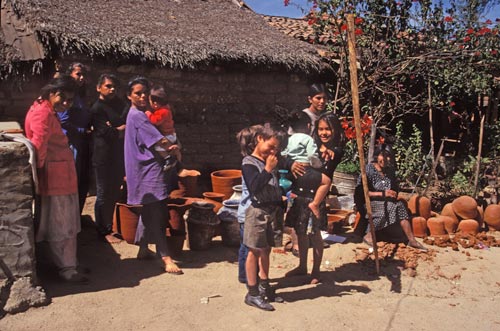
Spring: Transitions Abound

Neighboring towns come to Alamos in the spring and celebrate their Indian Heritage.
Indian Day comes to Alamos in the Spring. Villagers from around the Alamos region come by bus to the Alameda and celebrate their native culture. Dancers, musicians and exhibits fill the business center with color, motion and music. Nacion Mayo and Nacion Popagayo are some of the regional dancers, musicians and exhibits competing in front of a panel of judges.

A mourning mother’s deep wails, crows cawing – perched on white crosses…
It is a warm spring day as we explore the “Pantheon” – (Cemetery) on the road to the Sierra Madres, minutes east of the Colonial Center. The ages speak here. Be it ancient mountain sounds or human voices, mourning and celebrating since 1794. All is timeless, and all thoughts are a point on our circle of life.

It all begins and ends in the Working Center of Town.
The Alameda, center of activity, transportation hub, bars, offices, shops, gas station and markets … This is Mexico working, traveling and playing. Boom boxes serenade food carts and shoe shines.

Not that long ago the best way to travel to Alamos was by mule train.
Alamos has a 5,000 foot runway, at 1,300 feet elevation, awaiting your landings and takeoffs.
The Alamos City Airport, to the west, is minutes away from downtown. Talk about arriving first class.

Behold a Cornucopia of Color, Shapes, Textures and Scents.
Alamos has six seasons a year and a diversity of native and imported flora. Gardening is both a passion and industry. It can become all consuming. It can be an mental oasis, freedom from the outside world’s cares and concerns. And it is something to share with those who visit, be it bug, bird, mammal or human.

<

Spring Day in the Plaza – Part One: The Race.
Spring days in the Plaza de Las Armas are a portrait of the community at large. Here, we start with small children with big back packs enroute to their classrooms. This sunny morning, there are school races, boys and girls, around the Plaza.

Spring Day in the Plaza – Part Two: Getting Ready for another Day.
In the cool of the morning folks go about hand sweeping and cleaning the streets and sidewalks of Alamos, Sonora, Mexiso. Residents take pride in the town’s appearance. Enjoy a 360 degree pan of the plaza from the gazebo-bandstand in its center. We end with the garbage men making their rounds.

Spring Day in the Plaza – Part Three: People come and go and the day goes on.
This is easter weekend in the Plaza De Las Armas. People come and go across the Plaza or are headed for the bus station to leave town for the holiday. A crowd leaves the church and will travel along the streets of Alamos following a reenactment of the Crucifixion.

Spring Day in the Plaza – Part Four: From Light to Night.
Afternoon shadows begin to creep across a Plaza shared by all: young and old, workers and those relaxing on a bench, going from here to there, meeting others, watching Alamos pass by, hearing the news, being one with all that surrounds… Horseback, on foot, bicycle or driving – it is wonderful to be part of the eternal promenade.

The Streets of Alamos, Sonora, Mexico become Another Time in Another Place.
Easter week in Alamos is a special Spirit. Viernas de los Delores is celebrated on Good Friday. Decorated altars are displayed in windows and doorways throughout town. In the evening people stroll the streets viewing these commemorations of Christ”s suffering. In this segment we join a reenactment of the Crucifixion through the streets of Alamos to Guadalupe Hill.

Fast paced music video that is more than its parts, much like Alamos itself..
This is an experimental clip that weds close-ups textures shot out a moving car’s window and 120 blended stills images of Alamos life. High speed video at its best. Alamos, Sonora, Mexico has never looked like this.

In another era, Estancia Crysalis was a working horse ranch.
Today, the spirits of these departed steeds, proud Arabians, are present, be it a sound of a branch breaking under weight or a small flurry of dust. Shut your eyes and listen, they are still here.


Special thanks to the following contributors:

Pember, Elizabeth and Kit Nuzum, Puerta Roja Inn, Estudiantina de Alamos, Quartet de Alamos, Los Angeles Cathedral Choir, Museo Costumbrista de Sonora, Antonio Estrada, Francis Curry, Antonio Figueroa, Teri Arnold, Sharon Bernard, Rudy Hale, Chaco Valdez, Dr. Joaquin Navarro, Ernesto Alcorn, Antonio Mendoza, San Sanchez, June Ray, Swickards, Meisenheimers, Frielobs, Cooks, Stephanie Meyers, Bruce Miles, Earle and Joan Winderman, Doug Reynolds, Robert Ganey, Gary Ruble, AtomicSonics, William Brady, R. Harrington, Donna Beckett, Del Mar TV 38, Robyn Ardez and all the people of Alamos for their grace, warmth and hospitality

To see more Alamos Journal pages.

To return Home.

©2013 Anders Tomlinson, all rights reserved.
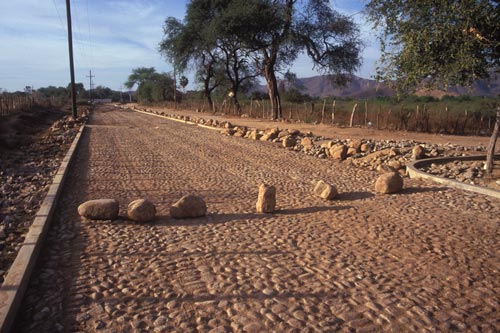
Winter: A Time of Grace

Buckle-up as we take a super fast car ride through Alamos on a grey winter day.
Driving Across Alamos on an overcast December day starts at La Puerta Roja Inn. We head east and circle the Plaza de Las Armas before heading to the Panteon – Cemetery. We head back to La Puerta Roja exploring different routes. The best way to travel is walking.

A parade of lights brings song and joy to colonial Alamos streets during Christmas.
We see a traditional Posada visiting from house to house and arriving at Casa de los Tesoros where children in their holiday attire play and adult family take in another Christmas in Alamos. It is a tradition. Another scene is a trip to the Alameda.

A special time in a special place for people who feel special.
This is the introduction to a film that was shot over the 1993 winter holidays in Alamos. This is a glorious season for the town. We start out at the airport and head east into town and visit the Alameda lined with stores and professional offices.

Pember told Anders, “always call us Alamos, Sonora, Mexico.” And Anders has.

Pember and Elizabeth Nuzum were a major part of the North American Community for decades. Their casa next to the Church on Calle Comercio #2 greeted many many who visited Alamos, including Anders. It is not uncommon to have rain squalls in December. And it was common to hear Pember playing his theater organ in the Nuzum music room. Those days are gone. But the spirit lingers, it always does.

Music is part of the Alamos fabric, the Alamos way of living.
The location is the Old Miners Hotel on the east side of Plaza de Las Armas. The event is a holiday wedding reception with imported polka band and a free flowing bar. High spirits, friends, family and a driving beat makes for a good time. Tomorrow would be another day.

Time stands still: a river moves on and letter-press printing continues.

Two days before Christmas 1993 the film crew travels out to the Rio Cuchujaqui. It is a world unto itself but not that far away from Alamos. And then we visit a print shop that has been in operation for over 100 years. Alamos had the first printing press in the Californias. One wonders if these presses are still at work. Letter presses have an imprint-edge that can be felt with the fingers and the soul.

They come from all over the region with things to buy and sell.
Sunday, north of Arroyo La Aduana, there is an open-air market filled with people and music. Meals, snacks, produce, clothing, toys, tires, bikes, tools and what ever folks bring to sale fill out both sides of a colorful promenade. It is a wonderful place to shop and meet neighbors, family and friends, new and old.

Warmth Radiates off of Adobe Walls as Another Winter Day Begins.
Kite flying is popular in Alamos, Sonora, Mexico. Drinking beer outside the pickup with friends is popular. Fun and work go on side by side as we visit a wood shop.

Tis the Season of Love and Jackets.
Christmas in the Plaza de Las Armas is a time of of sharing and joy. Food, fireworks and the town coming out to be seen and see is what community is all about.

Night is Filled with Sounds and an Occasional Lull of Only Stars Whispering to Each Other.
The Bells of Alamos ring through the day and night. They have for over two hundred years. We visit the bells as they are being rung, watch folks mill about the Plaza and enter the church from the belfry. And then it is out for an evening walk from the Plaza to the Alameda. And the steps we take have been taken for hundreds of years.

Towns Live On Through the Skills and Attention of Its Maestros, Craftsmen and Laborers.
Walking is a common choice of transportation in Alamos, Sonora, Mexico. To school, work, play, church, shopping to the buses. There are taxis and cars but walking is the Alamos way for most. And in the day wherever you walk there are workers at work. Big jobs, little jobs, it is all work.

Exuberance is Everywhere: Listen for the Laughter of Youthful Rhythm.
Kids playing games on the streets of Alamos is a common fabric of everyday life. We also tour a couple of homes and their gardens. Smiles are honest and come easy.

<

It takes a Village to Make these Films.

This is the crew that captured Alamos-Christmas-1993 and our hosts the Nuzums.

Here are, left to right, Chaco Valdez, Anders Tomlinson, Gary Ruble, Donna Beckett, Robert Harrington, Robert Ganey, Jo and Kit Nuzum, and Elizabeth and Pember Nuzum. Rudy Hale and Teri Arnold also provided assistance. A fine time was had by all. Photo-Gary Ruble.

Special thanks to the following contributors:

Pember, Elizabeth and Kit Nuzum, Puerta Roja Inn, Estudiantina de Alamos, Quartet de Alamos, Los Angeles Cathedral Choir, Museo Costumbrista de Sonora, Antonio Estrada, Francis Curry, Antonio Figueroa, Teri Arnold, Sharon Bernard, Rudy Hale, Chaco Valdez, Dr. Joaquin Navarro, Ernesto Alcorn, Antonio Mendoza, San Sanchez, June Ray, Swickards, Meisenheimers, Frielobs, Cooks, Stephanie Meyers, Bruce Miles, Earle and Joan Winderman, Doug Reynolds, Robert Ganey, Gary Ruble, AtomicSonics, William Brady, R. Harrington, Donna Beckett, Del Mar TV 38, Robyn Ardez and all the people of Alamos for their grace, warmth and hospitality

To see more Alamos Journal pages.

To return Home.

©2013 Anders Tomlinson, all rights reserved.
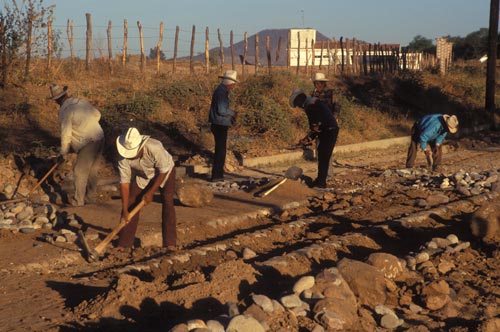
Alamos Photo Portfolios

Chasing the moment and capturing that which allows itself to be captured.

Photographing Alamos, Sonora, Mexico was a great pleasure, and challenge, for Anders Tomlinson. His portfolio of 1,200 selected scans from 35mm film – Fuji Velvia 50, Provia 100, Provia 400 and Fujichrome Tungsten 64 – is divided into 17 subjects.

Anders shooting with a 35mm Canon body before the digital dawn.
photo- Jim Morgan

Presented below are one image representing each of the subjects with the number of images in that collection. There is a DVD of all the slide-scans that is available upon request.

Aduana Time… 25 images

This donkey could have been related to animals used to grind mercury in the 17th century, The satellite dish brings a rural Aduana school in touch with all of modern Planet Earth. photo- Anders Tomlinson

Alameda Action… 87 images

Only in the afternoon heat of a summer day is the Alameda this quiet.
photo-Anders Tomlinson

Barrio Life… 222 images

Near the northern edge of town it is a simple life, not easy, but simple.
photo-Anders Tomlinson

Church Days… 52 images

Our three-tiered belfry glows gold in spring morning light.
photo-Anders Tomlinson

Flood Stage… 23 images

End of August, this is not the day to take a bicycle trip to the east side.
photo-Anders Tomlinson

Garden Graces… 74 images

Serenity and the touch of tropical sun upon bare shoulders,
it is Alamos time... photo-Anders Tomlinson

Cemetery… 45 images

Alamos families, and friends, are here in the Cemetery-Pantheon.
photo-Anders Tomlinson

Inside Walls…15 images

Art, artists and music are part of the Alamos lifestyle.
photo-Anders Tomlinson

Mirador… 24 images

A summer kite festival at the Mirador ovelooking Alamos.
photo-Anders Tomlinson

Views from High Ground…30 images

Alamos in the summertime from Red Cross Hill.
photo-Anders Tomlinson

Nature Notes… 47 images

Looking south towards Sinola from atop Sierra de Alamos.
photo-Anders Tomlinson

Night Music…90 images

Cat and dog rest near a house filled with bird cages.
photo-Anders Tomlinson

Palacio… 26 images

The Palacio is the cultural and governmental center of Alamos.
photo-Anders Tomlinson

Portraits… 96 images

Not all roads lead to Navojoa, but this one does.
photo-Anders Tomlinson

Plaza Promenade… 109 images

Later that evening a tropical storm would tear through the Plaza.
photo-Anders Tomlinson

Colonial Center… 156 images

These kids continue a long history of public education in Alamos.
photo-Anders Tomlinson

Ruins…66 images

Time to restore and build a new roof, and drink beer.
photo-Anders Tomlinson

Anders is looking for partners to publish a book that Anders would design using these photos.
These images will also be used in high-definition multi-media Alamos presentations.
Later this year more slides will be scanned with an emphasis on details of daily life in Alamos.

To see more Anders Alamos photos visit the Daily Journal or enjoy Alamos Slideshows
as well as Night Magic photos.

Return to the home page.

©2010 Anders Tomlinson, all rights reserved.
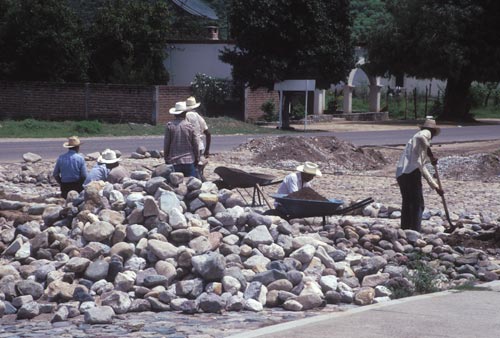
Alamos Slideshows

A Way of Life

Behold a Cornucopia of Color, Shapes, Textures and Scents.The flora of Alamos is the many splendors of Sinaloan tropical forest and Sonoran desert living together in unexpected harmony. Many properties have gardeners watering, pruning, consulting, planting, cutting, raking, commiserating, trimming and… year round. Flowers and vegetables are planted in November for winter blooms and crops that last until May or June’s heat… Mangos, papayas, bananas, palms, amapas, orchidias and other trees provide food and shelter for native and migrating birds. Cascades of colors come from flowering vines: blue veracruzana, orange trumpet, red, magenta and orange bougainvilla and… And the smells and scents that envelope one’s senses… Formal, informal… it all contributes to this symphony and riot that is the passing seasons in Alamos, Sonora, Mexico.
Photos, editing and produced by Anders Tomlinson. Music is “Jardin de Colores”, written and performed by Samuel Delatorre Dorame, from his 2013 CD “Memorias de Alamos, Sonora.”

View from Above

Mt. Alamos is some 6,500 feet above sea level. It towers 5,000 feet above the town of Alamos. It is another world, wild parrots, dry tropical forest, granite and… Up and down is a day’s effort, it is well worth it. To reach the top it is recommended to start hiking early while it is still dark and cool.
Photos and editing by Anders Tomlinson. Music from “Camino Songs” by SonicAtomics.

Here was Silver

Here, seven miles west of Alamos, at 2,500 feet elevation with surrounding mountains as high as 4,700 feet, Aduana has a few hundred people where once there was 5,000. A church, country store, cemetery, a small restaurant-inn, a plaza with a dry fountain in its center are surrounded by the past. Spanish conquistador Vasquez de Coronado camped here during the winter of 1540-41. He was searching for gold in what turned out to be mountains with veins of silver. The mines closed in 1906 after nearly 400 years of continuous mining. La Aduana was the “custom office”, it was all about taxes and royalties.
Photos and editing by Anders Tomlinson. Music from “Camino Songs” by SonicAtomics.

Graveyard

It is another day in the graveyard. Not just another day… but another day. It has been this way since 1794 when this plot of land was deemed the municipal cemetery. Graveyards are a special place: they are public art, they are public history and they are markers of their own civilization. And another day begins… and somewhere out there someone is dying and somewhere near here someone is being born. In the end it is all about this precious balance we call life.
Photos and editing by Anders Tomlinson. Music from “Camino Songs” by SonicAtomics.

Bishop Reyes Cathedral

Bishop Reyes’ Cathedral takes up the entire southern side of the Plaza de las Armas. Its three tiered belfry towers above town and touches low passing clouds. Along with multiple daily services the church is also a religious classroom. Religion speaks of yesterdays, todays, and tomorrows. It speaks of better days and better places. Religious followers are asked to endure and conceptually, eventually, benefit from their days of survival and struggle on this small planet.
Photos and editing by Anders Tomlinson. Music from “Camino Songs” by SonicAtomics.

And Then the Storm Came

The summer rains are here, the sweet night air cools warm bodies bringing relief and contemplation. The purity and hope of laughing young couples, alone with each other, drenched to the bone, clinging wet clothes, make their way home late at night splashing and dancing in cobblestone puddles. Above, the heavens explode, a cannonade of thunder rumbles across silhouetted mountain ridges backlit by fantastic lightening. It is time to go to asleep under one sheet in the cool of a warm night. And then the big storm, remnants of a tropical typhoon, arrived. In an instant the sky turned angry dark, the air became colder and a deafening wind shrieked through the trees. It rained and continuously howled from late afternoon until just before dawn. In the morning, stunned town folk came out and watched from a safe distance the fast running rivers that are normally dry arroyos. Over the coming days waters receded, children played in cool shallow pools and rock men filled their trucks with fresh sand. Photos and editing by Anders Tomlinson.
Music from “Camino Songs” by SonicAtomics.

The Commercial center of Alamos

The commercial center of Alamos, Sonora, Mexico, the Alameda, was laid out in 1769 and it has been busy ever since, some decades more than others. Today, it is bustling with activity. The bus station is the transportation hub for surrounding towns and ranches. he Alameda, center of activity, transportation hub, bars, offices, shops, gas station and markets … This is Mexico working, traveling and playing. Boom boxes serenade food carts and shoe shines.
Photos, editing and produced by Anders Tomlinson. Music is “Vientos Sonorenses”, (Antonio Saavedradorame and Samuel Delatorre Dorame) Antonio and Samuel both added to this beautiful melody titled “the Winds of Sonora”, It was arranged for the classical guitar by Samuel for his 2013 CD – “Memorias de Alamos, Sonora.”

These images were shot in 1996. The Alameda is different now. Hurricane Norbert, on October 12, 2008, flooded the Alameda and took out the giant cottonwood shade trees. It remains the commercial center.

The Place to Be and Be Seen

It is a wonderful feeling to sit with a friend in the plaza on a pleasant evening. Here, one can watch people come, be and go. This is the a place to be seen and see. When all have come and gone it becomes a romantic refuge for a young couple. 
Imagine horse drawn carriages, burro pack trains, and cars that have come into Alamos along these streets. Imagine the families that have been here for centuries. Imagine the change of government, some peaceful some violent. It is all here in the shadows of night. Photos and editing by Anders Tomlinson.
Music from “Camino Songs” by SonicAtomics.

It is In The Night That the Past Dances Down Narrow Streets

Oh little town of Alamos. Lights sparkle in the evening darkness. Pungent smells float with the shifting breeze. Music, live and recorded, rises up from the homes and neighborhoods. Birds sing under star filled skies. Dogs bark and cars pass by. Footsteps on cobblestone and smoke from fireplaces create mystic moments. Children of all ages play late into the night on the quiet streets. Night time is not threatening, it is a celebration of another day both coming and going. Night time is magical. The town seems smaller. The world becomes all you can see looking down a street. It is easy to focus on the smallest thing. And behind the walls there are other worlds: private legacies, conversations., comforts, learnings, entertainments, deliberations, dreams.
 Photos and editing by Anders Tomlinson. Music from “Camino Songs” by SonicAtomics.

To see more Alamos Journal pages.

To return Home.

©2013 Anders Tomlinson, all rights reserved.
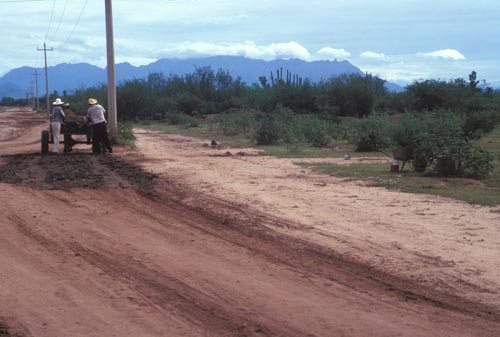
Night Magic Photos

Nightfall brings out spirits, ghosts and legends.

Oh little town of Alamos dreams, as seen from Gringo Point in the Sierra de Alamos.

Lights sparkle in the evening darkness. Pungent smells float with the shifting breeze.
Music rises up from the homes and neighborhoods. Birds sing under star filled
skies. Dogs bark and cars pass by. Footsteps on cobblestone and smoke from
fireplaces create mystic.

Friends gather outside a Friday night dance.

Anders arrived his on first visit to Álamos at 4 A.M. after an 18 hour drive
from Tijuana. Coming into town at night accented the fact he had arrived
in a place where time stood still and discovery awaits. Seeing the
town in morning light did not diminish his first impression.

Thick walls embrace outside and inside a house on Calle Comercio.

Children of all ages play late into the night on the quiet streets.
Dogs and cats lay together by front doors. Night time is not threatening,
it is a celebration of another day both coming and going.

Romantic songs, live and recorded, come from many houses aglow with music.

Music concerts happen on a public and private level. Guitars and singing
takes place all over Álamos. Singing and dancing are part of the
passion for life that begins as little children and continues
throughout life. It is felt with every step and heartbeat.

The plaza at night is refuge for a young couple.

It is a wonderful feeling to sit in the plaza on a pleasant evening
with a friend. Here, one can watch the people come and go. The church
draws people throughout the day and into the evening.
It is a joy to listen to the church choirs practice.

The Estudiantina entertains at a local hotel.

The Estudiantina de Álamos are a group of young men learning music and
performance styles from the days of old. The Museo de Costumbrista
de Sonora coordinates their training and busy schedules. They are
bring a pride and joy wherever they go.

For over 300 years people have been in their homes on this corner.

The thick walls help keep out the cold and heat and hold in the spirits
of anyone who has walked inside. If there is a place where past, present
and future come together it is inside the walls of Álamos. These photos
are slices, literally. from a portfolio of 100 Álamos night scenes by
Anders Tomlinson. Some day Álamos may be able to look at them on
exhibit or projected at night.

On a road heading out of the colonial center lights become fewer..

Imagine the horse drawn carriages, the burro pack trains, and cars that
have come into Álamos along these streets. Imagine the families that
have been here for centuries. Imagine the change of government,
some peaceful some violent. It is all here in the shadows of night.

Two friends share thoughts at the entrance to town center.

Summer nights find townsfolk outdoors in the cooling air. The sky can
light up with a roll of distant thunder. If it begins to rain people
stay under the sky and embrace the blessed moisture. Listen to the
crickets. Listen to your heart.

Rain is always welcomed in Alamos. It is Life.

Night time is magical. The town seems smaller. The world becomes all
you can see looking down a street. It is easy to focus on the smallest
thing. And behind the walls there is another world. Private legacies.
Conversations. Comforts. Learnings. Entertainments. Deliberations. Dreams…

The Place to Be and Be Seen

It is a wonderful feeling to sit with a friend in the plaza on a pleasant
evening. Here, one can watch people come, be and go. This is the a place
to be seen and see. When all have come and gone it becomes a romantic refuge
for a young couple. 
Imagine horse drawn carriages, burro pack trains, and cars
that have come into Álamos along these streets. Imagine the families that have
been here for centuries. Imagine the change of government, some peaceful some
violent. It is all here in the shadows of night. Photos and editing by Anders
Tomlinson. Music from “Camino Songs” by SonicAtomics.

It is In The Night That the Past Dances Down Narrow Streets

Oh little town of Álamos. Lights sparkle in the evening darkness. Pungent
smells float with the shifting breeze. Music, live and recorded, rises up
from the homes and neighborhoods. Birds sing under star filled skies.
Dogs bark and cars pass by. Footsteps on cobblestone and smoke from fireplaces
create mystic moments. Children of all ages play late into the night on the
quiet streets. Night time is not threatening, it is a celebration of another
day both coming and going. Night time is magical. The town seems smaller.
The world becomes all you can see looking down a street. It is easy to focus
on the smallest thing. And behind the walls there are other worlds: private
legacies, conversations., comforts, learnings, entertainments, deliberations,
dreams.
 Photos and editing by Anders Tomlinson.
Music from “Camino Songs” by SonicAtomics.

Return to the home page or visit the Alamos photo portfolios.

©2010 -2017 Anders Tomlinson, all rights reserved.
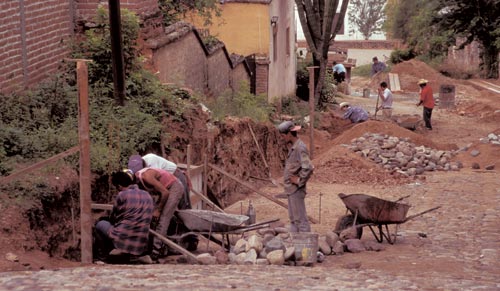
Alamos Daily Journal

101… On Mirador for the kite flying contest.

Kite festival in Alamos, Sonora, Mexico. Photo by Anders Tomlinson.

Kite flying is a popular past times for the children of Alamos.

The winds of Alamos more come than go and when they are blowing kite flying takes place across the barrios. Sticks, paper, string are a child’s opportunity to take flight and be one with the elements. The child in all of us enjoys watching children enthralled with their kites dancing on a breeze.

Participants in the kite flying contest parade through the town on their way to and from El Mirador, Alamos, Sonora, Mexico.  Photo by Anders Tomlinson.

Many of the festival's colorful kites parade proudly through Alamos.

On the day of the festival kites, and their builders-owners, are seen on their way to and returning from El Mirador. Colorful pennants snapping in the winds on El Mirador announce to the people below that today celebrates a special event.

Kite flying participants atop El Mirador, Alamos, Sonora, Mexico.  Photo by Anders Tomlinson.

This is the place to be: a windy day on top of the world with friends.

The kite flying contest was started by Cammie Nuzum and her then husband Chaco Valdez. These photos are from the 1996 festival. The recent 2012 contest was sponsored by Cammie and Elizabeth Nuzum. Kites were not always a place for children’s imaginations to soar. One of the first written records of kite flying is from around 200 B.C., Chinese General Han Hsin of the Han Dynasty wanted to know how far his troops would need to tunnel to enter a rival city. He flew a kite to measure the distance. With this information in hand his army was able to surprise the enemy and capture the city.

Close-up of a festival kite's construction, Alamos, Sonora, Mexico.  Photo by Anders Tomlinson.

It is colorful and well constructed but it will if fly with grace and agility.

The kites become what their builders want them to be. Days of design and construction lead up to contest. There is much to learn building a kite. Natural science, mathematics, aeronautics, history, culture, art and crafts come together as a flying objects and opportunities for self-expression.

Kite being presented to a judge for judging, Alamos, Sonora, Mexico.  Photo by Anders Tomlinson.

A kite awaits inspection by a judge. The event was organized by the Museo.

The Museo Costumbrista de Sonora displays the kites after the contest. For centuries kites were used by only by the military. Around the year 600, during the Silla Dynasty of Korea, General Gim Yu-sin’s troops refused to continue fighting because they has seen a shooting star and believed this was a bad omen. The General sent a fire ball into the sky with a large kite. The soldiers, seeing the star return to heaven, rallied and defeated the rebels.

Detrails of competing kites flying in the Alamos kite Festival with Earle and Joan Winderman watching, Alamos, Sonora, Mexico.  photos by Anders Tomlinson.

The kite festival is a colorful event to attend with all of Alamos at your feet.

Joan and Earle Winderman, that is a nice kite flying name, enjoyed a sunny day on El Mirador. Besides myself, they were the only gringos I saw at the festival. Whether one is flying a kite, or a spectator, everyone watches the kites.

Buddhist monks brought kites to Japan around the 7th century. They were thought to be able to protect rich harvests and deter evil spirits. During the Edo period kite flying became very popular when Japanese people below the samurai class were allowed to participate. The Edo (now Tokyo) government tried unsuccessfully to discourage this pastime as “too many people became unmindful of their work.”

Kite Festival in action, Alamos, Sonora, Mexico.  Photo by Anders Tomlinson.

Amongst all that is going on a flyer must keep his focus on his kite.

Alamos is a wonderful place to fly kites especially from El Mirador up high and open to the winds that carry molecules Caesar, Leonardo da Vinci and Marilyn Monroe breathed. There is a timeless quality to kite flying. It is as as much about the flyer’s thoughts as it is about flying.

Kite flying began in Asia and slowly word spread to Europe. Marco Polo, around the end of the 13th century, brought back to Europe stories of kite flying. Period Illustrations showed military banners with non-flying dragon kites. 16th and 17th century sailors brought kites back from Japan and Malaysia. Kites at first had little impact on European culture and were regarded as curiosities.

Flyers work their kites on a western wind, Alamos, Sonora, Mexico.  Photo by Anders Tomlinson.

Boys and their flying machines work winds off the Sea of Cortez.

Standing with their backs to the Sea of Cortez, the kite-flyers work the western on-shore winds and the drafts that come from the eastern Sierra Madre foothills.

As time marched on kites became universal and many used kites as scientific research tools.
In the 18th and 19th centuries men like Benjamin Franklin and Alexander Wilson learn more about the wind and weather used their knowledge of kite flying. Airplanes came about with the help of kite experiments by Sir George Caley, Samuel Langley, Lawrence Hargrave, Alexander Graham Bell, and the Wright Brothers.

A young boy flying his kite at the Alamos Kite Flying contest, Alamos, Sonora, Mexico.  Photo by Anders Tomlinson.

And all the world, this very moment, is in his hands and in his control.

Here atop El Mirador the Sea of Cortez is some fifty miles to the west and the Copper Canyonlands are some fifty miles to the east. One could say the kite-flyer’s feet mark the center of the universe and their kites announce ownership of the moment.

Kids walking home from the Kite Festival, Alamos, Sonora, Mexico.   Photo by Anders Tomlinson.

The kite flying festival has come to an end. On now it is a Spring walk home.

The kite festival was a wonderful day on a typical hot, windy dry Spring day. Summer is coming. Home is always near, just a short walk with friends and their colorful kites.


See something of interest? Click on the blue number and you are there!

100: Alamos horses… 99: Elizabeth Nuzum’s special place-garden…
98: El Pedregal Palapa 97: Cobblestone crew… 96: Kids playing in streets…
95: Red brick building… 94: 1993 Views of Alamos 93: Sweeping streets…
92: Restoration and repair… 91: Easter Sunday in the country

90: Taxi ride to Easter Sunday… 89: El Palomar Guest Ranch…
88: Inside Bishop Reyes’ Cathedral… 87: Cathedral details…
86: Grave diggers and street mourners… 85: Ceremony at the cemetery…
84: Victor digs a cistern… 83: Bilingual powers & flower details…
82: Border politics… 81: Galeria de Arte

80: Summer rains… 79: Four Almada women… 78: Nuzum rooftop garden…
77: Jacoby gardens & tequila… 76: Plaza kiosk-bandstand…
75: Traveling hypnotist… 74: Anthropocene & human nature…
73: Ethnic accounting… 72: Spanish Conquistadors… 71: Pueblo Magico

70: Beisbol, rodeo and dancing horses… 69: Estancia Crysalis… 68: Pemex…
67: Kids in the summer… 66: Painting the Mercado… 65: Kids at night…
64: Two churches, two men, two bells… 63: Uvalama pottery family…
62: Alamos woodworkers… 61: Dr. Joaquin Navarro

60: Security devices… 59: Dry tropical forest… 58: Good cop, bad cop…
57: Sadnah and San… 56: Doug Riseborough… 55: Population history…
54: Ode to the “mother range”… 53: Human condition, Hotel La Posada…
52: Los Tianguis… 51: Reflections from high ground

50: Geologic timeline… 49: Street posters… 48: Ruins with no roofs…
47: Calle Delicias in La Compana… 46: Blue paint & Mexican political parties…
45 Missionaries of Fatima, Mexican army base, Nueva Esmeralda…
44: Winter film crew… 43: Tebeto, 42: Auto icons… 41: Children at play and work

40: Conasupo comes and goes… 39: Workers repairing roofs… 38: Casa Obregon…
37: Alameda tree falls… 36: History walk at Escuela Paulita Verjan…
35: Calle 16 de Septiembre… 34: Casa Esmeralda… 33:Traffic cops and artists…
32: Casa de los Santos… 31: Calle Alberto Guitierrez, VW, watermelon. angels

30: Night Scenes… 29: Cattle, El Camino Real… 28: Late Spring, mountain views…
27:
Highways, roads… 26: Alamos gardens… 25: Elizabeth & Pember Nuzum…
24: Margo Findlay, Jim Wilson… 23: Maria Felix, Calle Galeana #41…
22: Antonio Figueroa… 21: Plaza waking up

20: Window treatments… 19: Cats, sheep… 18: Bishop Reyes Cathedral…
17: Summer floods… 16: Fiber optics & mechanics… 15: Estudiantina de Alamos…
14: Aduana… 13: Pantheon… 12: Peeling paint… 11: A tale of two seasons

10: Men working on ladders… 9: Curio shops… 8: Umbrellas… 7: Doric columns…
6: Palacio Municipal.. 5: Church youth choir… 4: Alameda Traffic…
3: Train tunnel & jumping beans… 2: Making adobe bricks…
1: Secondary school & Independence day

To return Home.

©2013 Anders Tomlinson, all rights reserved.