Journal entries 81-90
Last modified: January 18, 2013Taxi ride to Easter Sunday… El Palomar Guest Ranch… inside Bishop Reyes’ Cathedral… Cathedral details… grave diggers and street mourners… Ceremony at the cemetery… Victor digs a cistern… flower details… Border politics… and Galeria de Arte.
90… Part One: On Easter Sunday in the Country…
There are some days one never forgets. Easter Sunday 1995, on the Figueroa family ranch was one of those days for me. Unfortunately my workbook for this period of time is not to be found, so the names of Antonio’s parents, wife, daughter, brothers, sisters, nieces and nephews are not at hand. It will be hard to tell a story about a large family without their names but I will do the best I can. This story will be told in two parts.

Antonio invited Anders to join his wife and daughter for a weekend trip.
Antonio Figureoa had been inviting me for several weeks to spend part of Easter weekend at his family’s ranch east of town. I appreciated Antonio’s friendship and was honored by his hospitality but I would not confirm that I would make the trip. I explained to him that I was dealing with a couple of health issues that would such a trip problematic. Antonio persisted. On the Wednesday before Easter he asked me again. He talked of his family, ranch, countryside, history, views and the… I answered yes. Antonio flashed his big Figueroa smile and thanked me. I learned the plan was we would take a taxi from the Alameda Saturday afternoon and return Sunday afternoon. And off he went, a happy man crossing the Plaza on his way to his home at the northern foot of Guadaloupe Hill. At the time, Antonio was renting a three room apartment with a large backyard on Calle Aquiles Serdan for 400 pesos a month, $60 or so.

From here all of the town and surrounding countryside can be reached.
Immediately I started to have reservations. Over the next couple of days I went back and forth in my mind, should I go or should I stay? I was not feeling good and the concept of being in close approximation with four people inside a cab, including a sniffling kid did not bode well. In defense of the sniffling child, everyone here in late spring had a sore throat, cough, sniffles, or all of the above. Late Friday night I decided I would go. Saturday afternoon was noisy and colorful in the Alameda, as is it is on most weekends. There was much to see and many to be seen by. The bus station was extra busy with relatives coming and going to join their families and friends for Easter.
Street carts cooked fragrant food. The cab reserved by Antonio was waiting for us. We all hopped in the cab. The trunk lid and doors were closed, the engined started up and we headed east on our journey away from today and towards yesteryears.

Unfinished, upended, water treatment facility rests in arroyo east of town
As we left the cobblestone streets of Centro Alamos and traveled on dirt roads that connected the surrounding barrios and campo I thought of the arroyo we would be crossing that carried raw Alamos sewage towards the Cuchujaqui River. I looked up and there in the Arroyo de la Aduana, east of Arroyo Agua Escondia, Arroyo la Barranca and Arroyo la Aduana’s confluence, was the beached remains of a future-to-be wastewater treatment plant that was under construction when Hurricane Fausto destroyed it the preceding summer. I understood that when completed it was designed to reduce raw sewage that had been free-flowing east for a couple of centuries. And so it was, the technological future had yet to arrived as we prepared to travel back in time to when and where Spaniards irrigated their 18th century orchards with foot-wide-brick-lined aqueducts.
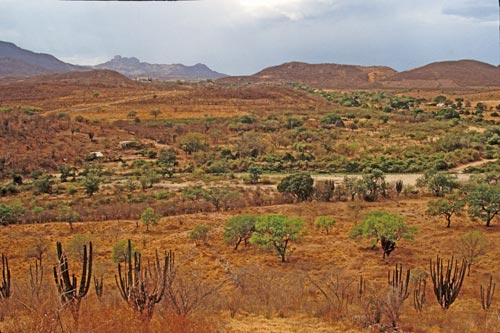
The arroyo, carved by seasonal rains, snaked through dry dusty hills.
We passed the cemetery and Ida Franklin’s house and made a turn to the right on the narrowing road and we were immediately in the country. The town was behind us, the Sierra Madre foothills ahead. The rutted road traveled next to the arroyo that we would have to cross from time to time. When we did I would hold my breath to avoid sewer gas wafting up from the tainted runoff. Every once in awhile we would pass modest dwellings. The farther east we went the greater distance between humble ranches. After a fifteen to 20 minutes ride we arrived at our destination, gathered up all our bags and started a short walk through dried orchards up to the house. We were greeted by Antonio’s mother and two brothers. One brother was the family comedian who worked in town as a laborer and the other Moro who lived on the ranch. Moro spoke only to animals. Antonio’s father was there but I never saw him in person. One of Antonio’s sisters and her husband and daughter would arrive later from Navajoa. And here we were, here where Antonio was raised as the youngest of 17 children.
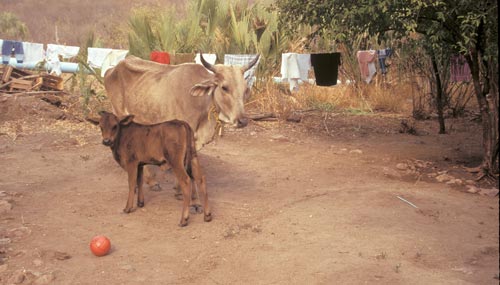
Cows are interested in a little one on one football as the clothes dry.
We were here, unconnected from the 20th century. The Figueroa ranch was above and a good distance from the arroyo. Behind it was a large hill that we would climb the next morning. One of the points that Antonio made was we would have a good high ground view of Alamos from the east. Though the house was not connected to any wires or modern sewer lines it was connected directly to the big blue water pipe that brought water a good distance from the Cuchujaqui River to the east near Sabinitos. An author’s aside: this is the same Cuchujaqui River that Alamos sewage was headed towards. When the blue pipe reached the Figueroa ranch the builders wanted to keep it running in a straight line run through a barn and corrals behind the house. The workers put a faucet into the pipe in exchange for damaging Figoeroa property. When we arrived I was cautioned to be careful when I turned water on because of the great pressure coming from the big blue pipe, unrestricted, to the sink or shower. On being connected, one can always be disconnected.
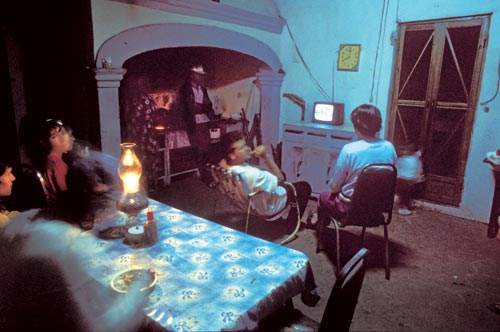
Time for a hour or two of solar panel powered TV. Grandmom keeps cooking.
The brothers and I went out to watch the sunset and arriving stars. They were playing a game they always played when together on the family ranch. Who would see the first passing satellite that evening? As we searched the heavens for the hand of man I noticed how quiet it can be away from the city. Centro Alamos is not a quiet place: church bells on the quarter hour, radios, televisions, cars, trucks, humans, dogs, cats, burros, city bred farm animals, native birds, insects… Here at the ranch, warm soft breezes rustled dry grass and branches as crickets fiddled. We concentrated on the sky. And the game was done, Moro spotted the first satellite. The comedian brother turned to me and said Moro always wins this simple but cosmic game. We retired to the house and awaiting dinner. Antonio’s mother was dishing up food off the big wood burning stove. The women and daughters were watching, more listening, to a TV. This was courtesy of a small solar panel provided by a government program intending to give all the rural off-line ranches access to solar generated electricty. Modern times allowed this household to chose between a radio for eight hours, a light for three or four hours or the small black & white television for an hour or two. Or some combination of electrical appliances at night for as long as there was stored energy. Choices, choices, choices.
I knew I would have a good sleep and I looked forward to Easter morning with the Figueroas in the Campo.
89… Life in the country, life in the old world…

One's world changes depending on where they are in Alamos at that moment.
Flora, fauna, sounds and smells vary as one travels through the barrios, hills, arroyos and surrounding mountains. This is a gentle land that has moments where the forces of nature can change the landscape in an instant. All roads lead somewhere if nothing more than to an end. The road to El Palomar Guest Ranch introduces one to hosts Felipe and Cherisse Acosta, their family and staff. Felipe- sportsman, cattle rancher, wildlife enthusiast, naturalist- shares his enjoyment and skills for bird hunting, fly fishing and horseback riding. Cherisse is a wonderful chef, certified yoga instructor and mountain biker and all-around cowgirl. Both are fluent in English and Spanish. At the end of the road, Rancho El Palomar offers stress-free sanctuary and Sonoran serenity with lodging for 12. Each room has its own fireplace and bathroom. Wakeup to fresh brewed coffee.

Rancho El Palomar Guest Ranch is three miles west of Alamos.
Rancho El Palomar, three miles – 15 minutes west of Alamos, sits on 1200 acres that were originally a land grant to the Acosta family in the 1700’s. In the 1960’s the main ranch house with bricks formed and fired on the ranch. Mexico Norte, a well-known Mexican film was shot in 1976 on the ranch. Here are 360 degree views of Sierra Madre mountain range to the east, all-surrounding foothills, Cacharamba to the west and Sierra de Alamos to the south. Here is a place to watch a moonrise and connect with all things natural. The hunting season runs from the first week in November to the first week of March.

ooAHH cooo coo coo is a serene song sung by the mourning dove
The grounds surrounding Rancho El Palomar include citrus orchards, a large patio, pool, echo cactus, tropical flower gardens and mesquite trees. There are miles of horseback riding, horses are available, hiking and biking trails to explore on the 1200 acre ranch with mountains, canyons, and grassy fields. There are guides available to take one off the beaten path.
Rancho El Palomar has a well earned reputation as one of the best dove hunting areas. Felipe has hunting grounds throughout the region, so there’s lots of variety. The Sonoran hunting season begins in the first week of November and runs to the first week of March. Speaking of birds, Alamos in the foothills of the mountains between the deserts to the north and the tropical areas to the south is a fantastic bird watching area. At the rend of the road there are opportunities for activities, enjoyment and relaxation. Away from town, life in the gentle valleys and rugged canyons is a step further back in time. It is a place where time is measured by sunrises and sunsets. “ooAHH cooo coo coo”… “ooAHH cooo coo coo”… “ooAHH cooo coo coo”…
For more information visit Rancho El Palomar website.
88… Inside Bishop Reyes’ Cathedral where time stands still…
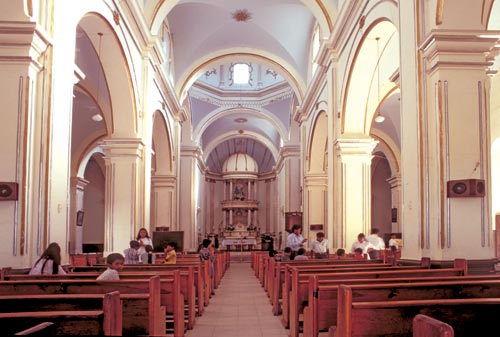
There always seems to be someone, or group, inside the church.
Bishop Reyes’ Cathedral takes up the entire southern side of the Plaza de las Armas. Its three tiered belfry towers above town and touches low passing clouds. Along with multiple daily services the church is also a religious classroom.
Jesuit missionaries founded missions in southern Sonora between 1613 and 1620. Early settlements grow around a mission protected by a fort. The early Jesuits brought Catholic teachings to the Indians as well as trade and farming skills.

From up high the church looks taller and the echoes sound louder
Think of all the people who have walked on this floor and sat in these pews. Imagine hundreds of voices reverberating off these walls as they enter and leave the church and the wonderful choir filling the space with song during services. And there is always the church bells tolling time 24-7.
Here is a long history. Bachiller y Licenciado Pedro de Barecelon was an acting priest from May, 1685 to August, 1686. The first parish priest, Father Francisco Saenz de Carrissa, wrote the first recorded date in Alamos history in a “book which are entered the Baptisms, Burials and Marriages started by me on the 28th of August, 1686.”
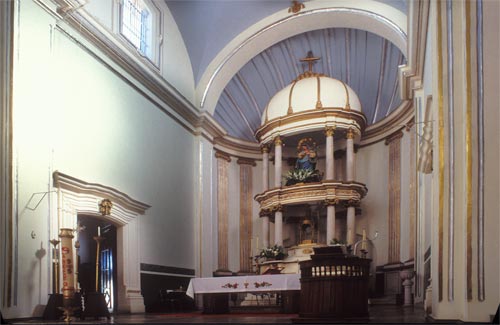
The Cathedral's high ceiling atmosphere creates its own sound and weather.
Grandeur on a human scale. No matter how and where one lives this is an extension of their house. It is their communal living room. It is a place that they can come and be with others or be by themselves. It is their place in their time for all of time.
Parish Priest Don Pedro Gabriel de Arago in 1735 reconstructed La Purisima Concepcion, on the same site as of the originalt small Alamos church made from adobe and cut rock with a beamed ceiling. A 1736 inventory by visiting Bishop Martin de Elizacochea Dorre Escheverria noted all the church’s religious objects were silver except for the gold shrine and chalices.
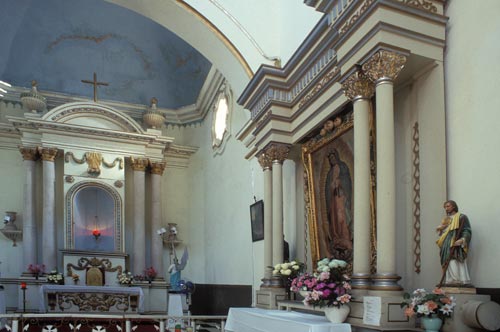
Here one can come, rich or poor, and be part of something larger.
This is a place of words, music and prayer. As I was taking these photos I watched and listened to praying individuals scattered across the front pews. The intensity of their prayers spoke of their needs or losses. Before me was the human condition in the court of last appeals.
King Carlos III in 1781 ordered a new diocese for Sonora, Sinaloa and the Californias. Bishop Antonio de los Reyes was stationed in the then capital of Arispe in 1783. A few months later he moved to Alamos to avoid Indian raids. Bishop Reyes started to build around and expanding the old church. Services continued here, on the same site as the present cathedral.
The old church was torn down in 1794 when the new cathedral’s walls were ready for rafters and supporting columns. Don Juan Ross was, according to church records, the first contractor. He received a payment of $11,250 pesos in 1786. The cathedral was finished in 1803 under the supervision of Father Camilo Sanmartin. The silver and bronze altar rail was made in Oaxaca. A silver candelbra and lamps provided manmade illumination. This was a fine cathedral, simple but commanding on the outside and elegantly reassuring on the inside.
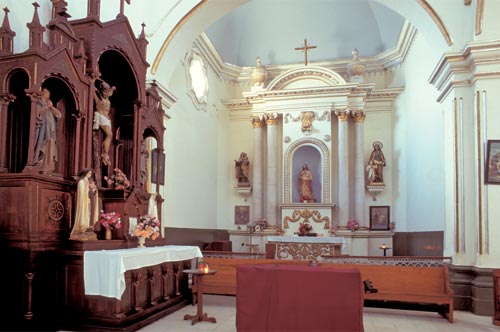
Life is not easy, on many levels, and sanctuaries like this ease the pain.
In the home of God, there is handcrafted furniture, art, sculptures, color, gleaming metals, proportion and design. Natural light streams in. In this home of God, Catholics gather and take on life together as a huddled mass. Outside, it has been forever changing as modern times evolve. Inside, it always strives to remain being a continuum of the past, above and beyond forces of change. Life is not easy for the church-goers and it is not easy for the church.
From 1855 to 1861 the War of Reform, church against state, raged on between church members Conservatives and reform minded Liberals. Benito Juarez had created laws that limited the church’s powers, privileges and holdings. Don Jesus Gandara led the Conservatives against General Ignacio Pesqueria’s Liberals supporting the new federal laws. During the war Alamos was won and controlled by both the Conservatives and Liberals. At times, Alamos citizens were engaged against each other.
In 1859 Apaches reached the Alamos district. Alamos Mayor Manuel Salazar came to a peace agreement with the Indians in December 1859. And then the French landed troops in Vera Cruz in December 1861. Conservatives and Liberals ended their War of Reform and came together to defend Mexico from foreign invaders. These were tumultuous times surrounding church and state and Bishop Reyes’ Cathedral stood its ground, as it does today.
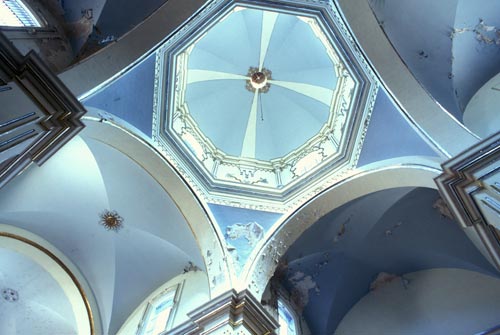
Through the years weather and armies have laid siege on this church.
It is true, it is not easy to maintain Bishop Reyes’ Cathedral. There are issues of scale, materials, gravity and weather. And warring man has shot at it, broken in and plundered over the years. The church is a symbol respected by many and held by others, through the years, in low regard.
General Angel Martinez on January 7, 1866 near Alamos defeated the Imperialists commanded by Colonel Jose Maria Tranquilino Almado. General Martinez ordered that the church stripped of any precious metal that could be melted. During the next twenty years days of peace were few and far, scattered between unending revolts, battles, wars and plundering.
And through it all, to this very day, winds and rains made life for the Cathedral a battle of man’s maintenance against nature’s forces. The original designers, builders and artisans would be proud that the Cathedral, their efforts, still stands.
87… Details from inside Bishop Reyes’ Cathedral…

The innocence of youth looking toward a future of hope and promise.
So much of most human life revolves around childhood, children, grandchildren and…
Those needing guidance and care become those that guide and care.

And we all lay our heads downs to rest and our bodies follow.
Religion speaks of yesterdays, todays, and tomorrows. It speaks of better days and better places. Religious followers are asked to endure and conceptually, eventually, benefit from their days of survival and struggle on this small planet.
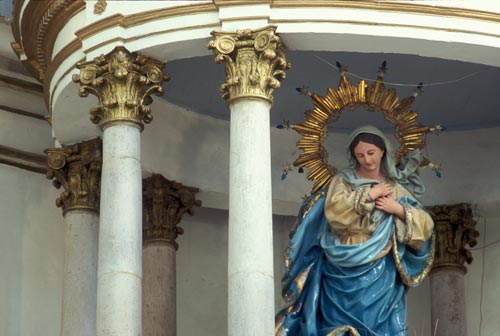
Moments of comfort and caring soothe the human condition.
Detail is added to detail as we near the church’s heart, the congregation’s visual focal point and cosmic backdrop. It is here, for this moment, that all are equal under a supreme and unifying force, the power of human belief and the human drive for universal understanding. Here all seek, in their own ways, answers to what life is.

There are columns that support and there are columns that sustain.
I often wonder about the artisans and workers who made columns like this. What was their human condition as they strived for supreme beauty. What was their roof made from, what did they stand on as a floor, what food was served for dinner? How old did they live to be? How many children did they have? And who has come along to restore and maintain these columns? And how did their lives differ from the one’s that came before? I would rather ask a question than give an answer.
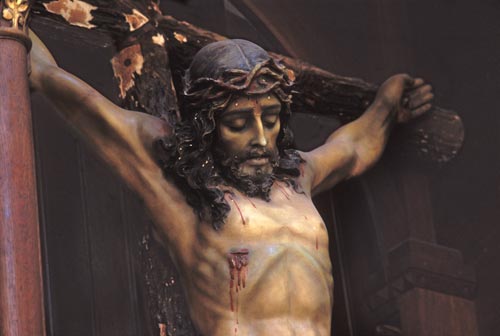
Everyone that visualizes Christ know him in their own light and setting.
Humans seek forgiveness. Humans need forgiveness. Salvation resonates and persists across humankind. It is human to feel imperfect. It is human to seek direction. It is human to come together. It is human to leave. It is human to establish us and them. It is human to protect resources. It is human to feel superior to those outside of their own tribal social circles. It is human to war. It is human to demand retribution. It is human to accept redemption. It is human to take advantage. It is human to overlook unintended consequences. Vulnerable human psyches, looking for direction, migrate across uncharted existences. Be the humans dominate or submissive, rich or poor, all humans have hope, fear, love, hate, need, desire, doubt, confidence, triumph and defeat. And so this is what the human condition has been, is and will be as suns rise and suns set.
86… There comes a moment when we all say goodbye…
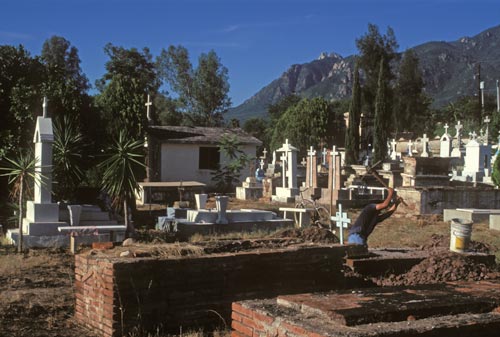
The Alamos cemetery provides an inspired and sacred work place.
There is always work for the grave diggers be it preparing the graves or maintaining the cemetery in a park-like setting for visitors and residents alike.

Another inhabitant will soon join those from the near and distant past.
Hours layer this grave will be occupied. Across town friends and family are preparing for a day all knew would come sooner or later. The earth gives way to the relentless pick.

The maestro's assistant watches another tombstone in progress.
Tombstones are made outdoors across Arroyo La Barranca and Arroyo La Aduana at the foot of Cerro Compana. Words of love and respect are chiseled into stone as stone gives way to the persistent Maestro’s tools.

A time of loss, mourning, memorializing and inner reflection.
The church is ready, the church is always ready. The body has arrived followed by those who wish to say farewell and share with others this sad moment of passing.
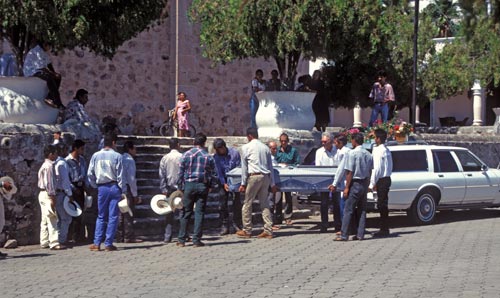
Church bells ring out as solemn friends and family approach.
For one the wait is over, for others it is an emotional weight that will slowly pass with time. Today a name will be spoken out loud, in months it will be recalled in mind and soul and whispered to no one but oneself and the universe.
.
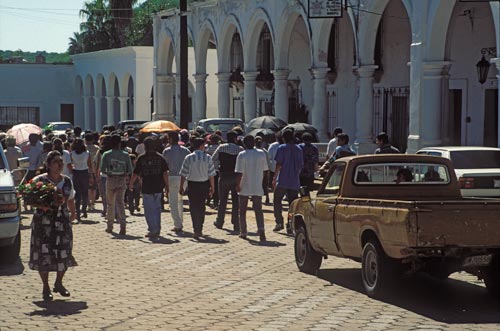
After church services the procession across town begins as bells ring.
A mass leaves mass and the cobblestones of Alamos bear witness to another passing. There is a path from the church to the cemetery that has been worn smooth by loss and love.
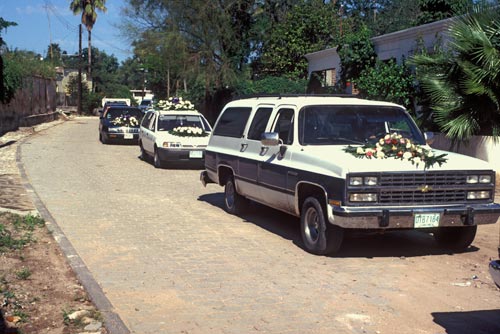
A procession travels through Barrio La Compana as it nears the cemetery.
And they came in numbers day after day, year after year, century after century… it is what humans do. They walk, they talk, they cry and recall moments that were and plans that did not come to be… it is what humans do.
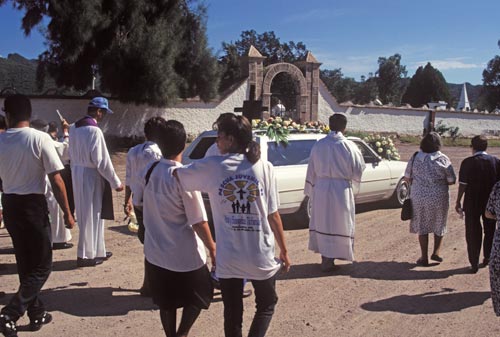
The procession has slowly made its way east from the church.
The fresh grave awaits, clouds line the morning horizon, crows chatter in surrounding trees and barrio dogs go about their barking as the sounds of daily Alamos life echoes off surrounding hills and mountains. For some, at this moment, their world has stopped amidst the world that goes on uninterrupted.
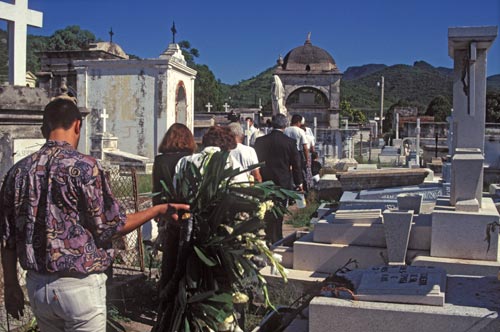
The dead await a new arrival, passing feet kick up dust, little needs to be said.
People travel narrow pathways, cut flowers, in passing, brush against closely place tombs. The street-wide procession through town from church has become a solemn single rank slow marching to the grave.
85… The moment has arrived and we are there…

Away from the burial service the cemetery is quiet as the dead rest in peace.
Patinas of passing time, an unavoidable ornamentation, take over the graves. Here, across the way, a new body has arrived. From this point on they will always be here. At any time they will be available for visits as their great-grand children become great-grand parents.

The new grave joins others that have been here for a long time.
It is another day in the graveyard. Not just another day… but another day. It has been this way since 1794 when this plot of land was deemed the municipal cemetery.
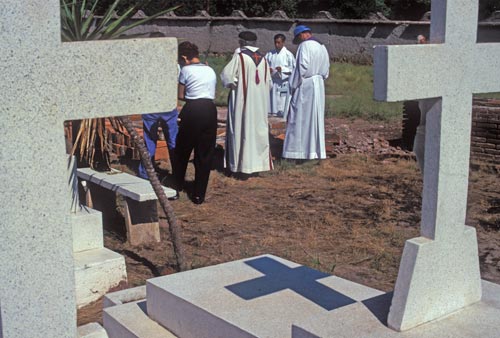
Words are spoken, the moment is being accepted, a journey ends.
The priest in a baseball cap performs in an ancient tongue a ritual that goes back thousands of years. No one needs to understand the words being spoken. The need for these words to be spoken is what is understood. It is hard for most in attendance to hear anything but the thoughts swirling in their minds and pulsing with each heart beat.
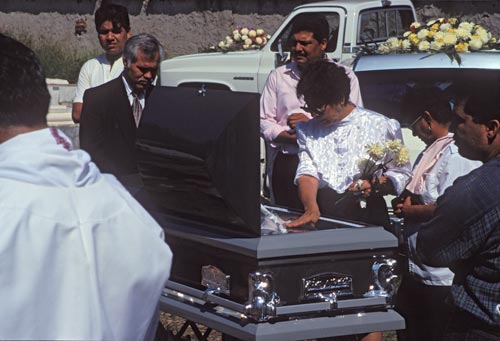
Reaching out to touch a departed spirit for one last time.
And they are gone… the last look says so… the last touch confirms… this is a tender moment… this is life… and life leads to one place, death, and here we are this morning…

The service has ended and a beam is placed on top of the casket.
Folks had come from far and wide to attend the services. One can see the deceased’s connections and social standing by attending the graveyard service. For some it is a throng with paid assistants and sub-contractors. For other it is a few friends and, or, family that volunteer to dig the grave and offer their regards in quiet prayer. For the dead the ride is much the same.

All watch silently as the men placed bricks over the casket.
Each brick adds to the finality. For the living this is an opportunity to come together with friends and family. With the passing of a love one they see their own tribe standing shoulder to shoulder. The moment goes beyond the dead and becomes the living, In a way they have come to say that they are alive, “we are here”.
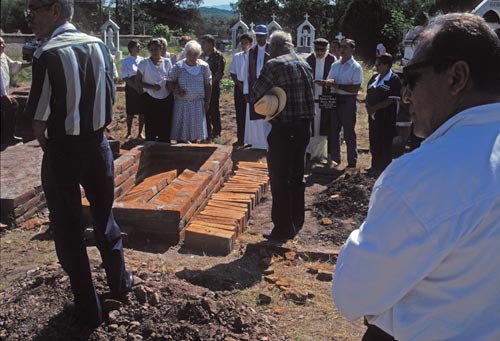
Soon the grave will be covered by flowers and touched by the winds.
And soon the mourners will go their separate ways. They were united once again by the passing of one of their own. They had stopped what they were doing and made the time and way to come together, once again, as one.

After all have taken their leave flowers remain in a temporary respect.
From dust to dust, the world goes on, today becomes another footnote in the wind. The flowers will wilt and dry away under a tropical sun. At some graves there will always be fresh flowers until the day no one is left to bring flowers.

After all these years there is still available ground for graves in the cemetery.
Graveyards are a special place: they are public art, they are public history and they are markers of their own civilization. And another day begins… and somewhere out there someone is dying and somewhere near here someone is being born. In the end it is all about this precious balance we call life.
84… Making a cistern, talking fresh water and coming full circle…
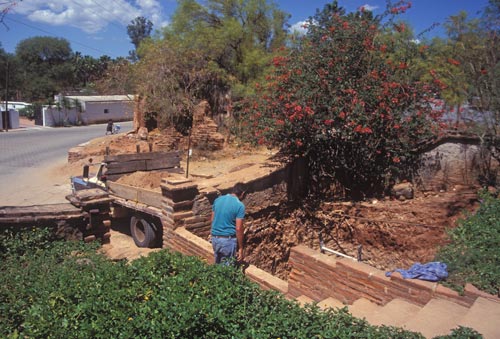
Victor takes a deep look into his newest construction project, a cistern.
Cisterns, the collection and holding of rain water using lined waterproof storage devices, began sometime in the Middle and Late Bronze Age, 2200 -1200 B.C. Our first record of lime plaster lined cisterns was in what is now Lebanon, Syria, Jordan, Israel and Palestinian territories. In 850 B.C. King Mesha of Moab recorded in the famous ‘Moabite Stone”, “so I said to all the people, make your every man a cistern in his house.” Cistern comes from the latin for “box”. In the 1900’s rain collecting cisterns were common in new house construction across the USA. Victor, seen above overseeing digging, was owner of a flat-bed truck and Black Power, a black pickup truck with a powerful engine.

Other than Victor's truck everything on this project is done with human muscle.
Victor was proud of this project. He saw it as the wave of the future and a wonderful opportunity for new work to keep his crew employed. I enjoyed my time with Victor, his deep voice and easy laugh gave a hard working man an easy going disposition. Not too far back in time rain water was considered, rightly so, a resource to be gathered and saved. 2.5% of earth’s water is fresh water and 68.6% is captured in glaciers and ice caps and the balance is stored as ground water. 73.1 % of fresh surface water can be in found ice and snow, 20.1% in lakes, 3.52% in soil moisture, 2.53% in swamps & marshes and 0.46% in rivers. However one looks at fresh water it is a rare commodity that is needed by a growing human population. There is the same amount of fresh water to take care of the soon to be seven billion people as there was for as few as 1,000 human breeding pairs surviving the eruption of Lake Toba’s super-volcano 69,000 to 77,000 years ago. Fresh water volumes are a planetary constant. Cisterns capturing rain water are a natural tool to help sustain human life. Yes, Victor was proud of this project.

The hole is dug, the bricks are set and finishing work begins.
The maestro on this project was well respected and hired by Victor because of his experience with cisterns. This cistern was not designed to capture rainwater. Its purpose was to store city water to draw from when there were problems with municipal water deliveries. During my stays in Alamos it was not unusual to have access to city water for only a couple of hours a day and on isolated occasions no water was available. As Victor’s crew worked hard to finish this project I heard of other folks considering building cisterns. This was music to Victor’s ears.
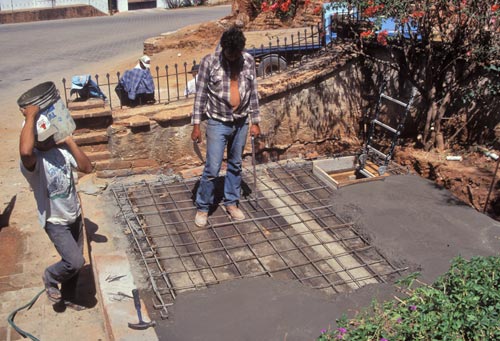
The cistern's roof is nearing completion under the maestro's watchful eye.
The maestro had a lazy eye and I couldn’t figure out where exactly he was looking. When I watched him in town he struck me as on odd bird. The maestro liked to drink, and the more he drank the louder he became. I learned on my next trip back to Alamos that this project did not have a happy ending. I was told that Victor and the property owner had a falling out and they were going to court to settle the dispute.
Today nearly every home in North America has a cistern, be it a small cistern, the toilet tank storing water for the next flush. It may be time to consider each new home having a cistern system to capture roof rainwater. We face a constant reality – 99% of the water on our planet is unusable for man to freely drink or irrigate with, and of the remaining one percent: 99% is groundwater, .86% is from lakes and .02% from rivers. The sustainer of terrestrial life, fresh water, is in limited quantities. A good rule of thumb is grab fresh water when you can, and when you have it, value it and use wisely.
83… Life’s details float away like flower petals on a breeze…

There are many reasons why North Americans have chosen to call Alamos home.
One of the healthy aspects of living in Alamos, or anywhere, for bilingual speakers is the byproduct of using two, or more, languages on a consistent basis. The Executive Control System of the brain manages information while focusing on what is relevant at the moment and discarding unnecessary distractions.
“Bilinguals manifest a cognitive system with the ability to attend to important information and ignore the less important,” Ellen Bialystock, cognitive neuroscientist.

With all that can be seen the focus turns to a summer blooming vine.
Every time a bilingual speaks, both languages popup and the executive control system determines what is relevant and how to respond. This process rewires the brain. In a study of 400 Alzheimer patients, bilinguals, on average, show symptoms five or six years later. The bilingual can cope with the disease longer. When one actively uses two languages they are performing healthy brain calisthenics. All in a day for bilingual ex-patriots.

Unfolding miracles are there to be seen in the exquisite detail of living matter.
Alamos, Sonora, Mexico is a wonderful place for native English speakers to exercise a second language, Spanish, as they go about their daily routines. It is also beneficial for their native Spanish speaking neighbors and friends to use English whenever the opportunity arises. During my stays several residents saw me as someone they could practice their English with, or on. They were extending their English vocabularies by speaking and listening. I took part in some very entertaining, and humorous, conversations when the languages became intermixed: juxtaposed meanings, mutated intents and convoluted requests. The art of verbal communication is a forgiving trial by fire for burgeoning bilinguals. Where there is a word, or gesture, there is a will, or connection.
82… The border between where, who, what and why …
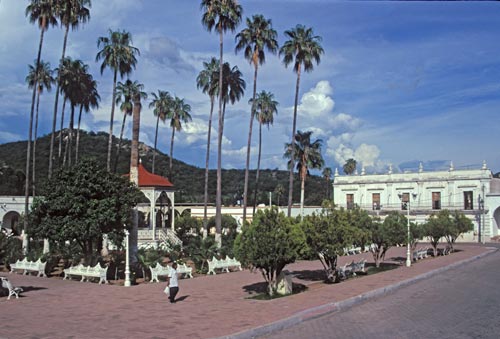
Summer afternoon in the Plaza, two story Hotel Alamos is in the background.
This is a simple moment in a complex world. A woman of Indian blood crosses an empty Plaza as she returns home from her daily shopping trip to the Alameda. The lack of people goes hand in hand with siesta time on a summer afternoon. Stepping back, taking a satellite view, she is surrounded by Sonora, Sinaloa, Chihuahua, Sea of Cortez and not far to the the north, the US – Mexico border. She is in the middle of a violent and costly battle moving drugs across the border to feed growing addictions in the United States: an estimated 660,000 pounds of cocaine, 44,000 pounds of heroin and 220,000 pounds of methamphetamine were sold on America’s streets last year. The first question that comes to my mind is why is there a need by so many addicted people to escape their realities and cross a internal border that has no borders? Why? What would be the Indian woman’s answer to this question?

The Plaza from the Church looking north and beyond to the other side.
The US-Mexico border fortifications have grown over the years: 650 miles of prison grade fencing and sheer concrete walls, 17,600 Border Patrol Agents, 1,200 National Guard soldiers, 165 truck and train x-ray machines, thermal imaging devices that turn night into day, 467 remotely controlled surveillance cameras feeding control bunkers, 4 predator drones overhead – along with helicopters and light aircraft, 10,800 ground sensors and… The border separates families, towns, valleys, histories and futures. Last year 254,000 pounds of cocaine, 3.6 million pounds of marijuana and 4,200 pounds of heroin were captured trying to smuggled across the border. None the less, drug gangs are to have made $25 million dollars last year fulfilling some of America’s many addictions. This is Big Business: an industry of logistics and persuasion serving markets that demands networks and complicated systems to feed its escalating needs. At some level it becomes, “hey, it’s just business – nothing personal.”
There are other costs. On the US side it is estimated that the drug addictions’ health services, interruptions of economic and social progress, crimes and legal systems, jails, court rooms and prisons total $193 billion a year. This is RBB: Really Big Business. Guarding the border over the past decade has cost $90 billion alone, a train x-ray machine costs $1.75 million. Many unsuspecting peace-loving famalies, on both sides of the border, owe their livelihoods, directly or indirectly, to the drug lords, these titans of greed and their investments, corruption and violence. And what is the cost to Mexico? Again the question must be asked, why do so many Americans need drugs to answer their physiological and psychological addictions? Why?
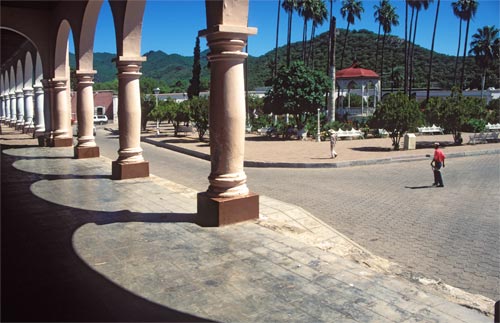
The Plaza framed by a classical world: timeless, enduring, thankful.
The border is many things to many people: It is neighbors, economies, opportunities, sovereignty, entrance, exit, hope, pride, burdens, politics, law enforcement and… Most of the two dozen counties that are on the US side of the border have Hispanic majorities. On one side is San Diego, Yuma, Nogales, El Paso, Del Rio, Laredo… On the other side is Tijuana, Mexicali, Cuidad Juarez, Laredo, Matamoros… On a map it is is hard to tell by place names where the US or Mexico begins. When on the border, the poverty- lack-of-consumerism on the Mexico side is stunning compared to just across the border before, and after, the barriers went up.
Hispanics made up half the USA population growth in the past decade. New York, according to the 2010 census, has 2.3 million Hispanics, Los Angeles – 1.8 million, Houston – 920,000, San Antonio – 840,000, Chicago – 780,000, Phoenix – 590,000, El Paso – 523,000, San Jose – 313,000 and San Diego – 376,000. The USA is turning a little Hispanic. And the southwest, for so long the nation’s frontier and place to go when there was no more room or opportunity back East, was part of New Spain before the United States was the United States. Today, the border region, north to south, from San Francisco to Alamos is its own world, and Hispanic influence is spreading nationwide. Workers, from foreign countries have always made, and make, the USA rich compared to the world. There must be something in the Constitution that supports cheap labor.

A mountain, cathedral, bandstand, hotel and a heartbeat, priceless.
Ten years ago 1.6 million people, without documents, were caught at the border trying to cross into the United States. After 9-11-2001 the concept of secure borders began a national mandate as border fortifications, protection strategies and assets were developed. In 2010, 463,000 souls were apprehended attempting to cross to the “other side”, in many cases to join relatives. There are several causes for the decrease: controlling, with military precision, populated sectors along the 1960 mile border, growing dangers while passing though Mexico from the south, crime against “crossers” at the border, difficulties of crossing in remote mountains and deserts and… And there was the Great Recession that lingers on, the slow moving elephant blocking the way for paying jobs, especially in the construction industry.
The Great Migration across the US – Mexico border has been going on for decades and the economy took advantage of the resulting population increases: more workers, more consumers, more home owners, more citizens, more tax-payers, more possibilities and…
Migration for many species is the meaning of their lives, they are their migration. The history of the United States is one of migration, we are a nation of migrants: Asia, Europe, Africa, Central and South America, Middle East, East to West, South to North, rural to urban, city to suburb and… Migrations into, out-of, up-down and across will continue in search of water, food, resources, work, comfort, security, education, retirement… Migration is the human way. This is true for Vancouver, Chicago, Shanghai, London, Baghdad, Melbourne and Phoenix as well as Alamos, Sonora, Mexico.
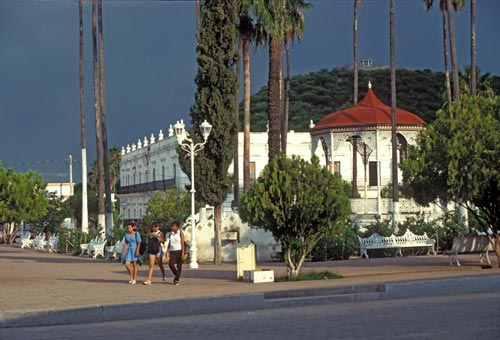
Any Politics' continuity most focus on child development to ensure its future
Let us look into the future by understanding today. 45% of children aged 5 to 17 in San Diego County are Hispanic. Baby Boomers, mostly white, in ten to twenty years, will need Hispanics to keep the economy going. And today, the Hispanics kids, who are the majority and in many schools almost all of the student population, need an excellent education to be in the position to function in a productive work force. There will be a huge population, they are already here aging, of Baby Boomers who will need this large trained work force to make their retirements comfortable. The Hispanic school kids need these Baby Boomers to vote, today, for better educational resources. In an era of I, Me and Mine it is nearing a time to consider You, We and Ours. What happens in Los Angeles is important to Alamos, Sonora, Mexico and what happens in Alamos, Sonora, Mexico is important to Los Angeles. It has always been so, and it will always be so, it is the human condition.
Three school girls, good friends – sisters in life, walk across the Plaza and into the future.
81… Upon the wall art becomes windows to somewhere else …

Galeria de Arte was in the building to the left as seen from the plaza.
Beverly Krucek sent me several emails about the gallery she had on the Plaza Las Armas for many years. The following information is complied from her notes. The photo above was taken during the summer of 1996. Beverly is also involved with the Alamos Heritage-History Association, AHA, that meets at the Agave Cafe in the Hacienda de los Santos once a month in the summer and every Thursday morning during the rest of the year.

At times Alamos itself seems a living work of art and history and futures.
Beverly Krucek opened the Galeria de Arte on the Plaza in 1994. On average 25 artists were shown in three rooms, portal and patio. Artists came from all over Mexico, some from Columbia, as well as Tucson, Phoenix, New Mexico and a couple from France. Some 10 year later, Bev decided to trade up to a gallery in an art mall being developed and promoted by the Franks in the Urrea house on Calle Obregon. Unexpected problems arose that stopped the art mall project from going forward. By that time, Bev had turned her rental lease over to B.K. Hamma for her use as book shop, gift shop, and a new art galley leased to Vickie Lockwood. Upon taking a further look at the situation, it appeared to Bev that the tourist trade, which was her main target for sales, had fallen off so she left the gallery scene.
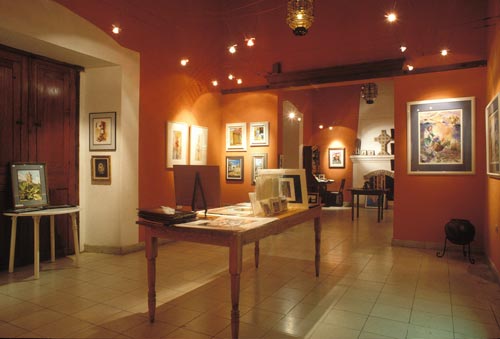
Upon these walls, that have seen so much, art speaks of inside and outside.
Beverly wrote about the block that the Galeria was located in,
“The Galleria was on the plaza in the row between the Hotel Alamos and what at one time was the Bank. That strip is now occupied by a games emporium, the Tourist Bureau, (then the Galleria) and a home restoration by the Bours. The strip prior to that, was The Hotel Alamos, The Casino, and I think either a bank or more probably a small residence occupied by the Bours. The Casino was a club like operation where the men gambled excessively and the women were welcomed on Wednesdays. Some reading offers the information that Alamos was a huge hub of gambling. Makes sense since most of mining management was an absentee sort of operation there was lots of both time and money. Cards were big as was cock fighting etc.”

View from Mirador of building where Galeria de Arte was located.
Years ago, when I was in Alamos, Hotel Alamos, also known by many of my friends as the old Miner’s Hotel, was in serious disrepair.
In her emails Beverly addressed the old hotel’s current condition,
“The building part that houses the former Hotel Alamos and to some extent the part that houses the Tourist Bureau is in very bad disrepair and held together in an attractive way by a nice paint job. Adobe keeps crumbling. Everyone grumbles about it but no one does anything. It is owned by Anamaria Alcorn. INAH in Hermosillo and the local government probably could step in and force the work to be done but who has the money and where does government restoration come in with private ownership? The end part (corner of Guadalupe Victoria and Comercio) has been well, and I think properly, maintained and restored by the Bours family.”

Looking down from the church at Casa Nuzum, Calle Comercio 2.
Calle Comerico 2, Casa de Nuzum, recently became an art galley, La Casa del Arte, managed by Tony Estrada and his wife, Lupita. Tony is director of Museo Costumbrista de Sonora, on the Plaza, which features regularly scheduled art exhibitions. Tony is also a gifted sculptor who takes discards and turns them into assembled artistic statements. Beverly commented on La Casa del Arte’s opening night, May 20, 2011,
“Tony and Cammy Nuzum will oversee other areas in the house to be used by artisans for producing their work and selling it from there. It was fun to see Tony’s opening at the Nuzum house where he showed 4 or 5 of the artists I had represented some years ago. It was great to see that they had continued to develop new depths in their work while still being identifiable in their own style.”
Calle Comercio 2 is across the street from the bank that was next to Galeria de Arte. When I was a guest of Casa Nuzum there were paintings on the walls and art books in the library. I always felt it would be a wonderful gallery space being next to the church and around the corner from the Plaza. Location, location, location… The concept of artists working and showing their work in this historic Casa is profound and hopefully productive. There is a recent history of artisans here, Elizabeth Nuzum hired local women to create her designer clothing line in a wonderful sewing studio in the back pool patio of the house.
Historic footnotes from Beverly that were included in one of the emails,
“There was a Hotel Minero across the Plaza from the Hotel Alamos. It is the first building on Madero off the Plaza, sort of tucked in at the lower level of the Portales Hotel. It was owned by Palomares (a war hero from the French invasion) and is now called the Hotel Enrique owned by Blanca Quijada Navarro.”
“We still have to add a tiny bit to the Chinese use of the Mexican silver peso…. Alamos did not specifically produce for China… they used the coin that was minted here and identified by A or an underlined A. Kin Rynd who lived there at the time (the 20’s) said it was always referred to as the Mex… much as we would say a buck. It also added balast to the ships returning to China after the deliveries to Northern Mexico.”
AHA… For more history visit History Club in the Alamos Portfolio.

Journal entries 71 – 80… Summer rains… four Almada women… Nuzum rooftop garden… Jacoby gardens & tequila… Plaza kiosk-bandstand… traveling hypnotist… anthropocene & human nature… ethnic accounting… Spanish Conquistadors… and Pueblo Magico.
Journal entries 61 – 70… Beisbol, rodeo and dancing horses… Estancia Crysalis… Pemex… kids in the summer… painting the Mercado… kids at night… two churches, two men, two bells… Uvalama pottery family… woodworkers… and Dr. Joaquim Navarro…
Journal entries 51 – 60… Security devices… dry tropical forest… good cop, bad cop… Sadnah and San… Doug Riseborough… population history… ode to the “mother range””… human condition, Hotel La Posada… Los Tianguis… and reflections from high ground…
Journal entries 11 – 20 … Windows treatments… cats, sheep… Bishop Reyes Cathedral… summer floods… fiber optics and Mexican mechanics… Estudiantina de Alamos… Aduana… Pantheon… peeling paint… and a tale of two seasons…
Journal entries 1 – 10 … Middle school and Independence celebration… youth church choir… making adobe bricks… crucifixion… workers… curio shops… men on ladders… umbrellas… Plaza de las Armas… Palacio… old train tunnel… and jumping beans…
©2010-11 Anders Tomlinson, all rights reserved.


