Journal entries 101- 110
Last modified: August 23, 2013102… Three places, three jobs, one community

Alamos Centro wraps around Guadaloupe Hill with the jail at the top.
The jail was a high-walled fortress stained by weather and crumbling with age. It sat looking out over all of Alamos for all of Alamos to see and hopefully fear. I recently asked Jim Swickard for the buildings current status. This was his response…
“The jail was closed about five years ago and some stabilization and restoration of the jail has taken place. The front portion is beautiful and used as the ‘Cultural Center’ for the village and is ideal for art shows, using the first two rooms as large galleries, with the jail yard and cells always open for public viewing.
The new jail is at the edge of town next to the airport on the San Bernardo road (next to the seldom used ball field). It’s a very nice complex with a separate jail building, car impound area, etc. Presently the project is being finished with sidewalks going past the airport, a newly paved road (remember the washboard before) and curb and gutter. A great improvement over the old road and really looks first class. The road project by the way is Alamos to San Bernardo (a new large bridge now spans the Mayo River just before San Bernardo),then to Queriego and on to Cd. Obregon on existing paved roads. Just above San Bernard a new dam has been approved (possibly started) which will be about 2/3rds the size of Mocuzarit. The name of the new dam is Los Pilares.
We had our first rain this week and a little green is beginning to arrive. One more rain and then the transformation takes place. ” 6-27-12.

The jail is its own world, its own community, isolated but connected.
This was not a country club. From the jail’s office displaying inmate crafted wares one could peek into the jail”s open court. Inmates were dependent on family or friends, on the outside, to help with food and other needs. I remember two inmates arriving under armed guard at the hospital for medical checkups. A sense of awe and curiosity swept through the crowded waiting area. Outlaws were walking amongst the villagers. With Alamos being a small town many knew the inmates. Others wondered what the inmates had done? The inmates did not have to wait, in they came and away they went.

Food and supplies are loaded into a truck headed to the rural villages.
A weekday morning on Calle Comercio as aid is loaded up to be delivered to the surrounding villages. These supplies were stored in an office next to the police department. Police trucks can be seen in the background. They were there day and night.

Loading up a truck ready to travel rough country roads.
Every little bit helps. Life in the the small villages is as close as to the old days as we can get in this era of mass consumerism. Many families are poor without all the modern conveniences. But they have their families and they have the days and nights and they have what is happening around them. And soon they will receive something from this truck.

Truck, auto and tire repair on the old El Camino Real.
This road would have taken you, back in the days when it was the King’s highway, all the way north to Petaluma, California.
In those days travel would be by foot, horseback or in wagons. A day’s travel would be about 20 miles, the distance short legs could walk in relative comfort. The 1200 miles of El Camino Real can now be retraced by driving the Juan Bautista de Anza National Historic Trail from Nogales, Arizona to San Francisco, California.

Spectators spending the afternoon watching the action at Alfonso's Servicio,
Watching others work is a poor man’s entertainment. Here is a place to watch modern man at work, a way to spend the day if there is little else to do. Here is another recent email that came from Jim Swickard…
“As you may know, Alamos is now being discovered by Mexico. It has been an interesting phenomenomen to watch during the past fifteen months. With the filming of the novela ‘La Fuerza del Destino’ beginning in January of 2011, then the airing of the 170 episodes, the village became known throughout Mexico. We are seeing more an more Mexicanos at Hacienda de los Santos who are wanting to experience ‘Old Mexico’, or have their children and grandchildren get a glimpse of the magic.” 5-30-12.
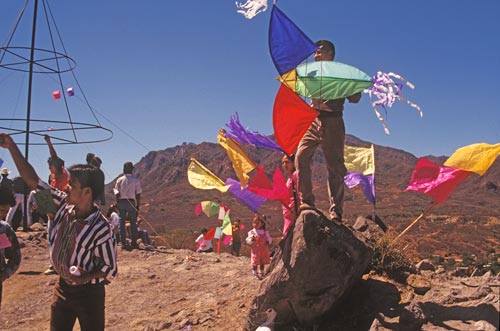
101… On Mirador for the kite flying contest.

Kite flying is a popular past times for the children of Alamos.
The winds of Alamos more come than go and when they are blowing kite flying takes place across the barrios. Sticks, paper, string are a child’s opportunity to take flight and be one with the elements. The child in all of us enjoys watching children enthralled with their kites dancing on a breeze.

Many of the festival's colorful kites parade proudly through Alamos.
On the day of the festival kites, and their builders-owners, are seen on their way to and returning from El Mirador. Colorful pennants snapping in the winds on El Mirador announce to the people below that today celebrates a special event.
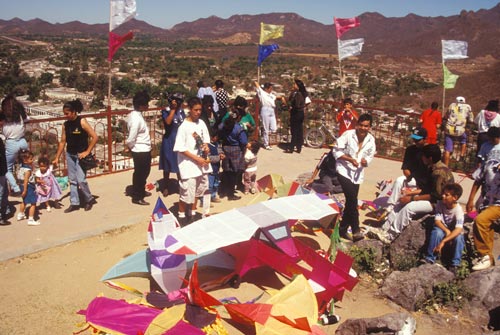
This is the place to be: a windy day on top of the world with friends.
The kite flying contest was started by Cammie Nuzum and her then husband Chaco Valdez. These photos are from the 1996 festival. The recent 2012 contest was sponsored by Cammie and Elizabeth Nuzum. Kites were not always a place for children’s imaginations to soar. One of the first written records of kite flying is from around 200 B.C., Chinese General Han Hsin of the Han Dynasty wanted to know how far his troops would need to tunnel to enter a rival city. He flew a kite to measure the distance. With this information in hand his army was able to surprise the enemy and capture the city.
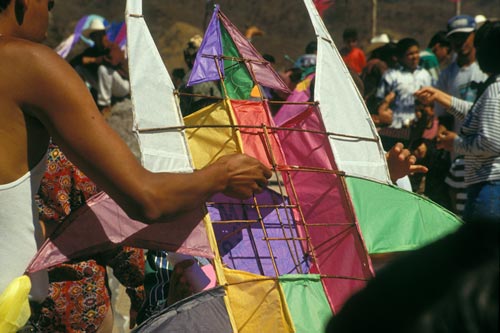
It is colorful and well constructed but it will if fly with grace and agility.
The kites become what their builders want them to be. Days of design and construction lead up to contest. There is much to learn building a kite. Natural science, mathematics, aeronautics, history, culture, art and crafts come together as a flying objects and opportunities for self-expression.
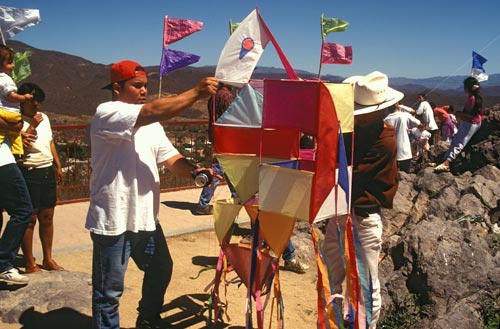
A kite awaits inspection by a judge. The event was organized by the Museo.
The Museo Costumbrista de Sonora displays the kites after the contest. For centuries kites were used by only by the military. Around the year 600, during the Silla Dynasty of Korea, General Gim Yu-sin’s troops refused to continue fighting because they has seen a shooting star and believed this was a bad omen. The General sent a fire ball into the sky with a large kite. The soldiers, seeing the star return to heaven, rallied and defeated the rebels.

The kite festival is a colorful event to attend with all of Alamos at your feet.
Joan and Earle Winderman, that is a nice kite flying name, enjoyed a sunny day on El Mirador. Besides myself, they were the only gringos I saw at the festival. Whether one is flying a kite, or a spectator, everyone watches the kites.
Buddhist monks brought kites to Japan around the 7th century. They were thought to be able to protect rich harvests and deter evil spirits. During the Edo period kite flying became very popular when Japanese people below the samurai class were allowed to participate. The Edo (now Tokyo) government tried unsuccessfully to discourage this pastime as “too many people became unmindful of their work.”
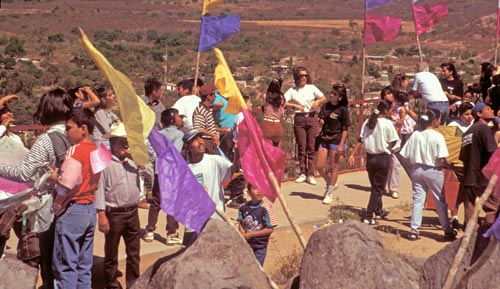
Amongst all that is going on a flyer must keep his focus on his kite.
Alamos is a wonderful place to fly kites especially from El Mirador up high and open to the winds that carry molecules Caesar, Leonardo da Vinci and Marilyn Monroe breathed. There is a timeless quality to kite flying. It is as as much about the flyer’s thoughts as it is about flying.
Kite flying began in Asia and slowly word spread to Europe. Marco Polo, around the end of the 13th century, brought back to Europe stories of kite flying. Period Illustrations showed military banners with non-flying dragon kites. 16th and 17th century sailors brought kites back from Japan and Malaysia. Kites at first had little impact on European culture and were regarded as curiosities.
Boys and their flying machines work winds off the Sea of Cortez.
Standing with their backs to the Sea of Cortez, the kite-flyers work the western on-shore winds and the drafts that come from the eastern Sierra Madre foothills.
As time marched on kites became universal and many used kites as scientific research tools.
In the 18th and 19th centuries men like Benjamin Franklin and Alexander Wilson learn more about the wind and weather used their knowledge of kite flying. Airplanes came about with the help of kite experiments by Sir George Caley, Samuel Langley, Lawrence Hargrave, Alexander Graham Bell, and the Wright Brothers.

And all the world, this very moment, is in his hands and in his control.
Here atop El Mirador the Sea of Cortez is some fifty miles to the west and the Copper Canyonlands are some fifty miles to the east. One could say the kite-flyer’s feet mark the center of the universe and their kites announce ownership of the moment.

The kite flying festival has come to an end. On now it is a Spring walk home.
The kite festival was a wonderful day on a typical hot, windy dry Spring day. Summer is coming. Home is always near, just a short walk with friends and their colorful kites.

Journal entries 71 – 80… Summer rains… four Almada women… Nuzum rooftop garden… Jacoby gardens & tequila… Plaza kiosk-bandstand… traveling hypnotist… anthropocene & human nature… ethnic accounting… Spanish Conquistadors… and Pueblo Magico….
Journal entries 61 – 70… Beisbol, rodeo and dancing horses… Estancia Crysalis… Pemex… kids in the summer… painting the Mercado… kids at night… two churches, two men, two bells… Uvalama pottery family… woodworkers… and Dr. Joaquim Navarro…
Journal entries 51 – 60… Security devices… dry tropical forest… good cop, bad cop… Sadnah and San… Doug Riseborough… population history… ode to the “mother range””… human condition, Hotel La Posada… Los Tianguis… and reflections from high ground…
Journal entries 11 – 20 … Windows treatments… cats, sheep… Bishop Reyes Cathedral… summer floods… fiber optics and Mexican mechanics… Estudiantina de Alamos… Aduana… Pantheon… peeling paint… and a tale of two seasons…
Journal entries 1 – 10 … Middle school and Independence celebration… youth church choir…
making adobe bricks… crucifixion… workers… curio shops… men on ladders… umbrellas… Plaza de las Armas… Palacio… old train tunnel… and jumping beans…
©2012 Anders Tomlinson, all rights reserved.


